
Top image: Isaiah Chua / RICE File Photo
Picture this: You find out that your fiancée consulted a friend for help with their wedding vows. How would you feel about that? And would you feel differently if it turned out that “friend” was ChatGPT?
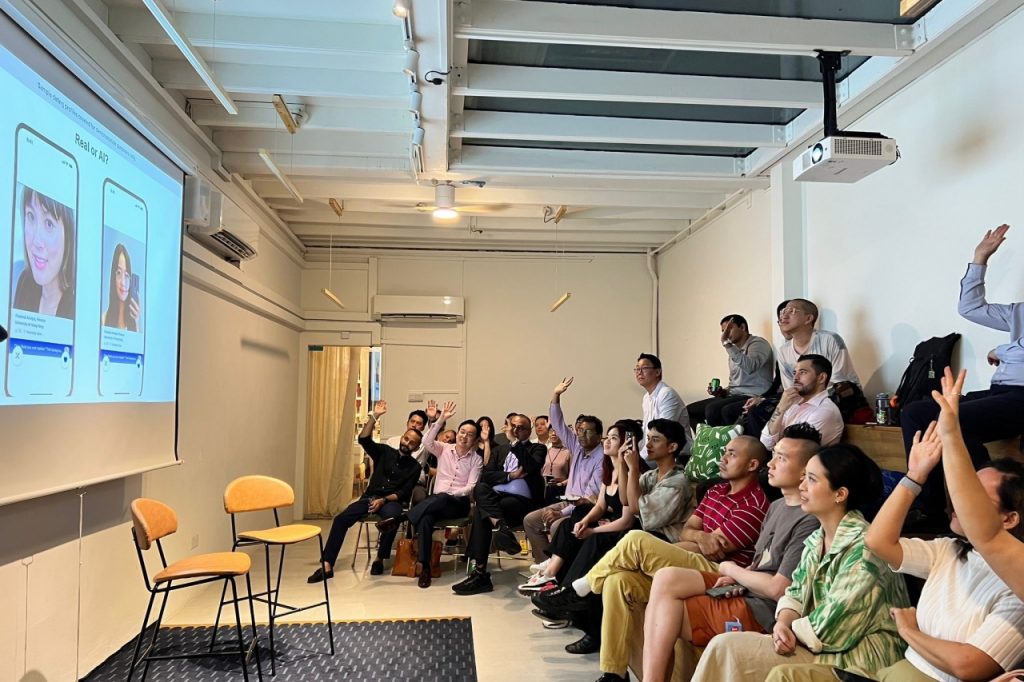
Of the 38 attendees at a recent RICE Media and Deloitte dialogue on technology and social contracts, 79 percent said they’d be cool with their partner seeking help from a friend. But only 63 percent were on board with their partner seeking wedding vow help from ChatGPT.
Now, this is just an informal poll and is hardly a representative sample. But if I’m being honest, I’d expected more to be against the ChatGPT wedding vows. The idea of my future husband staring into my eyes at the altar while spouting AI slop like “Love isn’t just found in grand moments—it’s built in the quiet ones,” turns my stomach.
Clearly, however, this isn’t a universal feeling.
As AI becomes more embedded in our lives, it’s undoubtedly affecting our social interactions. We’ve got workers who use it, but are afraid to be open about it. We’ve also got people relying on it as a confidante, even as experts warn against it.
It seems like we’ve yet to form a solid consensus on what’s socially acceptable and what’s not. As AI usage continues to grow, though, we really should.
People are starting to use ChatGPT instead of Google for queries. Schools don’t have solid playbooks on how to deal with AI academic fraud. And I’ve seen firsthand during workshops how our secondary school students struggle to come up with ideas without consulting AI tools.
To get to the core of all the mixed feelings on AI usage, however, I think the question is less about the relentless march of technology. It lies in something more human: Trust.
When AI Infiltrates Our Relationships
Our sense of what counts as an ‘authentic’ or ‘sincere’ interaction has always shifted with technological advancements.
A phone call seems warmer than a text message; a physical wedding invitation feels more sincere than a link sent over WhatsApp. But those judgments have evolved over the years, as more and more people adopted these new communication tools. With artificial intelligence (generative AI, in particular), the adoption curve is so steep that norms haven’t had time to catch up.
To put things into perspective, it took Instagram two and a half years to reach 100 million users; ChatGPT took two months to reach the same milestone.

The result is a population divided on whether introducing AI into our communication and work makes us less sincere or simply more efficient. And due to the speed, we haven’t even had the time to unpack why we feel the way that we feel.
While there are huge proponents of AI out there, as well as staunch anti-AI advocates, I’d hazard a guess that most of us lie somewhere on a spectrum when it comes to our attitudes towards it. In scenarios like using AI at work and for political speeches, for example, dialogue participants were a lot more forgiving.
“Politicians ask their folks to write the speech for them. On top of that, with the government, everything is a template… So what’s the difference?” artist Yeo Ker Siang asserted, to some chuckles around the room.
On the topic of AI usage in interpersonal relationships, though, there’s less of a consensus. Ever since Gen-AI tools have gone mainstream, they’ve wormed their way into our relationships in a number of ways. Some use them for advice, to draft messages, and even resolve romantic tiffs.
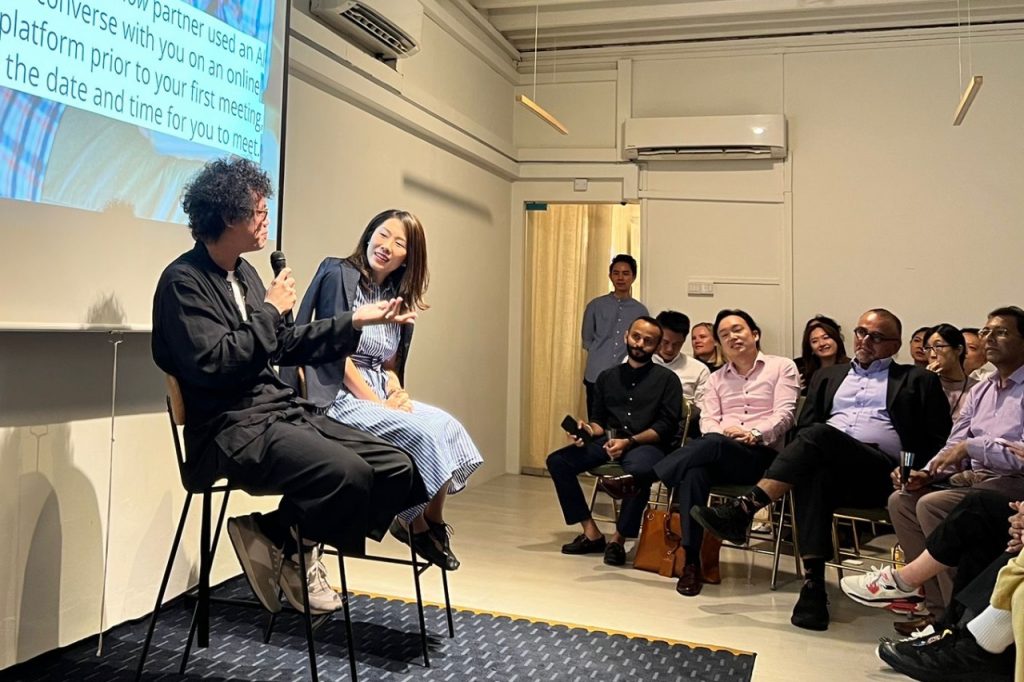
Shn Juay, the CEO of Coffee Meets Bagel Worldwide, is of the opinion that relying too much on AI isn’t healthy for our relationships. For example, building a habit of immediately turning to an AI chatbot for emotional support instead of one’s spouse can border on emotional infidelity, she said.
Another dialogue participant offered a different perspective. Why not think of ChatGPT as more of a therapist that helps someone process their emotions, he asked.
“You process your emotions from work before you bring all that baggage home. And because you process those emotions, you actually become a better spouse to your partner. In this scenario, is speaking to AI first instead of your partner necessarily bad?”
Consider another scenario where AI impacts everyday social dynamics. You’re having a text conversation with a close friend—the discussion is heating up, but you notice that they’re starting to sound suspiciously like ChatGPT. You call them out on it, and they come clean.
RICE co-founder, Julian Wong, shared that he recently found himself in this situation. And he still isn’t sure how to feel about it.
“[My friend] was saying he used AI because he was trying to make sure that he was expressing himself clearly. And I told him that the way I received it was that I felt that it was completely insincere.”
Perhaps the reason situations like these—where you find out belatedly that you’ve been having an AI-mediated conversation—are jarring is that AI is not like the tools we’ve used before.
Unlike tools like Google Translate or spellcheck, AI doesn’t simply extend our abilities. Rather, it’s capable of mimicking human language and emotion. The line between communication tool and participant starts to blur.
When we speak to someone, there’s an unspoken assumption: the words come from a sentient, accountable person. Discovering that a chatbot has been answering in their place feels like a betrayal.
But maybe before we take offence, we can consider focusing on the intention instead. Is the person’s use of AI an attempt to bypass emotional labour? Or are they using it to better express themselves? Again, the lines are blurry here.
What We Still Owe Each Other In the AI Age
Research consistently links authenticity to well-being in all relationships, be it offline or online.
The problem is that it’s getting harder and harder to tell what’s genuine. Everything from photos and videos to actual personas can be generated by AI. And even when you’re talking to an actual human being, it can be difficult to suss out whether they’re bringing ChatGPT, Deepseek or Gemini into the mix behind your back.
It wouldn’t be a stretch to imagine that, whether we’re flirting on a dating app, negotiating at work, or debating politics online, AI may already be shaping the words we exchange (whether we like it or not).
Perhaps it’s easier to think of it this way: AI cannot erase the responsibility we carry for the impact of our words and actions. And it can’t erase our obligations to each other. After all, we still owe honesty, effort, and care to others, with or without AI.