
All images by Stephanie Lee for RICE Media
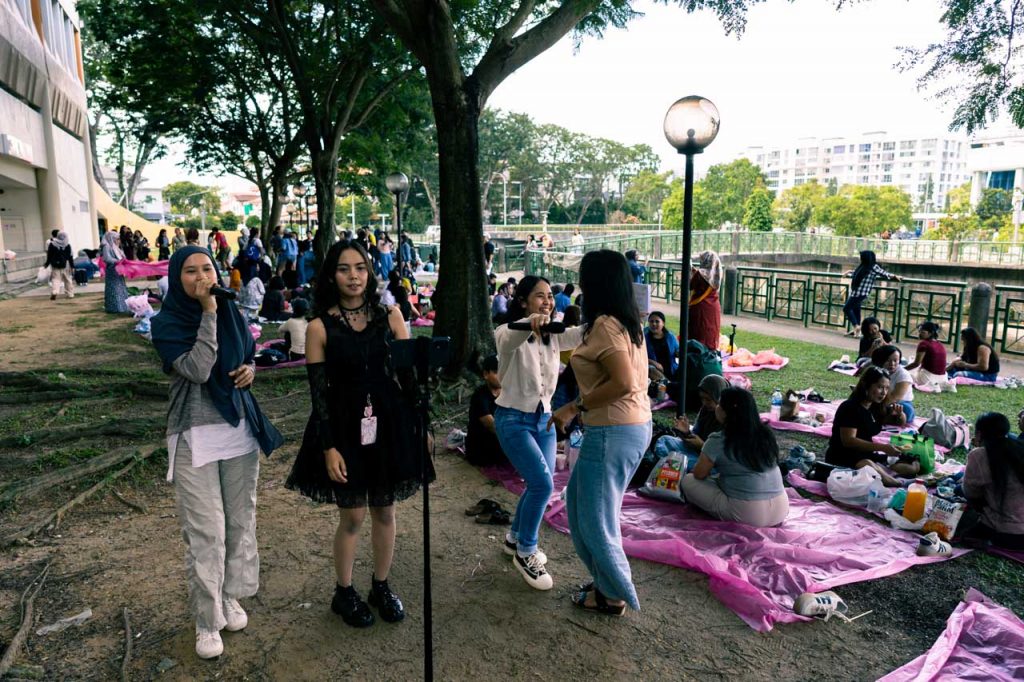
It’s a cloudless Sunday morning. For many Singaporeans, it’s a day for sleeping in. For the nation’s domestic helpers, it’s an off day typically spent outdoors with fellow migrant workers. At 10 AM, the grass patch flanking City Plaza in Geylang, slightly larger than a basketball court, is already filling up with people on picnic mats.
The party has already started. A group of women is belting out Indonesian dangdut melodies into wireless microphones. A hulking bluetooth speaker broadcasts their crooning across the entire lawn.
“The workers on this side are a bit quieter. I usually start talking to the ones at the other side of the building,” Jeremy Lim, the 27-year-old founder of Thirteen Employment Agency, tells me as we weave through the crowd.
Perhaps quiet is the wrong word, I think to myself as I nod along to the upbeat tunes. Jeremy quickly clarifies: “They just don’t like (employment) agents around. They usually frown when I tell them I am an agent.”
Most migrant workers in Singapore often associate employment agents with debt and dependency, thinking of them as unscrupulous middlemen who charge them months of salary in exchange for job placements, he says. It’s a practice all too common in the industry, alongside other grifts like fake work permits and job scams.
“But when I tell them ‘tak potong gaji’ (no salary cuts), they start smiling.”

Singapore’s domestic worker industry is tightly regulated. Still, deeply entrenched power imbalances mean the odds are stacked against domestic workers. Coming to Singapore to work often means taking on debt before earning a single cent. Then there’s also the risk of abuse and exploitation.
Jeremy makes it clear that not all employment agencies here exploit migrant workers. But the fact that domestic workers are startled to encounter an agent who advocates for them says plenty about how low the bar has been set.
That gap is what fuels Jeremy’s bigger ambition: To run an ethical employment agency in an industry rife with exploitation.
The Price of Employment
Every few weeks, Jeremy takes to Paya Lebar Quarter and City Plaza to conduct outreach sessions. He introduces his agency to the domestic workers frequenting those hotspots on the weekends, listens to their grievances, and occasionally makes them laugh with his rudimentary Bahasa Indonesia.
“I don’t really keep track of how long I spend. I just bring a thick stack of flyers with me and aim to give them all out,” he says. Bold headings in English, Bahasa Indonesia, and Burmese advertise his zero-placement-fee promise.
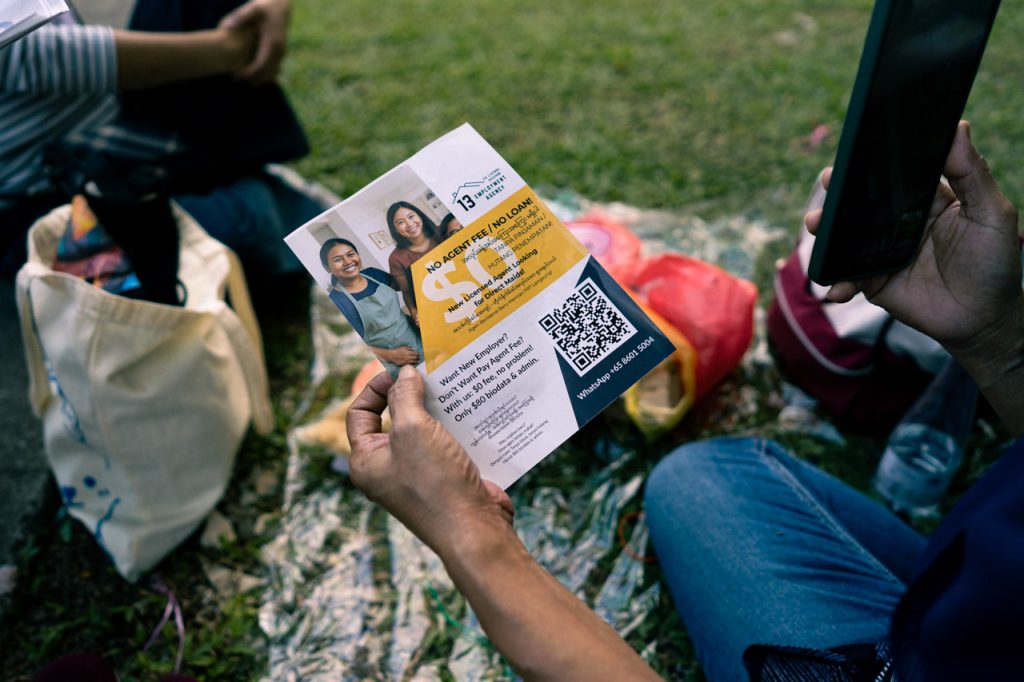
I hang back as the lanky, bespectacled young man approaches two migrant domestic workers reclining on a picnic mat.
Just as Jeremy predicted, his introduction prompts a flash of apprehension on the women’s faces. As he explains his ethos in broken Bahasa, though, their faces light up. One woman even video-calls her sister in Indonesia, who’s looking for work in Singapore.
What Jeremy’s trying to do shouldn’t be perceived as radical. And yet it is.
Thirteen Employment Agency, which began operating six months ago, does not charge workers any placement fees. Instead, it charges the workers’ employers “above $1,000 but below $2,000” with each placement.
“Some of the bigger agencies charge the employer about $2,000, and they also charge the helper a placement fee,” Jeremy explains. “So they actually earn from both the employer and the helper. We’re not talking about making a living. We’re talking about making a killing.”
“I don’t need to make a killing to be comfortable.”
As of June 2025, there are about 308,700 foreign domestic workers on work passes in Singapore. Government-licensed employment agencies play a central role, bringing domestic workers into the country and matching them with local employers.
On paper, the system is regulated. The Ministry of Manpower (MOM) caps agency fees chargeable to domestic workers at two months’ salary per employment contract.
In practice, overcharging is widespread, Jeremy says. However, this goes unreported because some workers willingly pay through the nose in order to secure a job in Singapore. To make matters worse, domestic workers are sometimes also fleeced by agencies in their home countries.
These overseas agencies sell profiles of domestic helpers—commonly called ‘biodata’ in industry parlance—to Singapore-based agencies. They also charge workers eye-watering amounts for job placements, according to Jeremy.
“The traditional business model is that the helpers will be charged about seven months’ salary. Normally, that means the foreign agency gets five months of the worker’s salary. The agency in Singapore gets two months.”
Domestic workers often can’t afford to pay out of pocket. So the employer fronts the seven months’ salary—assuming the helper earns $500 per month, that’s $3,500—while the domestic worker repays it once she starts working. That means that in her first months here, all her salary goes towards placement fees, and she effectively earns nothing.
These intermediaries are based overseas, beyond Singapore’s jurisdiction—and migrant workers seeking opportunities abroad are highly dependent on these agencies for work placements. The agencies coordinate work permits, medical checks, training requirements, insurance, and travel logistics. They also perform the crucial yet tedious task of vetting and matching employers and domestic workers.
Jeremy tells me he tries his best to suss out exploitative foreign agencies and to avoid working with them. His first question is always the same: How much do you charge the helper?
“When they usually tell me they operate the traditional way, or they try to justify it,” he says, “it’s either I ghost them, or they ghost me.”
For now, Jeremy tells me he’s prioritising the placement of transfer maids—workers already in Singapore—because it lets him reduce fees and avoid overseas recruitment chains.
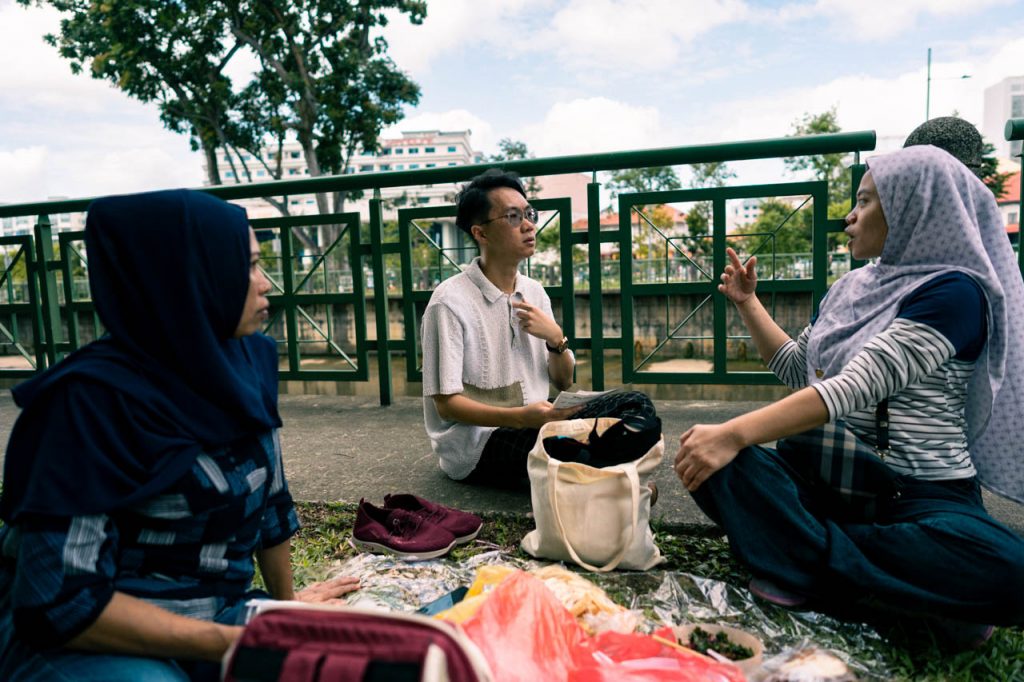
To do that, he conducts outreach sessions on Sundays—typically when workers are off work—at local hotspots frequented by domestic workers. Lucky Plaza is where Filipino workers gather, while City Plaza is popular with the Indonesian crowd. He estimates he’s spoken to nearly 300 workers already.
In the six months it has been operating, Thirteen Employment Agency has yet to place any domestic workers. Jeremy admits it’s been an uphill battle to break into a saturated industry set in its ways. It’s doubly hard because he’s trying to do things “the right way”, he says.
Whether such a thing is possible—or sustainable—is the crucial question hanging over his business, his finances, and increasingly, his mental health.
The Helper Who Raised Him
Jeremy’s proposition is simple. All he wants is for domestic workers to be treated with dignity and respect. And it’s personal for him.
Jeremy was raised by Yati, an Indonesian helper who has been with his family for 16 years.
His father, a single parent, had to hire a domestic worker to care for him, he explains. In the absence of his biological mother—he declines to elaborate—Yati has been his maternal figure.
“Sometimes I just call her Mum,” Jeremy says, smiling fondly.

Yati was exploited by agencies twice. The first time she came to Singapore in 2009 to work for his family, she forked out over six months’ salary in placement fees. She later returned to Indonesia when her contract ended, but when she tried to come back to Singapore to work after her mother’s passing, an agency tried to fleece her again.
Yati had kept her return to Singapore quiet because she didn’t want to worry his family, Jeremy recounts.
“We only found out about her situation because we noticed she was using a Singapore number to message us, and we brought her back to our family,” Jeremy said.
Jeremy, a Murdoch University business graduate, had fully intended to find full-time employment after graduating in April. But when an employer offered him a $1,900 salary for a marketing executive role, he decided that he’d rather strike out on his own.
Opening an employment agency seemed like a viable choice because his father had some connections in the construction industry, he says.
When he told Yati he was thinking of becoming an employment agent, she was surprised but supportive. She even offered to help distribute his flyers, until he reminded her it was illegal —domestic workers aren’t allowed to moonlight.
“She knows about the direction I want to go with. She also shares with me the opinions of some of the Indonesian helpers themselves. That’s where I got my first insight, before I stepped on the ground.”
He’s since learnt that they often feel powerless to speak up about mistreatment and accept unfair fee arrangements out of necessity, not choice.
While most of the domestic workers he’s spoken to are rooting for him, Jeremy knows it’s not just them he has to win over. The real battle is to convince the employers.
The Weight of Doing the Right Thing
I detect an air of weariness, however, as Jeremy describes all the walls he’s hit in the last few months. Unfortunately, it turns out that convincing Singaporeans to treat their domestic workers well is a losing proposition.
In Singapore, $650 is considered a ‘high’ monthly salary for a domestic worker, Jeremy says, citing anecdotal evidence. The average salary of $500 hasn’t changed for nearly two decades, he estimates.
The main reason is simple. Employers aren’t willing to pay more; a 2019 survey found that half of Singaporeans believe domestic workers should be paid below $600 a month.
According to Jaya Anil Kumar, the senior manager of advocacy and research at HOME, domestic workers can work up to 16 hours a day, helping with household chores and serving as caregivers for children or elderly family members. Still, they remain undervalued.
“Firstly, domestic workers (in Singapore) may earn a lot more than in their countries of origin. Therefore, it is perceived as acceptable to pay them a low wage,” she tells CNA. “Secondly, domestic work is usually considered ‘informal’ work and may be undervalued.”
This rings true for Jeremy, who often gets ghosted by prospective employers the moment he proposes paying domestic workers a little more, he says.
He’s also had some disturbing interactions. One of the first calls he received was from a man who wanted a “fresh Indonesian maid” no younger than 23 and no older than 30. The man added that he wanted her to be single.
“He doesn’t want to find a domestic worker. He wants to find a wife. He wants to find someone vulnerable to take advantage of. I still don’t understand why. Because I think if you have some decency, you wouldn’t look at them as people you can take advantage of.”
His frustration bleeds through when he describes the difficulty of changing the casually callous way many people treat their domestic workers.
“It’s actually a very hard job. And this is something that has been on my mind for the past one to two months—the very, very, very limited power that I have as a company that is so small and new to this industry.”
The weight on his shoulders has really intensified in the last few weeks, he tells me. He has several workers waiting to be placed; he just needs to find employers who believe in his approach.
“The way I handle burnout is not very good. I go on holiday,” he admits sheepishly. He isn’t drawing a salary yet, so he’s dipping into his savings for these trips.
But he escapes to Malaysia on day trips, working remotely, because he thinks more clearly when he’s away from Singapore, he explains.
“I see Singaporeans everywhere, and I think to myself—would they be the type to prefer the old ways?”
Jeremy muses, “Sometimes it almost feels like I’m trying to put myself on a moral high horse, and that’s not what I’m trying to do. It’s very tiring.”
He’s not trying to change the entire industry. He’s just trying to prove that it’s possible for an employment agency to prioritise domestic workers’ interests over profits and be sustainable. But, increasingly, that’s looking like a tall order. It’s the thing that vexes him the most, I gather.
To cut through all the overthinking that he’s prone to, he says he has a simple benchmark for himself. “I just ask myself: If I make this decision, can I sleep at night?”
Baby Steps

Jeremy knows he is unlikely to transform the industry. Traditional agencies, he says, serve a market he cannot—and does not want to—reach.
“There are certain customer profiles that would rather do it the unethical way,” he said. “They would rather the helper be charged because they think the helper will work harder to earn it back.”
He has already encountered hostility.
Some look at what he’s doing with scepticism. On a recent viral LinkedIn post of his, one of the comments reads: “If you have values and principles, this is not the business.”
When I bring this up, Jeremy tells me he’s actually received worse comments. Once, someone associated with a well-known employment agency chain had commented: “If you’re so unhappy about the market, why don’t you just leave? Don’t play games.”
He shrugs. “I can’t change these people. All I can do is change the way I do things,” he ponders.
“Slowly, I’ll find my niche. When there’s a community of like-minded people, I’m sure the message will spread.”
He’s now considering finding a full-time job in order to keep his Thirteen Employment Agency pursuit financially viable. Ironic, considering he’d launched the company to escape the rat race.
But I suppose the difference now is that he has something to fight for: ensuring domestic workers are treated fairly and with dignity. The tougher battle, however, is Singaporeans’ long-entrenched mindsets about migrant workers and what they ‘deserve’.
His agency is hardly the first to pursue ethical job placements for migrant workers. But in this industry, good intentions can’t protect you from going under. For now, he’s taking it one placement at a time.
“Every single helper that I place is one person that I can impact,” he says.
“And I don’t see it as just helping one person, because if I help one of these helpers, I’m also helping their families.”