All images courtesy of Khai Asyraf
The Aceh River moved like it had unfinished business.
The rain has finally let up, and the sun is out. Still, standing on the riverbank, watching the currents lick at my muddy boots, I feel the same dread that hangs over the displaced Indonesian villagers around me. The river could take everything again, without warning, without ceremony.
It’s been a month since intensified floods and landslides tore through Sumatra, killing over a thousand people and injuring thousands more. The monsoon rainfall that kept Singapore cool in December told a different story here—one of levelled buildings, power outages, and widespread infrastructural destruction.
What hit Aceh wasn’t officially labelled a cyclone, but the devastation bore the fingerprints of Cyclone Senyar. Climate change and years of deforestation did the rest, leaving the land with nothing left to hold on to.
Relief was slow, or didn’t come at all. Political sensitivities and logistical friction caused vital aid to be stranded between checkpoints or halted by mere bureaucracy.
In some areas, there’s a cautious stance toward foreign assistance—shaped in part by post-tsunami sovereignty concerns and by Acehnese hopes that the local government will take a more active role in supporting their own communities. I hear it in conversations with humanitarian workers; I see it in the way volunteers stretch dwindling supplies, doing whatever they can while waiting for formal support.
I’m doing the same, but as the only foreigner involved in the efforts on the ground.
The Aceh Connection
“Are you sure you still want to come here?”
Misbahuddin wasn’t asking casually. He was worried about my safety. In the weeks leading up to my trip, he’d been sending me clips from across Aceh—villages in Pidie Jaya and Bireuën flattened, floodwaters climbing to the tops of electricity posts. Whole towns reduced to moving brown water.
Misbah is one of the many Banda Aceh orphans who lost their families in the 2004 tsunami. I met him in 2005, when he was 12 and I was a 19-year-old volunteer at an Islamic orphanage, helping kids like him find their footing again. We’ve stayed in touch since. In 2015, I returned to Aceh to film a documentary about the people there, and our friendship carried on from a distance.
Now 32, with a family of his own, Misbah has become my human anchor to a province I’ve never quite let go of. So when disaster swept through Aceh again last year, I didn’t need to debate whether I should do something. The only question was how.
It started as a message to friends, relatives, and contacts—anyone willing to chip in, so I could send the money to Misbah to donate on our behalf. A week later, the funds were substantial enough that the responsibility began to weigh heavily on me.
I needed to be there—to see where the money went, who it reached, and to be answerable for how it was used. I booked a last-minute flight, stuffed a large backpack with clothes and emergency supplies, promised my wife I’d stay safe, and left on what had become an unplanned year-end trip.
The plane touched down at Sultan Iskandar Muda International Airport on the night of December 28, a Sunday, under relentless rain.
The drive from the airport into Banda Aceh was short, but long enough to grasp how punishing the weather could be—visibility collapsed to almost nothing. I took some comfort in knowing I’d be staying near Masjid Raya Baiturrahman, the 19th-century mosque that miraculously survived the 2004 earthquake and tsunami with only minor cracks.
It didn’t take long to understand how difficult aid distribution would be. The Indonesian central government declined to declare a national emergency. Without that designation, large-scale international humanitarian systems never kicked in, even as needs on the ground grew ever urgent. And with bridges and roads destroyed, mountain towns and villages were cut off, effectively left to wait.
With Misbah and a few other volunteers on the ground, we managed to rent a pickup lorry—one of the few ways left to move anything at all. The plan was to drive four hours to Pidie Jaya, one of the worst-hit districts, and gather supplies along the way.
We loaded the truck with whatever we could get our hands on: sacks of rice, toiletries, snacks, diapers. Knowing how villagers wouldn’t have the means to cook, we emptied a couple of waroengs, buying up packets of nasi campur until there was no more to sell.

Helping from Within
I was thankful for having Misbah by my side—a local Acehnese who knows the lay of the land and someone I trusted on the ground. At every village we stopped by, he spoke to the village heads to explain what we were doing and got people organised for distribution. I like to think it’s because of my personal connection with him that I even dared to lead this independent humanitarian effort.
In truth, I wasn’t there as a foreign saviour or a decision-maker. I was simply a facilitator. Being on the ground meant I could see needs as they surfaced, rather than committing funds in advance based on assumptions made from afar.

Most of my role was connective—linking trusted local actors with wider networks already operating in Aceh, so efforts reinforced one another instead of splintering off.
When certain areas became inaccessible, that mattered. I coordinated with Hafiz Akbar, Chairman of the World Assembly of Acehnese Students (FORMAD), who was distributing aid in Aceh Tamiang Regency—an area we couldn’t reach because of washed-out roads and collapsed bridges. I redirected some funds to support his work while focusing our own efforts elsewhere.
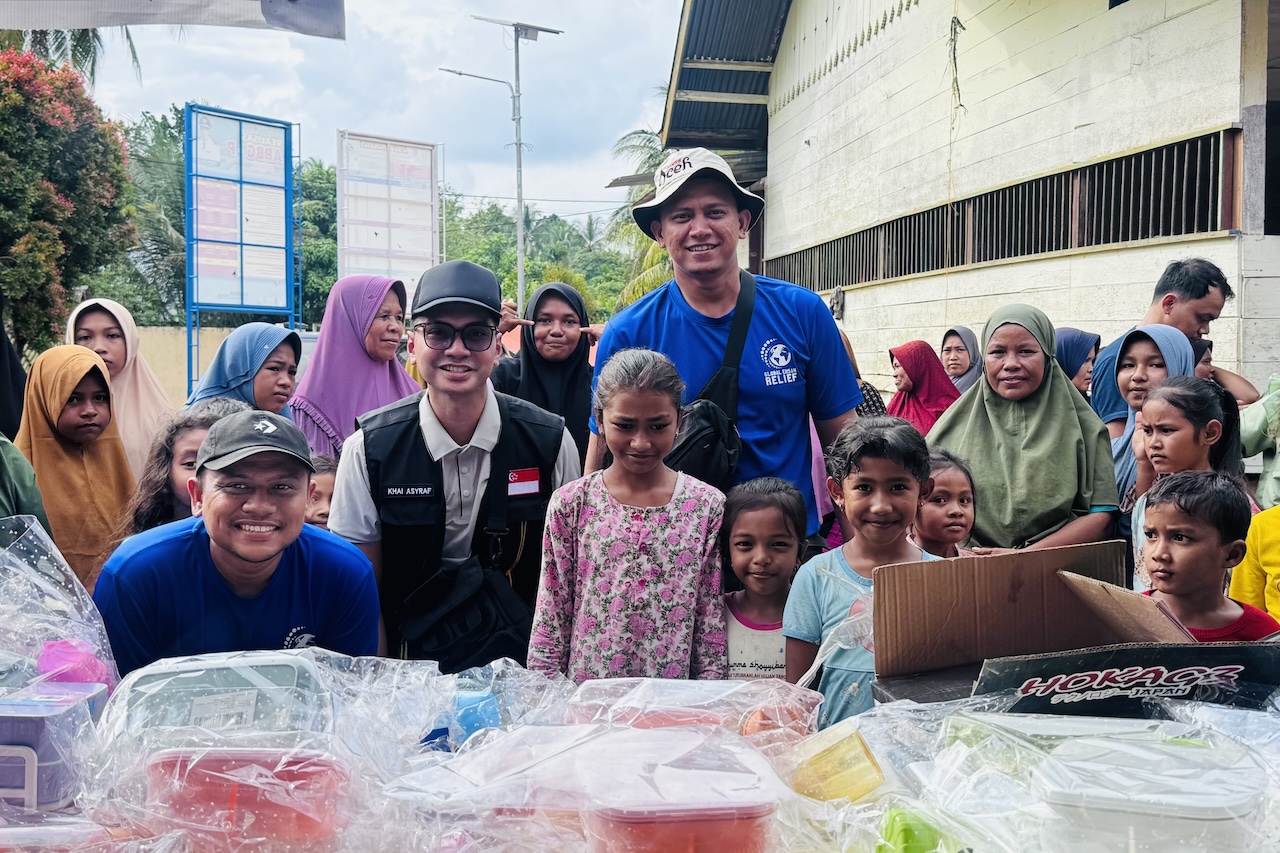
I’d also linked up with Global Ehsan Relief Worldwide’s local team and joined their distributions in Bireuën. Continued access to basic food supplies and clean water remains critical, alongside medical support, particularly for children experiencing post-flood infections and skin conditions. Logistics support to reach isolated areas where roads remain impassable was urgently needed as well.
Working alongside existing operations meant aid moved faster and farther, even within a compressed window of time. I’d only planned to be in Aceh until my flight home on January 1, 2026.
Time was short. The encounters weren’t.
Ilham, 5
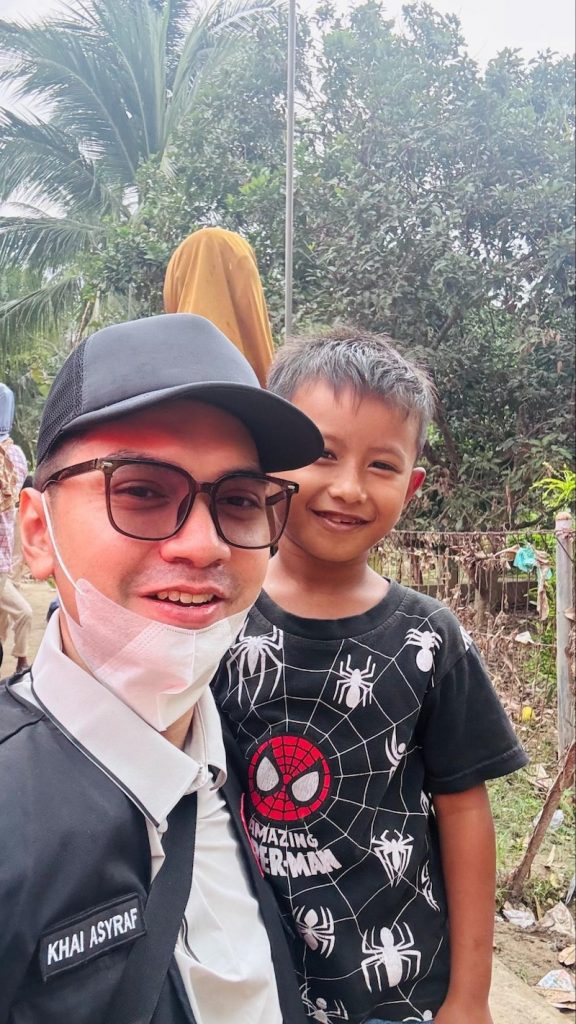
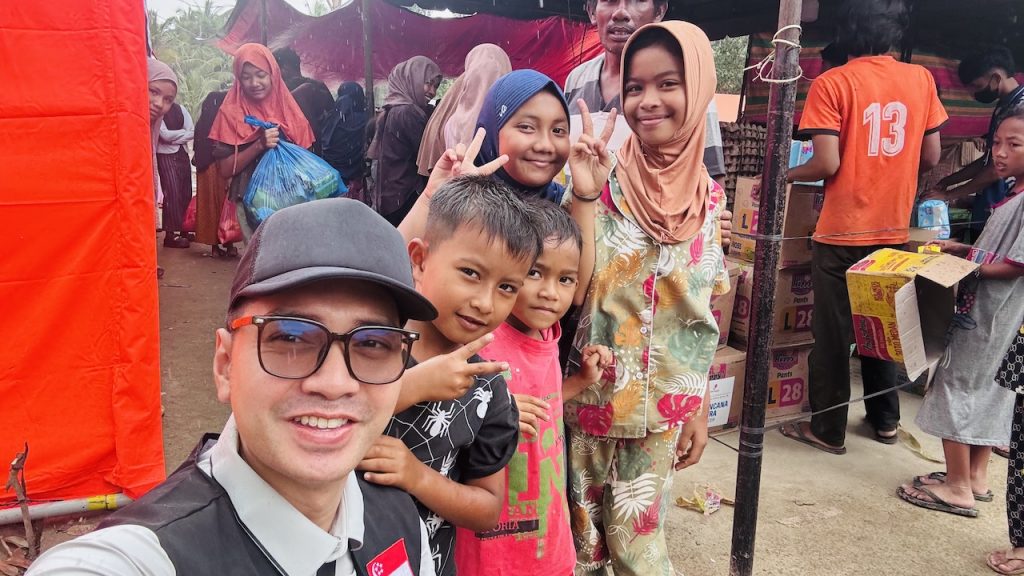
I was in the middle of coordinating aid when I saw him: a small boy in a Spider-Man tee, playing near the roadside while his mother queued for supplies.
Around me, trucks were arriving, and aid was being distributed. But something about his sprightly demeanour made me pause and squat down beside him.
I asked where he was when the flooding started. He looked up and said he was at home when the water began to pour in—first up to his ankles, then his knees. His mother grabbed his hand and told him to run.
They ran without shoes past shouting neighbours, past water that kept rising. He remembered being scared, but he also remembered his mother telling him not to look back.
They climbed to higher ground and waited until it was dark. That was what he remembered most: Waiting.
I asked for his name.
“Ilham,” he said. Something cracked inside me. That’s the name of my second son.
In that instant, the emotional distance collapsed. He wasn’t just a child affected by a flood. He could have been my own.
For the rest of the day, I carried that quiet grief with me.
Intan, 100
I was speaking with a few locals at Gampong Suak when I noticed her—a small figure seated near the edge of the aid post. Her weathered eyes carried a stillness that only time can shape.
Mak Intan is 100 years old, and in the village, an age like that commands authority.
When the river began to rise, no one needed to tell her to evacuate. She simply knew—the floodwaters had already entered her bedroom. She grabbed her walking stick and climbed uphill to higher grounds, alone.

She didn’t have much to say when I sat with her for a moment. She pointed once toward the river, then to her heart.
“Dulu air itu sahabat. Sekarang dia seperti tak kenal kita lagi.”
The river used to be a friend. Now it no longer recognises us.
Fakhrurrazi, 30
Fakhrurrazi and I stood side by side, staring at what had once been a school field in Gampong Meunasah Lhok.
Now it’s a river. A fast-moving stream with a deep brown hue. It’s as if it had always been there.
“Saya panjat ke atas rumah. Nggak ada makan minum selama tiga hari.”
Fakhrurrazi had to clamber onto the roof of his house when the flood engulfed it. For three days, he was exposed to the elements with no food—just the torrential rain battering him and the roof of his wrecked home. The current below kept moving, hard and fast.

When he could finally climb safely back down, everything he had was gone. And yet here he was, helping unload aid boxes with a smile.
Upon seeing the Singapore flag on my vest, he paused and asked: “Sana tak banjir ke?”
It doesn’t flood there, does it?
I didn’t know how to answer.
It Doesn’t Flood Here

It struck me how far removed our understanding of crisis has become.
Floods in Singapore could mean traffic delays or soggy socks. In places like Aceh, it’s about survival. Climate disasters manifest in death, displacement, and disconnection.
Misbah’s words linger in my head, long after I’m back home with my family. “Getting to deeper areas by land is almost impossible now,” he said. “The only way aid can reach them is through airdrops, but very few have the resources to make that happen.”
We Singaporeans have long been trained to look upwards to agencies and to systems that usually work. But urgency has a way of stripping systems down to their limits. What remains is community.
Change doesn’t come from ideals or authority—it comes from individuals deciding not to wait and act now. It can come from someone who sees a gap and steps into it, even when the response is imperfect or small.
We’re lucky enough here to be used to order and assurance. That comfort can make waiting feel sensible. But what happens when even the long-established rules of the world no longer make sense?
My experience in Aceh is a reminder that when circumstances take a turn for the worse, what matters is not how well a system is designed. What matters is whether we’re willing to step in for one another.