Top image: Stephanie Lee / RICE file photo
In the Geese song ‘Taxes’, frontman Cameron Winter wails at you to nail him down before he pays his dues. Dramatic, yes. But after Budget 2026, a few Singaporeans might be feeling the same—especially the ones who just saw their vices get pricier overnight.
Every year’s Budget speech arrives with a signal of what the government thinks matters right now—and what you should probably start worrying about. This year’s direction doubles down on national resilience, and God knows we need plenty of that in these strange, edge-of-societal-collapse times.
There’s the usual cushioning: vouchers, rebates, small reliefs to soften rising costs. There’s also the longer game in the form of a National AI Council chaired by Prime Minister Lawrence Wong, signalling that AI isn’t just startup fodder anymore. It’s now a national strategy. Go figure.
And then come the taxes.
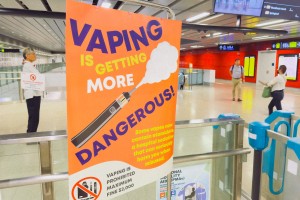
In Singapore, taxes aren’t simply abstract fiscal tools. They shape behaviour when some choices are getting more expensive on purpose. In Budget 2026, that role becomes especially clear through targeted measures such as a sharp tobacco tax hike, shifts in corporate tax rebates, and recalibrations of car ownership.
But hidden beneath these tax policy shifts is a question: What kind of citizen is the state nudging us to become in this volatile era? Healthier? Less car-dependent? More future-ready? And who feels that nudge the hardest?
Manu Bhaskaran, veteran economist and partner at research and advisory firm Centennial Asia Advisors, has thoughts on how these new tax changes function as behavioural policy in Singapore. In this Q&A, he examines who these taxes are designed to influence, who they leave untouched, and what they reveal about how the state is thinking about responsibility, restraint, and citizenship today.

What do Budget 2026’s measures suggest the government is trying to signal to Singaporeans right now? And what do you think is the underlying message that’s left unsaid?
The policy signal is a focus on the long term, particularly in adapting to AI. This marks a modest shift away from last year’s emphasis on addressing near-term threats through support measures such as CDC Vouchers and other forms of support for households.
Budget 2026 treats AI as something Singapore cannot afford to sit out, economically or strategically. What’s one assumption policymakers seem to be making about AI that you’re least convinced by?
AI is a highly complex story. It’s still evolving, and many learned academics who study it are still uncertain about its productivity benefits and when they will materialise. It is hard to even assess which sectors might be winners and which might be losers. So, policymakers have to do their best in this knowledge vacuum.
One focus of policy has been on re-skilling workers. This is the right direction, but Singapore still needs to work at getting the formula right. Do we have the right kind of courses? Re-skilling also requires an ecosystem of vibrant, mainly local firms, as they are most likely to hire Singaporeans. Remember that most Singaporeans work at local firms, mostly SMEs.
How do we build that eco-system? These questions remain unanswered.

Looking specifically at the tax changes mentioned in Budget 2026, what do they suggest about what the government thinks Singaporeans need to become in the next phase?
There were a few major shifts in tax policy this year, other than the corporate tax rebate and the hefty increase in sin taxes.
Speaking of sin taxes, an immediate 20 percent increase in tobacco excise duty is a strong signal. At this stage, will it meaningfully change behaviour, or are we already in a zone of diminishing returns?
Such a large increase will change behaviour. Recall that the last change was 15 percent, and before that, it was a 10 percent change. For one, there will be a greater incentive for hardcore smokers from the low-income segments to find smuggled tobacco products—and with that greater demand comes increased smuggling.
The signalling and deterrent effects of higher costs are likely to be quite strong. Especially for younger Singaporeans who are already turning away from smoking.
Smoking incidence has already been reduced in Singapore; the National Population Health Survey 2024, conducted by the Ministry of Health, found that 8.8 percent of Singapore residents smoked daily in 2023. This fell to 8.4 percent in 2024, reaching an all-time low. I don’t want to speculate on whether illicit alternatives played a role in this, but I would say we should study that possibility.
We need to determine whether we are approaching a floor at which further efforts to limit smoking yield diminishing returns. Is the optimal policy, then, simply to keep increasing the price of tobacco? Are the incremental benefits in terms of further reductions in smoking worth the incremental costs of increased smuggling and the higher cost of living?
For taxes meant to curb ‘undesirable’ choices—like smoking or private car ownership—what has actually worked in Singapore, and what tends to fail despite repeated hikes?
It is time Singapore reviewed its approach of price measures—such as taxes, ERP, COEs, and surcharges on water and electricity usage—to change behaviour. In all these cases, Singapore now has among the highest costs in the world.
For example, do higher ERP and COE costs curb congestion? That is debatable, and even if it were the case, we have not seen the evidence for it. If congestion is reduced, does the incremental improvement justify the higher costs imposed on Singaporeans?
It may be that we have reached the point where such tax/price measures simply raise the costs of living and business in Singapore without commensurate benefits. In my opinion, the government should audit these measures for effectiveness—there should be detailed studies of how each of these measures has affected the economy and consumer behaviour.
Ideally, we want taxes that change behaviour without imposing high deadweight costs on the economy.
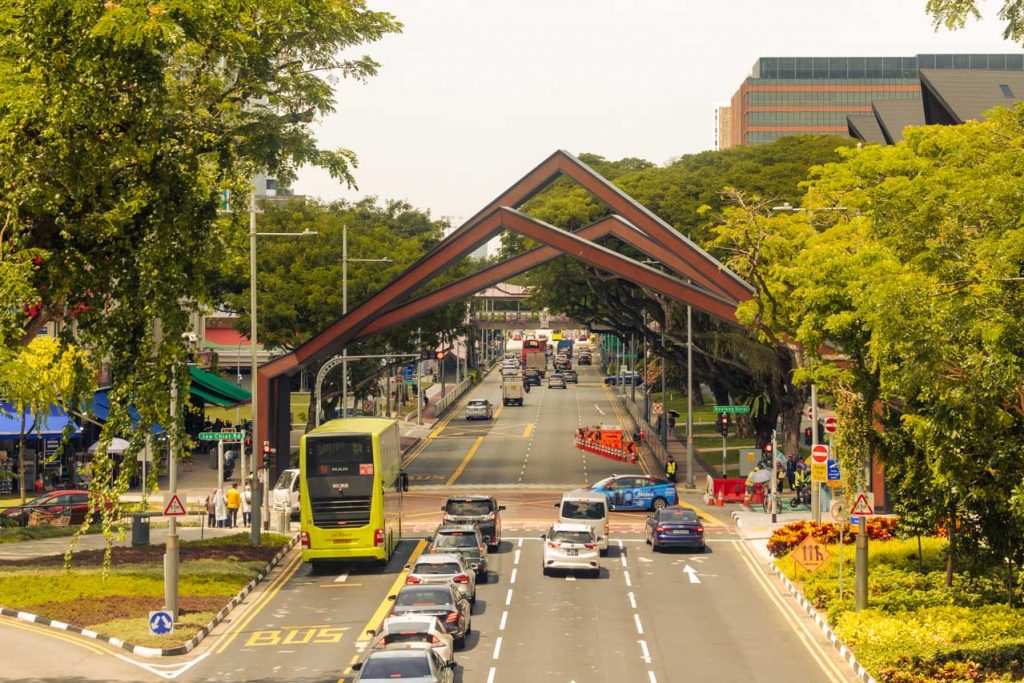
What’s the difference between taxing something harmful (like cigarettes) versus taxing something aspirational (like car ownership)?
I think the situation might be a bit more complex than this. Strictly speaking, for transport policy, we are not taxing car ownership. Some policies address car ownership as an indirect way to reduce congestion and maintain smooth traffic conditions.
The solution is to identify tools over time that can directly address the policy target rather than do so indirectly.
What unexplored policy tools might work better or more fairly in Singapore’s context—and why do you think policymakers are holding back from exploring them?
Where cigarette smoking is concerned, why not allow alternatives like heated tobacco and nicotine pouches, which have been shown to significantly reduce health risks from smoking? Why ban products that can be regulated and taxed with oversight while still allowing harmful cigarettes?
Similarly, to curb congestion, raising vehicle parking costs might be one way to deter car use. A more positive approach would be to improve last-mile connectivity—many regular car users live in private housing estates where it is still inconvenient to walk to an MRT station.
Hong Kong has public light buses that connect distant housing estates to metro stations. Perhaps we could experiment with a few pilot projects to see if something similar can be introduced in Singapore.
Should sin taxes be based on risk, not just moral disapproval? If the logic of sin taxes is to reduce social harm, should they be calibrated to the severity and probability of harm? For example, gambling addiction can lead to debt, family breakdown, and even crime—arguably far more severe outcomes than smoking. Then should gambling be taxed more aggressively than cigarettes?
At one level, this argument is appealing and has its merits. But on closer inspection, there are some difficulties with it. Cigarette smoking causes immense harm to health, resulting in premature deaths, and so forth.
But policy is not based solely on risk. Society also reserves the right to make policy decisions based on moral disapproval, and that has been the case for most societies. For instance, prison sentences are used not only as deterrents but also as a signal of society’s revulsion against some forms of crime, such as spousal or child abuse, or scams that target vulnerable old folks.
Society’s views on these issues also tend to change with time. For a long time, we simply banned most kinds of gambling, and police used to spend an inordinate amount of time smashing illegal gambling dens. Now we allow gambling, albeit under restricted circumstances.