Top image: Elijah Tay / Facebook
Civic lines in Singapore aren’t always drawn in paint or tape. Sometimes, you only find them when you’ve already crossed them.
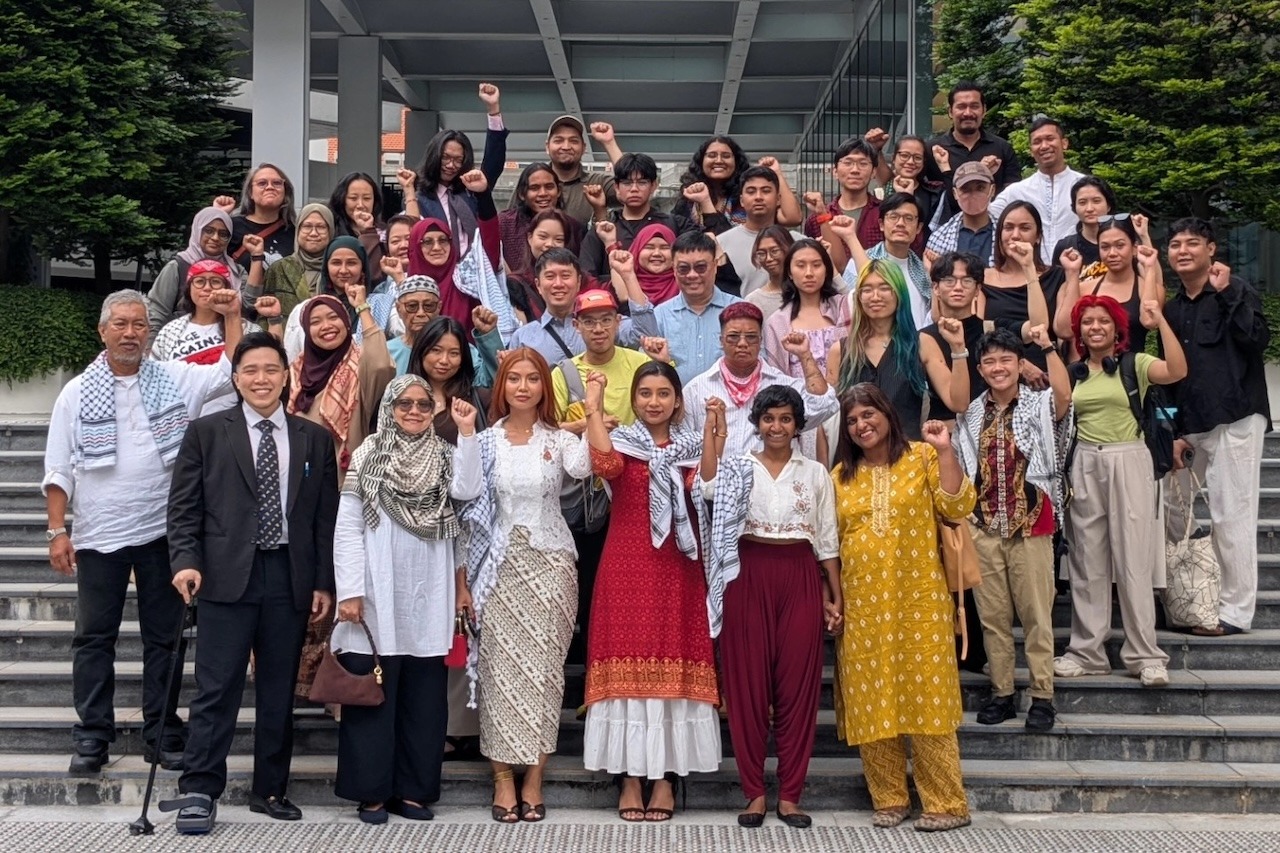
Earlier this week, three women who participated in a walk to the Istana on February 2nd, 2024, to deliver pro-Palestine letters to the Prime Minister were acquitted of taking part in an illegal procession.
Mossammad Sobikun Nahar, 26, Siti Amirah Mohamed Asrori, 30, and Annamalai Kokila Parvathi, 37, had been accused of organising a procession in which about 70 people walked from Plaza Singapura to the rear gate of the Istana, where the property’s mailroom is located. The group had walked along the perimeter of the Istana, which is a prohibited area under the Public Order Act (POA); public assemblies or public processions are typically not allowed in prohibited areas.
District Judge John Ng noted that while their attempts to frame the event as a mere letter delivery were “disingenuous” (they were clearly publicising the Palestinian cause), the prosecution failed to prove that the women reasonably knew the route they walked on was a prohibited area.
“The route taken was via a pavement regularly used by members of the public,” said the judge. “There were no signages or notices to indicate or inform users that the public path was part of a prohibited area promulgated by the minister pursuant to an order under the POA.”
Under the Public Order Act 2009, any assembly or procession in a public place that is for a cause or to publicise a campaign requires a permit. The only space where Singapore citizens may hold assemblies without a police permit is the designated area at Speakers’ Corner in Hong Lim Park. Even so, NParks, the statutory board which manages Hong Lim Park, has the power to reject event applications.
On paper, the rules sound clear enough. In practice, however, even seemingly benign acts can land local activists in legal trouble.
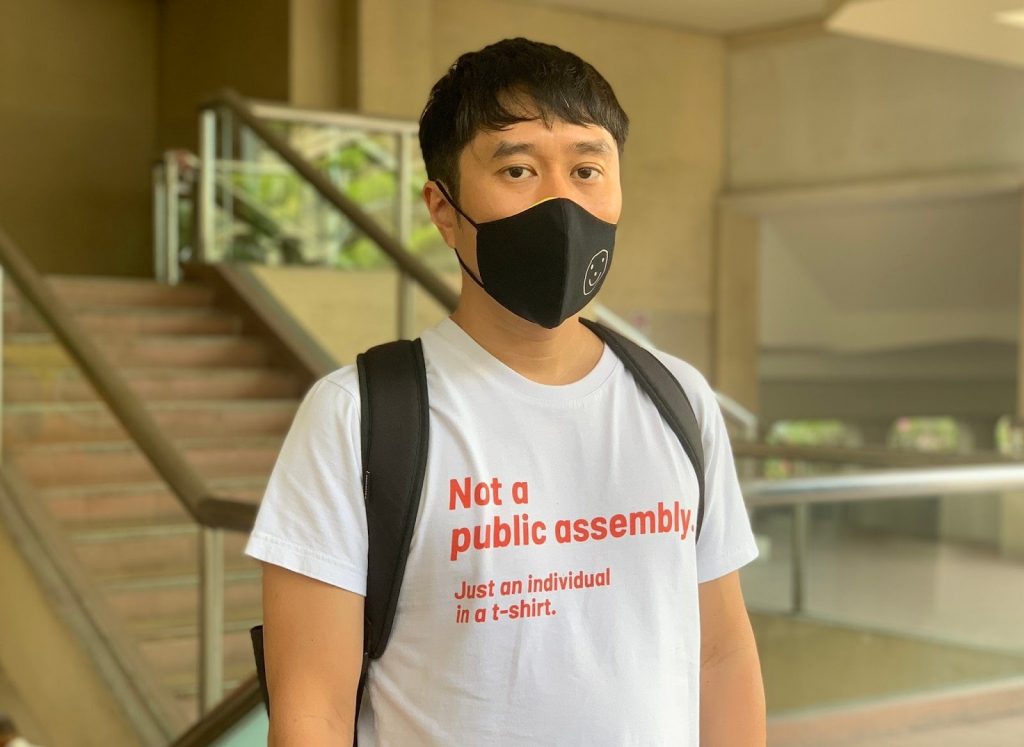
Activist Jolovan Wham, for instance, was fined for organising a conference event where Hong Kong activist Joshua Wong spoke via Skype. The virtual conversation was deemed an unlawful assembly. He was later charged again for illegal public assembly after holding up a smiley-face sign alone outside a police station.
These are activities that, anywhere else, wouldn’t strike one as remotely illegal. And yet, they are. This ambiguity becomes its own form of control: when no one knows where the line is, staying passive feels safer.
The Singaporean Instinct To Colour Within the Lines
What tends to happen, then, is a culture of overcautiousness. The “no U-turn syndrome”—that uniquely Singaporean hesitation to act without explicit permission—seeps into civic life too.
People assume that strong, public civic expressions should only happen at Hong Lim Park, that safety lies in doing only what’s explicitly allowed.
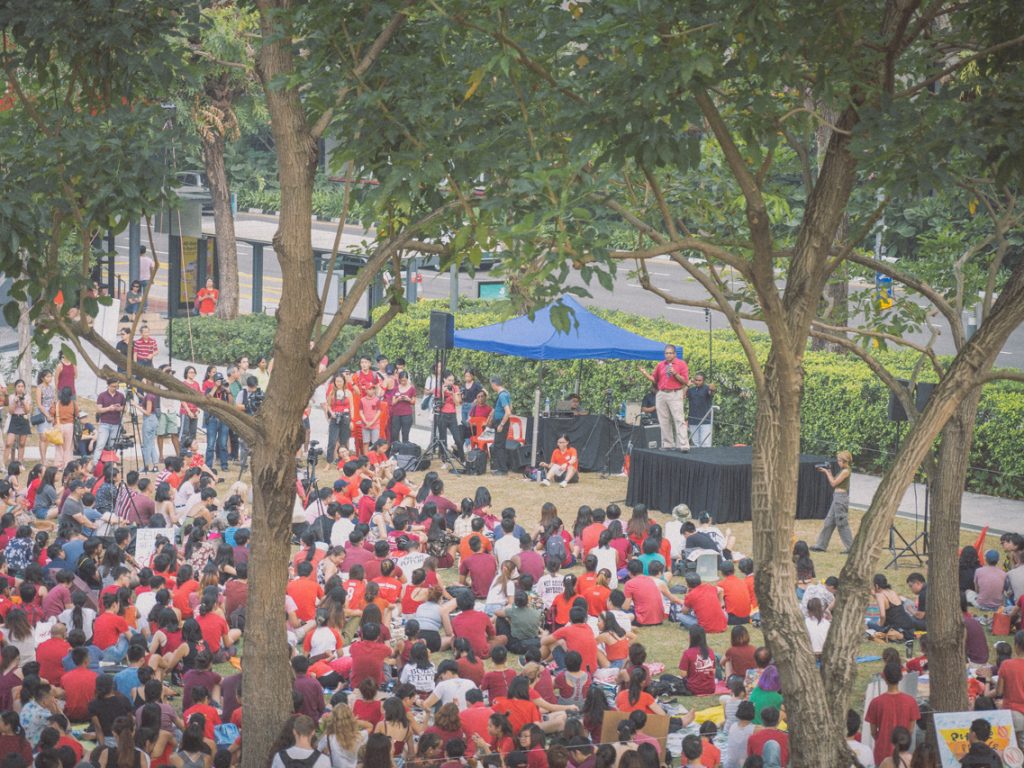
Over time, we begin to police ourselves more than the state needs to. Already, we see it playing out in comments reacting to the Orchard Road procession and to Singaporean students staging a memorial for the Palestinian students who have been killed in the genocide, saying these are cases of FAFO (or fuck around, find out).
That’s why this case matters.
It’s encouraging that individuals are still willing to engage in public expression, and that the courts can still recognise when activists don’t intend to flout the law. But even an acquittal might have a chilling effect on people’s willingness to organise such activities. Let’s not forget that the prosecution is still planning to appeal the verdict, so the three women might not be out of the woods yet.
Few will want to risk testing those same limits again. And after this widely publicised case, ignorance of the prohibited areas around the Istana will probably no longer be a viable defence.
Yet the line remains blurry—past letter deliveries to the same gates haven’t undergone the same legal scrutiny.
One of the women acquitted, Sobikun Nahar, told the court she had delivered letters to the Istana in 2021 and 2023 to appeal for clemency for death row prisoners. Back in 2011, the family of death row inmate Cheong Chun Yin had also delivered a petition to the Istana calling for his life to be spared. And in January 2024, just a month before the three women got in trouble, 17 youths walked to the Istana’s mailroom to deliver letters expressing solidarity with Palestine.
As far as we know, none of these deliveries resulted in any legal consequences for the participants.
Invisible Boundaries
The case also exposes a gap in civic understanding. How many areas in Singapore are actually prohibited for processions or gatherings? Are these boundaries publicly marked? And if they aren’t, does that uncertainty serve the purpose of having citizens err on the side of safety in silence?
None of this is to say that the acquittal should open the floodgates for unlawful protests. It shouldn’t. But it does highlight something fundamental: in a rule-bound society, laws must not only be fair but also visible. People can only follow what they can understand and what they can see.
The acquittal of the three women doesn’t blur the line between lawful and unlawful protest—it just reminds the state that fairness and clarity should cut both ways.
The law draws a line on something as fundamental as the right to assemble, so the least it can do is make that line more visible and convince us why it’s drawn there.
When the Speakers’ Corner at Hong Lim Park was first opened up for protests in 2008, then-Prime Minister Lee Hsien Loong said this would “widen the space for expression and participation“. And it did, for a time. But Singapore has grown since then. We are more informed, more socially aware, and more civically engaged than we were 15 years ago.
Is it possible for a mature society such as ours to offer more avenues for open debate and collective action—not as acts of defiance, but as signs of trust?
Harmony is precious, yes, but maturity means having the confidence to withstand discomfort. Yet our national instincts still betray a lack of faith in our ability to have responsible public discourse.
The loud gasps in the courtroom that followed this acquittal said more than the verdict itself. It reveals how deeply we’ve internalised the idea that there are ‘right’ and ‘wrong’ types of activism; that unsanctioned fights for certain causes are dangerous and will be punished by law.
A truly confident nation could see them differently—not as a threat to order, but as proof that its citizens care enough.