All images courtesy of Angela Sim and Edmund Lau.
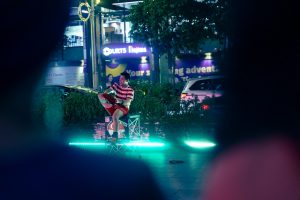
On certain evenings in Singapore, a makeshift stage appears on an open field. Workers bolt together tall metal poles before stretching a tarpaulin roof overhead. Fluorescent tubes flicker to life, shining light on the red plastic chairs fanning outward in uneven rows.
Behind this impromptu stage, costumes are lifted from garment bags and shaken loose, as though coaxed awake by the commotion.
Alex Goh, 29, stands in the middle of it all, phone in one hand, script outline in the other. He’s trying to keep Hokkien opera alive in a country that officially moved on from Hokkien long before he was born.
By day, he works full-time as an administrator at a logistics company. By night, he’s a troupe leader, performer, administrator, mediator, and sometimes therapist.
“Sometimes very rushing,” Alex tells me. “I finished work at 5 PM and must rush to the stage and get into character for the performance. I hardly have time to eat or prepare myself mentally.”
This is the life he signed up for. In May 2025, encouraged by his seniors and supported by his Taiwanese godmother, he founded Xin Long Feng Opera Troupe, one of Singapore’s youngest Hokkien street opera ensembles.
On paper, it sounds impressive. Xin Long Feng Opera Troupe specialises in gezaixi (Taiwanese opera) and hand puppetry—a roaming ensemble that now counts more than 50 members performing several times each month.
In reality, the troupe often operates at a loss. Performers like Alex juggle daytime jobs, and the loyal audiences that show up at every performance are ageing. The language of performance, Hokkien, is slipping further away from mainstream use. But Alex is undeterred.
“I am lucky,” Alex stresses. “I have my Taiwanese godmother who encourages and supports me regardless. And I’m slowly building a reputation for my troupe.”
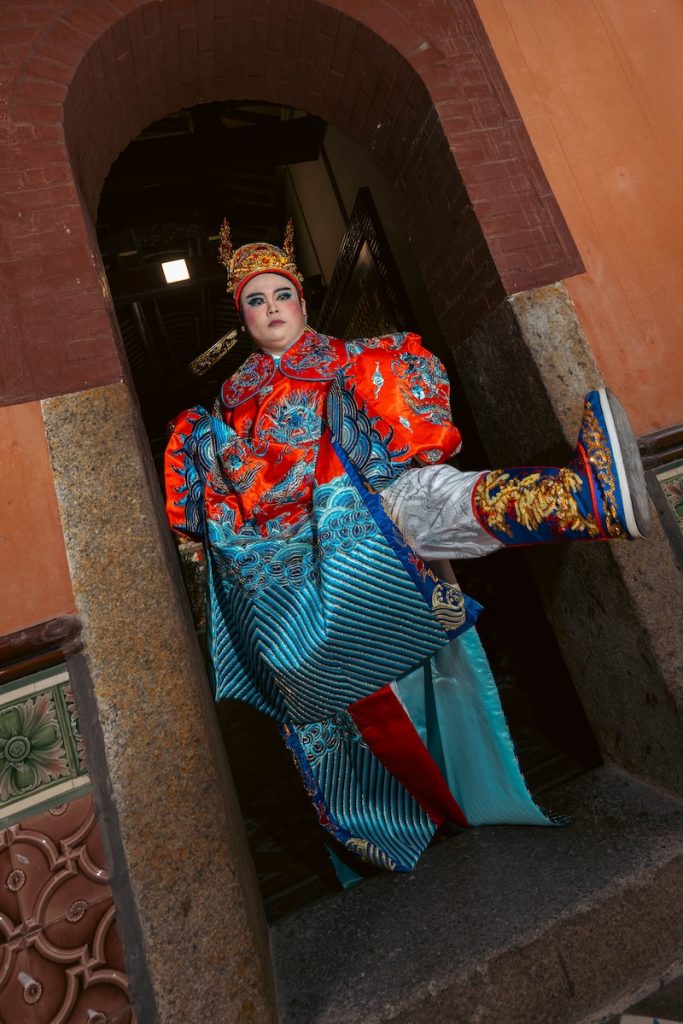
Hokkien, the Language That Once Carried a City
Alex grew up in a Singapore when Hokkien usage was already receding. “My younger work colleagues frown when I tell them I can speak fluent Hokkien,” he remarks, laughing.
“They say that it’s only a language their grandparents speak.”
There was a time when dialect structured Singapore’s immigrant landscape. Hokkien, Teochew, Cantonese, Hakka, Hainanese, Foochow—these were not merely linguistic categories but distinct social realms.
Markets, clan associations, temples, and businesses operated within dialect ecosystems. Hokkien functioned as a bridge language, spoken across the communities of Chinese immigrants. Recognising its reach and emotional weight, the late Lee Kuan Yew even addressed the nation in Hokkien in his first National Day Rally.
It was also the language gezaixi travelled in. Widely recognised as a Taiwanese opera genre that took shape in the early 20th century—often traced to Yilan—it emerged from centuries of cultural movement between southern Fujian and Taiwan. Folk singing styles from Zhangzhou merged with local Taiwanese songs, shifting performance from seated singing to mobile, dramatic storytelling.
As it evolved, gezaixi absorbed whatever it encountered: tea-picking songs, folk humour, vernacular speech. When it reached Southeast Asia, it found familiar ears among Minnan-speaking communities in Singapore and Malaysia.
During the late 19th and early 20th centuries, some of the most popular opera repertoires included classical narratives such as Romance of Three Kingdoms, The Legend of the White Snake, and Journey to the West. These stories, drawn from well-known historical epics and literary traditions, provided audiences with familiar characters, dramatic conflicts, and moral lessons.
What gives gezaixi its vitality isn’t just melody or spectacle, but language. Its use of everyday speech, slang, and rhymed banter turns opera into something intimate and recognisable. Love, betrayal, vengeance, humour—sung in the same register people use to argue at the wet market.
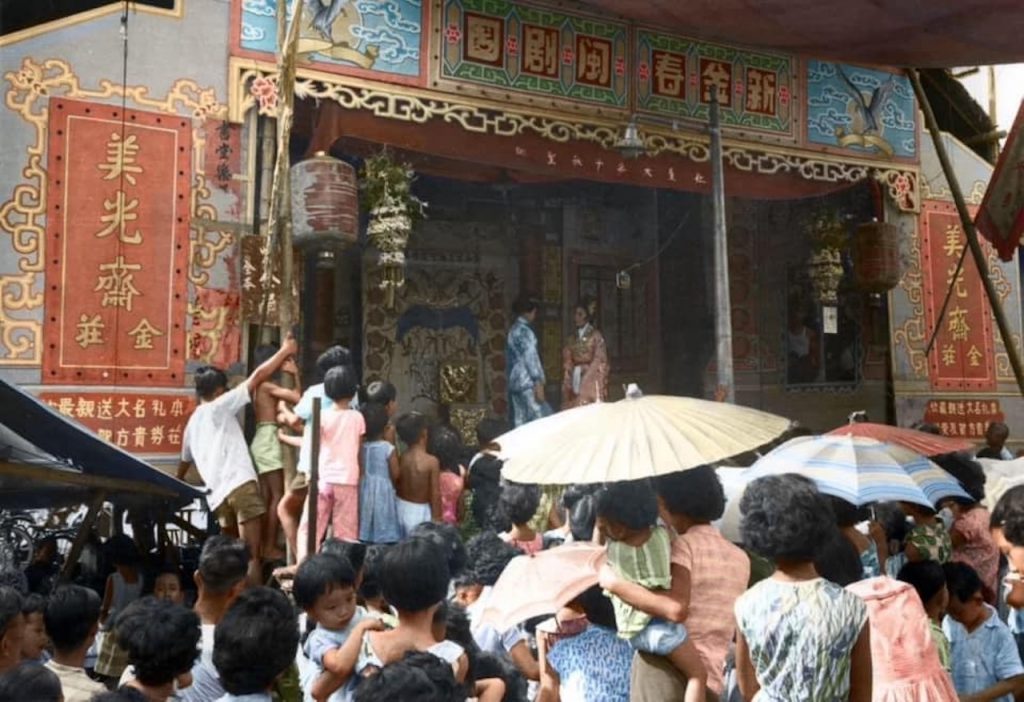
Performances were also staged for occasions connected to the accumulation of ‘merits and virtues’, particularly in ritual contexts involving spirits, deities, and the underworld. In such settings, the repertoire often included titles such as Zhong Kui Explores the Underworld (鍾馗下地獄), Mulian Rescues His Mother (目連救母), Journey to the West (西游记) and The Twenty-Four Filial Exemplars (二十四孝).
While these narratives conveyed moral instruction and cosmological themes, they were not limited to funerary or salvific rituals. The Twenty-Four Filial Exemplars, for instance, could also be staged for more celebratory occasions, such as an elder’s birthday or as an offering of thanksgiving to a deity.
Actively supported by businessmen and clan associations, Hokkien street opera flourished back then. Rooted in its nomadic origins, troupes staged performances at temple festivals, amusement parks such as Geylang’s Happy World, and makeshift theatres across Singapore. They moved constantly, drawing crowds that crossed class and dialect boundaries.
By the post-independence years, public interest waned. Industrialisation and urbanisation meant younger generations were reluctant to enter the opera business. The Speak Mandarin Campaign in 1979 slowly eroded dialects from everyday use. Once-prominent companies shuttered quietly, including the 116-year-old Sin Sai Hong.
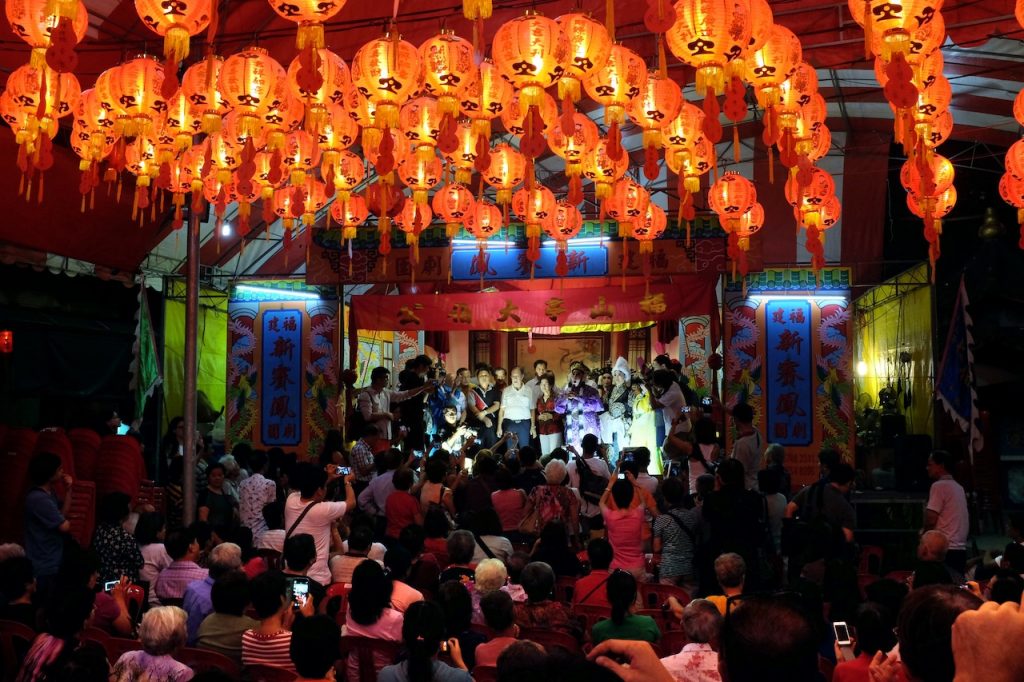
Alex sometimes looks out from the stage and sees younger audience members relying on projected Mandarin or English summaries to follow the plot. The stories remain intact, but the language that carries them does not.
“What we’re losing isn’t just opera,” he sighs. “It’s the way people used to speak to one another. The younger generation doesn’t understand or speak the dialect of their parents or grandparents anymore.”
Language policies have long been tied to survival and progress in Singapore. Dialects were streamlined in favour of Mandarin and English—tools for economic mobility and national cohesion.
That logic made sense; it still does. But something else was streamlined away with it: the texture of speech that holds memory of our yesteryears in its original cadence.
Learning the Old Ways
Alex is not nostalgic for a past he never lived. What troubles him is this: if a performance tradition disappears, what disappears with it?
“If I don’t even try, it will definitely end with my generation!”
Alex did not inherit his love for opera from his family; he apprenticed himself to it. Alone, he repeated dialect phrases to himself until they stopped feeling foreign in the mouth.
“Until now, I’m still learning with each performance,” Alex says. “Learning never ends. My seniors correct my tone when they hear me sing or how I pronounce my Hokkien and give me feedback on how I can improve.”
There are no full scripts in traditional gezaixi. On the day of the show, actors receive only a narrative skeleton from a storyteller. Dialogue is improvised; lyrics are composed live. Timing is negotiated in real time between performer and musician. This mode, known as ô-phait-á, demands deep musical memory, sharp listening, and collective trust.
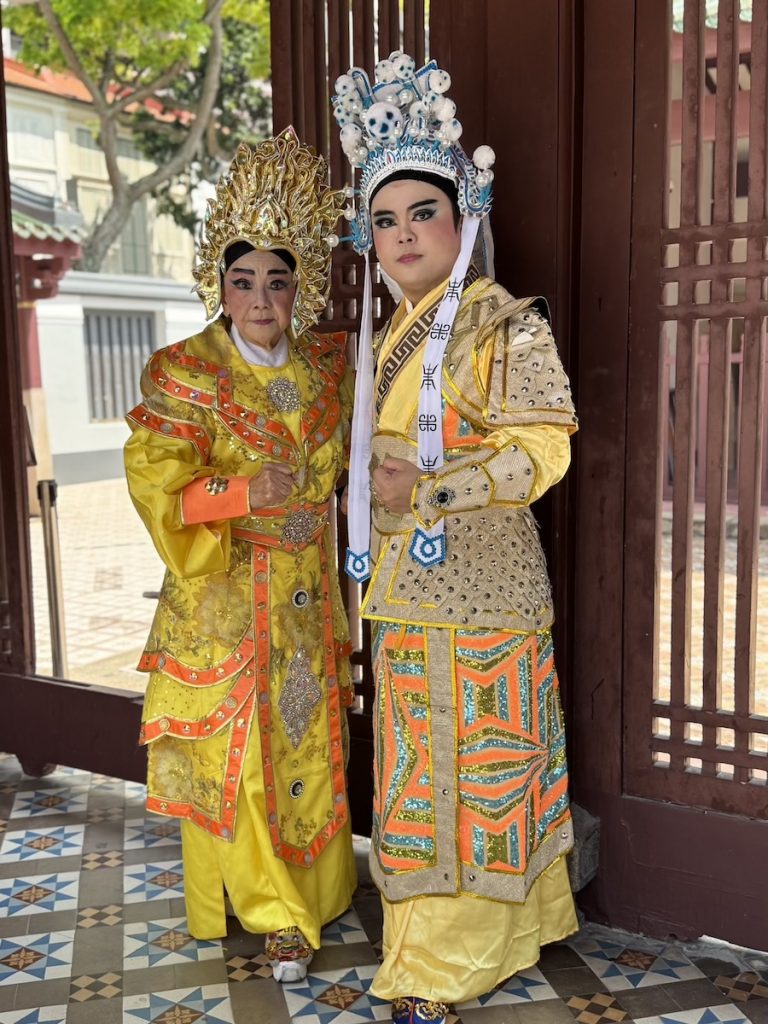
“We write our own story!” Alex exclaims.
“For puppet shows, which I also perform, I will arrange happiness and auspicious storylines. For the stories my opera troupe perform, they carry a message I would like to pass on to the audience that will have themes of zhōng xiào jié yì, which refers to four traditional Chinese cardinal virtues of loyalty, filial piety, integrity/chastity, and righteousness.”
Hybrid gezaixi loosens the historical constraints. Stories can unfold in fictional worlds, with plots built around love, betrayal, and revenge. The staging leans into the spectacle, like dramatic sword fights under disco lights.
Scenes change often on stage, and they do more than move the story along. They bring in new characters, buy performers time to swap into the next elaborate costume, and hold multiple plot threads in the air at once. A story might cut across locations or leap forward in time without warning. In an improvised opera, these transitions are what keep the performance coherent.
“You can’t fake it,” Alex says. “If you don’t know the language deeply, it shows.”
That depth takes years to master—opera demands endurance.
At rehearsals, Alex watches his younger members closely; many of whom are in their twenties. They join out of curiosity, sometimes out of affection for grandparents who once watched street opera.
But curiosity must mature into commitment. Otherwise, the art form becomes an aesthetic hobby—something sampled but not inhabited.
“The hardest part isn’t performing. It’s continuity.”
Opera as Offering
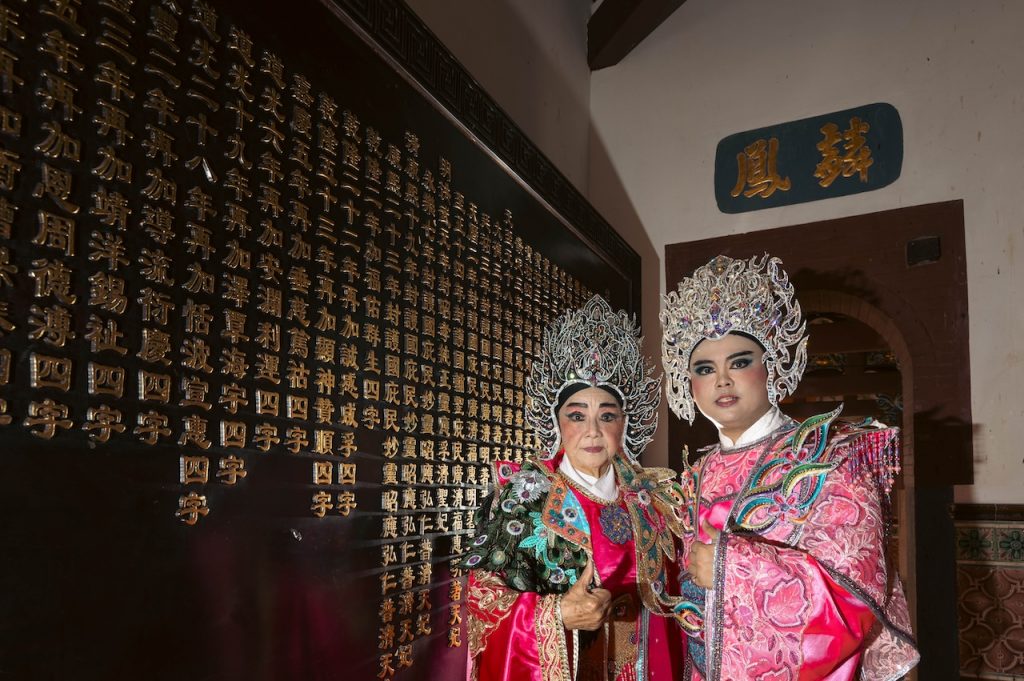
Most of Xin Long Feng’s performances are contracted by temples. A devotee commissions the opera as an offering to the gods during a festival.
The stage may rise beside a temple, in a temporary tentage during yew keng, or even on private property close to a sintua, where a spirit medium maintains an altar. Deities are ritually transferred to these sites to ensure their patronage.
There are no glossy posters and no ticketing system. Publicity for the performance spreads through WhatsApp messages and Facebook posts. Competition between troupes makes self-promotion delicate. This delicate ecosystem is sustained by relationships established between temple committees, musicians, veteran performers, and donors.
When Alex negotiates a contract, he enters a ritual that predates his birth. As the founder of Xin Long Feng Opera Troupe, he charges competitively for each performance while still ensuring everyone—musicians, actors, stagehands—gets compensated fairly. Factor in the stage setup, instruments, lighting, audio, props, makeup, and costumes, and costs often run into the five digits.
Most times, he runs at a loss. Spectacle is how he gets people to show up.
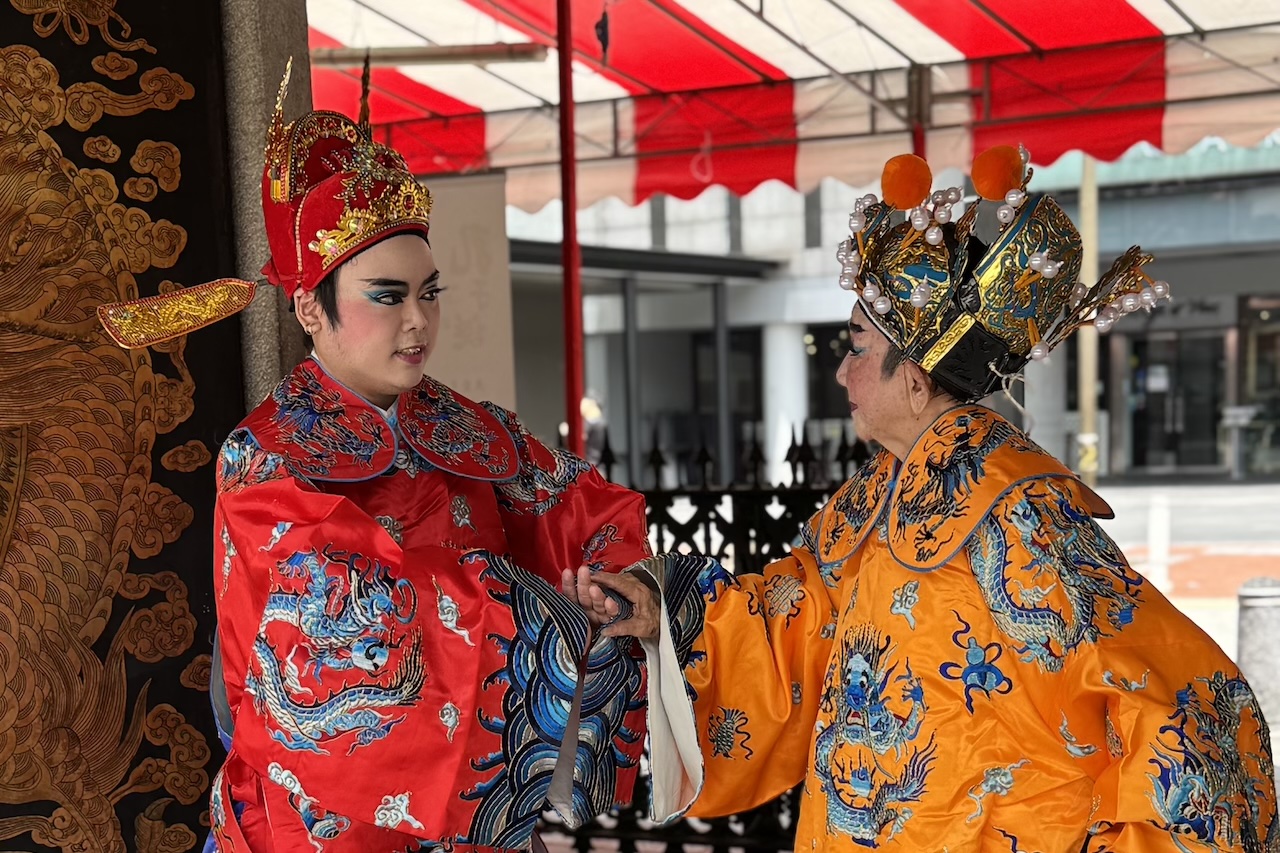
Hybrid gezaixi pulls in newer audiences through popular Hokkien songs like ‘Ai Pia Cia Eh Yia‘, flamboyant costumes, glittery makeup, expressive wigs, strobe lights, and smoke machines.
“We choose the pop songs quite carefully, so they still fit the mood of the story,” Alex explains.
“When the music starts, the atmosphere changes a bit. Suddenly, it feels less like opera and more like a karaoke session—the audience relaxes, some even sing along. The whole place becomes much livelier.”
Tradition can twist, but it can’t break—Alex knows that and relies on it. The question he wrestles with is how far it can bend before it stops being tradition at all.
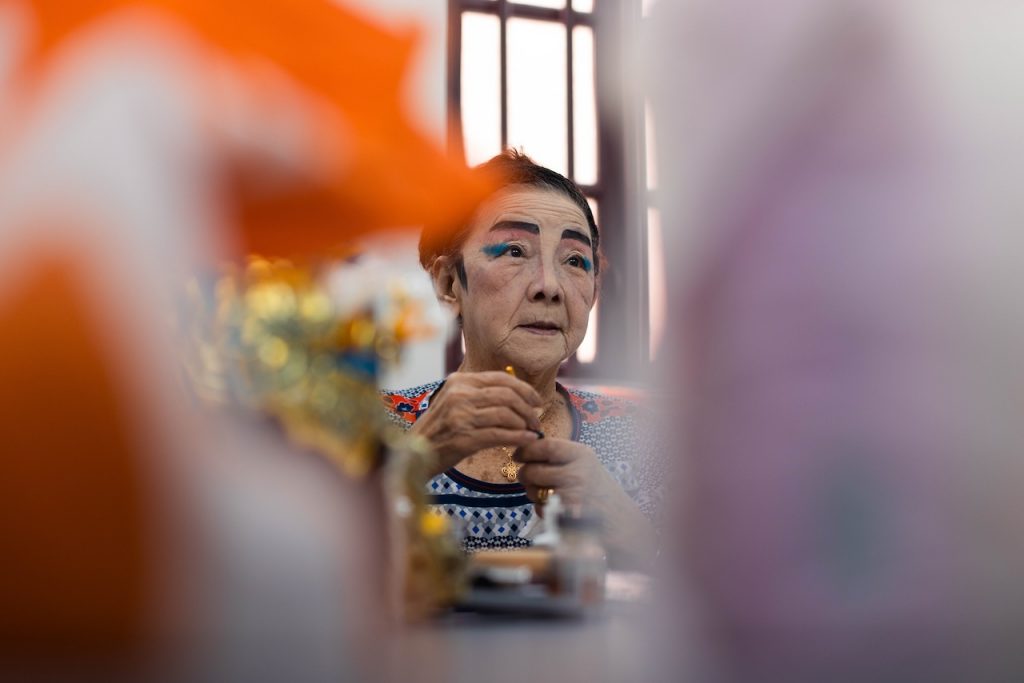
Backstage, 83-year-old Ā Xiào Yí adjusts her lashes with steady hands. She began as an opera child performer at 13 and still speaks of troupe life as family. Her hands remain unwavering, which speaks to the seven decades of muscle memory instilled in her for this crucial pre-performance process.
In street operas, makeup and hair aren’t decorative—they’re visual code. Male roles: thick, forceful brows. Female roles, like hers: long lashes, blue eye shadow, silver glitter. Everything has to be legible, even to audiences sitting in the back row.
“Everything is language,” she says, tapping her cheek. “Even the face.”
71-year-old musician Huáng Chéng Lóng listens close by with unwavering attention. He is less worried about performance quality than about attrition in the craft. When older members retire, who replaces them? Opera is not modular; you cannot simply plug in a new musician without years of shared vocabulary and understanding.
Alex feels that thinning acutely. He is young enough to belong to the generation that drifted from dialect, yet old enough to sense what its absence means.
“We’re the in-between generation,” Alex explains. “We can still understand the dialect, but if we don’t choose to carry it, our children won’t.”
The Show Must Go On
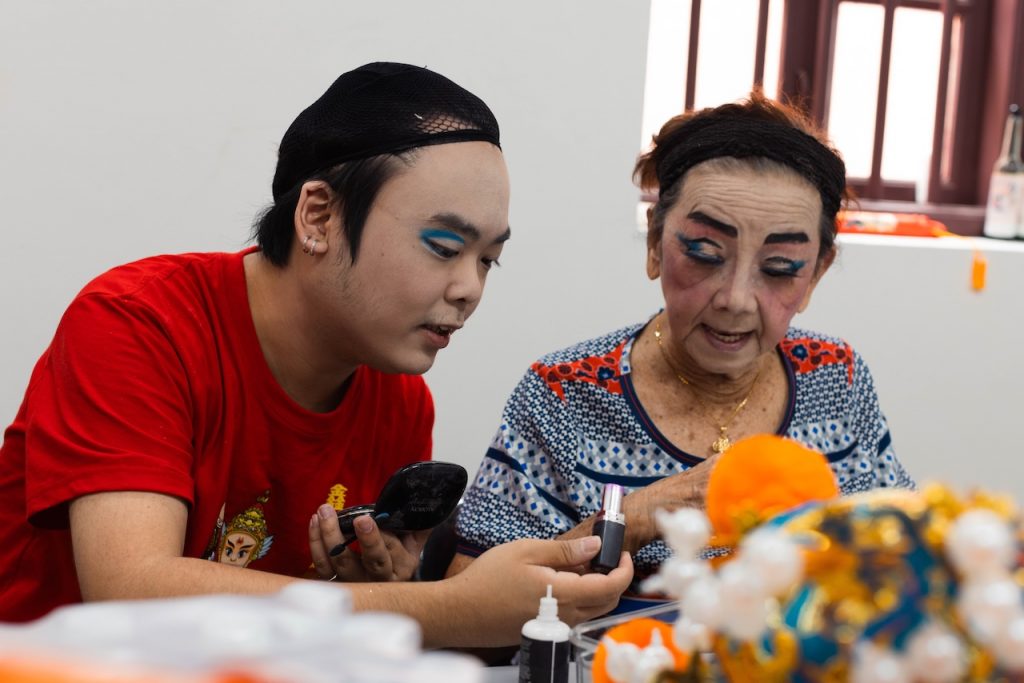
Singapore’s outdoor stages are unforgiving. Humidity melts makeup, heavy costumes trap heat, and rain arrives without warning. And yet the troupe sings scene after scene proudly, without scripts, building a story from fragments dictated hours before.
“Street opera was never meant to be comfortable,” Alex says.
“It was meant to survive. So, whether the makeup melts or the rain comes down, we keep going, because stopping is the only thing that really kills it.”
For a few hours, Hokkien is felt and seen again. The elders relive their youth; the younger performers feel the weight of history. The curtains keep rising because people like Alex believe the show must go on.
It would be easy to frame Hokkien street opera as heritage preservation—a charming relic kept alive by the devoted few. But that framing flattens what is really at stake.
It asks a deeper question of Singapore: What do we owe to the things that can’t justify their own survival? What do we keep when economic logic says let it go?
“Not everything valuable has to scale. Some things just need someone stubborn like me to keep them going. Maybe it won’t make money. Maybe the crowd won’t get bigger,” Alex ponders.
“But if we don’t keep showing up, then how? I don’t think about the future too much—I just think about the next performance. If we get through that, the rest can come later.”