
Imran Johri is a marketing strategist, an editorial veteran, and a father of three.
In this op-ed for RICE, he examines how Singapore has spent decades paying us to do what’s supposedly good for the country and for ourselves (like having more babies, saving for retirement, and now, reading) until good citizenship became a transaction.
Top image: Stephanie Lee / RICE file photo
Standing behind the two-way glass in the neonatal intensive care unit, seven-year-old me was a little confused. My mum had apparently just given birth. It was a bit of an emergency, and after all that running around with my dad, I was looking at what seemed like a kitten-sized human in a glass box.
“That’s your new sister; she arrived early,” the nurse said.
Wait, what? She’s barely the size of my palm.
What followed was years of back and forth in the early ‘80s —to hospitals and specialists—just so my fragile little sister would grow up to be the stubborn and deeply annoying sibling I absolutely love.
So imagine my horror when, well into adulthood, my father casually dropped this unsolicited nugget about his third child into conversation:
“Dulu bila Mak beranak adik, kita kena saman.” We got fined when your sister was born.
By the government, apparently. Because families then were supposed to stop at two.
Then, in a montage of childhood memories, everything just clicked into place. All that effort. All that medical care. All that commitment to keeping this premature third child healthy, while living in a country that was, at the time, actively discouraging families from having a third child at all.
My parents had done everything possible to bring my sister into healthy existence. And somewhere in the machinery of national policy, they were being financially penalised for having her.

Now I’ve been a little vocal on some campaigns and policies (like when I got called out by the DPM for my stand on Singlish in 2001), but this… this really pissed me off.
When pressed on what exactly the nature of the punishment was, my dad paused, almost struggling to recollect the trauma.
According to him, my mother’s salary as a teacher was cut, and he had to work overtime to pay off the medical bills. Archival records confirm that third and subsequent births came with real financial penalties, including higher childbirth fees and restrictions on paid maternity leave.

He recounted all this casually at first. But the more he remembered the tough times as a technician back then, the more I could see my dad getting retroactively pissed off, too.
Here’s where the collective anger of father and son gets unceremoniously placated. Despite the outrageous penalty, we did not push back. We didn’t revolt or protest then. We didn’t even, as one minister once put it, quit on Singapore. We simply paid our dues and moved on.
And that, I suspect, was how many Singaporean families responded then. I’m sure there were grumblings, belated shows of rage and such, but we took it in our stride—part and parcel of being a Singaporean citizen. But I’d wager there is an obvious reason for this.
We have been weaned on incentives. Even now, as Singapore struggles to produce enough children to replace ourselves, the assumption persists that somewhere there must be a policy lever capable of changing our behaviour.
The Carrot and The Stick

There’s a running joke that our government has literally cracked the social-engineering code. At the dawn of the nation, in fact.
And it’s not some convoluted methodology cooked up by mad scientists in a secret lab. Well, maybe it was, but I’d rather believe it was scholars.
The formula is amazingly simple: Want Singaporeans to do something? Reward us. Preferably with money. Then watch the engine kick in.
Of course, not before the usual chorus of eye-rolls, angry social-media comments (of late) and demands for a smarter, less transactional way of getting society on board.
But eventually, somebody greenlights the budget. And off to the races we go.
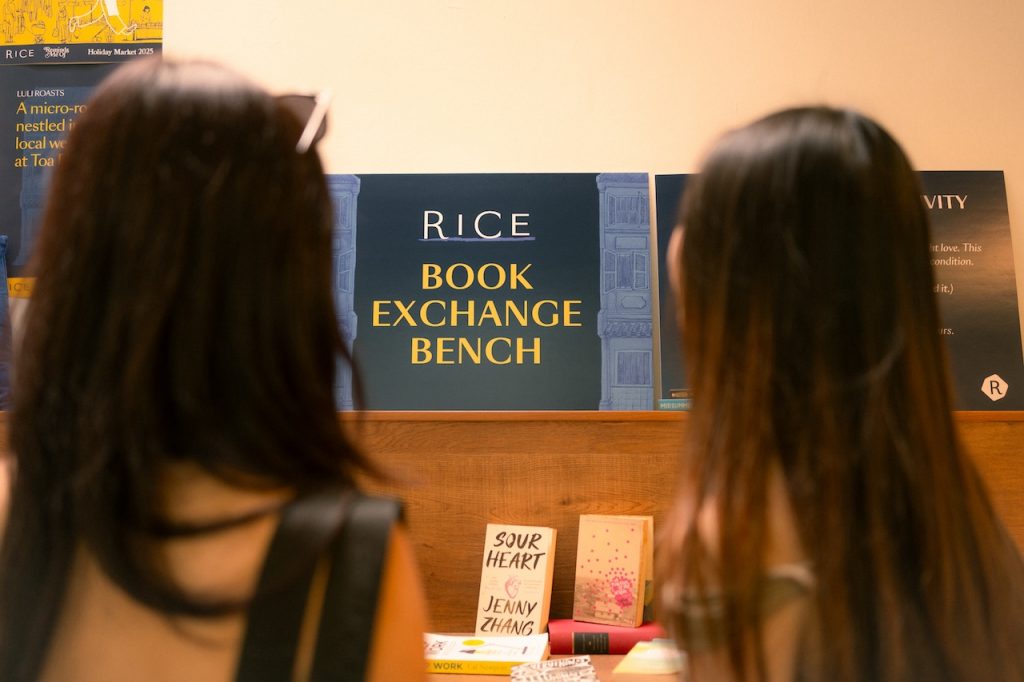
Some are hilariously banal. For ReadSG, Singaporeans are being encouraged to read for at least 15 minutes a day, with the act itself turned into a reward-driven challenge.
To be honest, that made me giggle. The sheer absurdity of incentivising reading.

Reading. The original low-tech mechanism for transferring vast knowledge, expanding multi-versal imagination, escaping stark reality, and occasionally avoiding conversation with uninteresting humans. A fun hobby has now been put through the national incentive machine.
On one hand, I get it. We are living through an era of goldfish attention spans, doomscrolling, meaninglessly short videos, AI-slop summaries and meme-heavy brain-rot.
Even the National Library Board frames ReadSG as a response to the challenge of ‘building sustained reading habits in an increasingly distracted environment’.
But surely there’s a better way. Or isn’t there? Surely people would want to read without needing a reward? But does that mean I’m a pompous reader-elitist? No, wait… and that’s when I stopped giggling.
It’s not so much that we need to do something about the unfortunate state of reading, but that we as Singaporeans are so easy—no, too easy—to incentivise.
How the hell did we get here?

Taste the Carrot, but Feel the Stick
We’ve been weaned on this. Social-engineering 101. Let’s go back to 1981, when my sister’s inception raised administrative eyebrows.
I can understand the logic. Newly independent Singapore was trying to industrialise at warp speed, raise living standards to be on par with the Swiss, and keep population growth from outrunning resources like housing, jobs, and infrastructure.
And apparently, getting enthusiastic Singaporeans to stop reproducing ‘unnecessarily’ was part of the development plan. Thus, the 1972 National Family Planning Campaign.
Consider that we are now trying to get more human production in, and it becomes jaw-droppingly preposterous that we even tried to curb enthusiastic reproduction. In 1984, we had the Sterilization Grant. Pause and read that again.
Now breathe and read this part slowly. Lower-income, less-educated women under 30 were encouraged to undergo sterilisation, and a $10,000 CPF grant for housing was introduced if they checked all the right boxes.
But wait, there’s more. That same year, the Graduate Mothers Scheme was also announced, encouraging graduate women to have more kids and throwing in all the necessary incentives to get smart women to churn out those babies.
You get CPF top-ups, everybody gets CPF TOP-UPS!
This is probably the only silver lining, or comedic karma, to this whole population-control debacle. Barely three years after the 1984 sterilisation grant, Singapore played what has to be the most dramatic demographic UNO Reverse card in our history. (Largely because of the 12.9-percentage-point drop in votes during the 1984 General Election)
By 1986, our total fertility rate had fallen to 1.42, well below the replacement rate. So in 1987, Stop at Two was officially replaced by Have Three, Or More if You Can Afford It.
What’s astonishing here isn’t the Mach 3, G-force u-turn, but that we managed to get everyone to basically curb coitus on a national scale. And horrifically enough, our national fuck-pace has never recovered since. We are still desperately short of babies.
To me, however, the biggest surprise in all of this, as shocking as these policies were, is how little visible public resistance they provoked.
There was some pushback for sure. Graduate women gnashed their teeth at being turned into reproductive policy instruments. Religious leaders had to, of course, object to super-convenient sterilisation. Even people in public office were reportedly uneasy.
The Singaporean response was not blind acceptance. It’s more: grumble, argue, comply, adapt.
Which, in retrospect, may be the most Singaporean part of all this.

This is the Way
Every good behaviour in Singapore eventually comes with a carrot; every bad one comes with a stick. Most of us can no longer say for sure whether we’d be motivated to do anything without a carrot or a stick.
Want fewer cars? Make ownership prohibitively expensive.
Want commuters to shift their travel times? Reward off-peak journeys.
Want people to exercise? Turn steps into redeemable points.
Want recycling to be a habit? Make it financially gratifying.
Want people to read? Turn reading into streaks and rewards.
Yet most of these mechanisms have entered everyday Singapore life with remarkably little drama. And reasonably so. I mean, would you take to the streets if you were given cash rewards for improving your diet and your physique? Hell no.
Maybe the remarkable thing is not that Singaporeans are easy to incentivise. I mean, who doesn’t respond well to carrots? What may be more unusual is how deeply the carrot has been shoved into our civic machinery.
Which leaves the harder question:
At what point does the incentive stop being an external reward and become part of the way we understand good citizenship?
I still don’t have an answer.
The Great Clan Experiment
The reason I don’t have an answer, though, isn’t from a lack of trying. I have seen first-hand the folly of the incentivised program once it starts losing sight of the forest for the trees.
It started innocently enough. Two of my elder kids, who were in primary school at the time, had discovered old episodes of PCK Pte Ltd on Netflix, and were collectively flabbergasted when their dad’s name appeared in the credits as the writer.
“You actually wrote that? How?”
And so the ‘Make Baba Laugh League’ kicked off in our home, where any joke told pitch-perfect and with the snarkiest punchlines, and depending on how many tears I shed in guffaws, would win points. Each point could be traded for a dollar. Yes. A dollar.
That was my first big mistake.
The second mistake was to impose hard criteria on joke construction and delivery, like what I suffered at the hands of my semi-sane Head Writer in that dank horror chamber we called the writer’s room back on Caldecott Hill.
My poor children were subjected to intense belly-laughter and points galore for fantastical and absurdist humour delivery. They faced abject disappointment and critique when the joke fell flat.
Then it really started going awry. My son, who revels in both toilet humour and slapstick scenarios, had accumulated well over a hundred points. His sister, determined to catch up on points and cash, started ploughing through joke books. The jokes got more technically correct and somehow less funny.
It became overly competitive and started to feel like a chore. I had crushed the joy of telling jokes for mirth and laughter, replacing it with the carrot of cold, hard cash.
Without meaning to, I had brought the Singapore model home. I had done to my family exactly what the state had been doing to me for years.
I’ve learnt that while incentives are good at getting people started, they are far less reliable at explaining why people should keep going. A carrot can trigger behaviour, but it is a poor substitute for meaning.

Maybe that is where the state’s job ends. It can get us through the door. It can reward us for taking the first step.
But eventually, reading has to become something worth doing because we enjoy reading. Exercise because we want to feel better. Recycling because bottles and cans shouldn’t end up in a landfill.
And make jokes because making the people around you happy is worth considerably more than a dollar.