All images by Darren Satria for RICE Media.
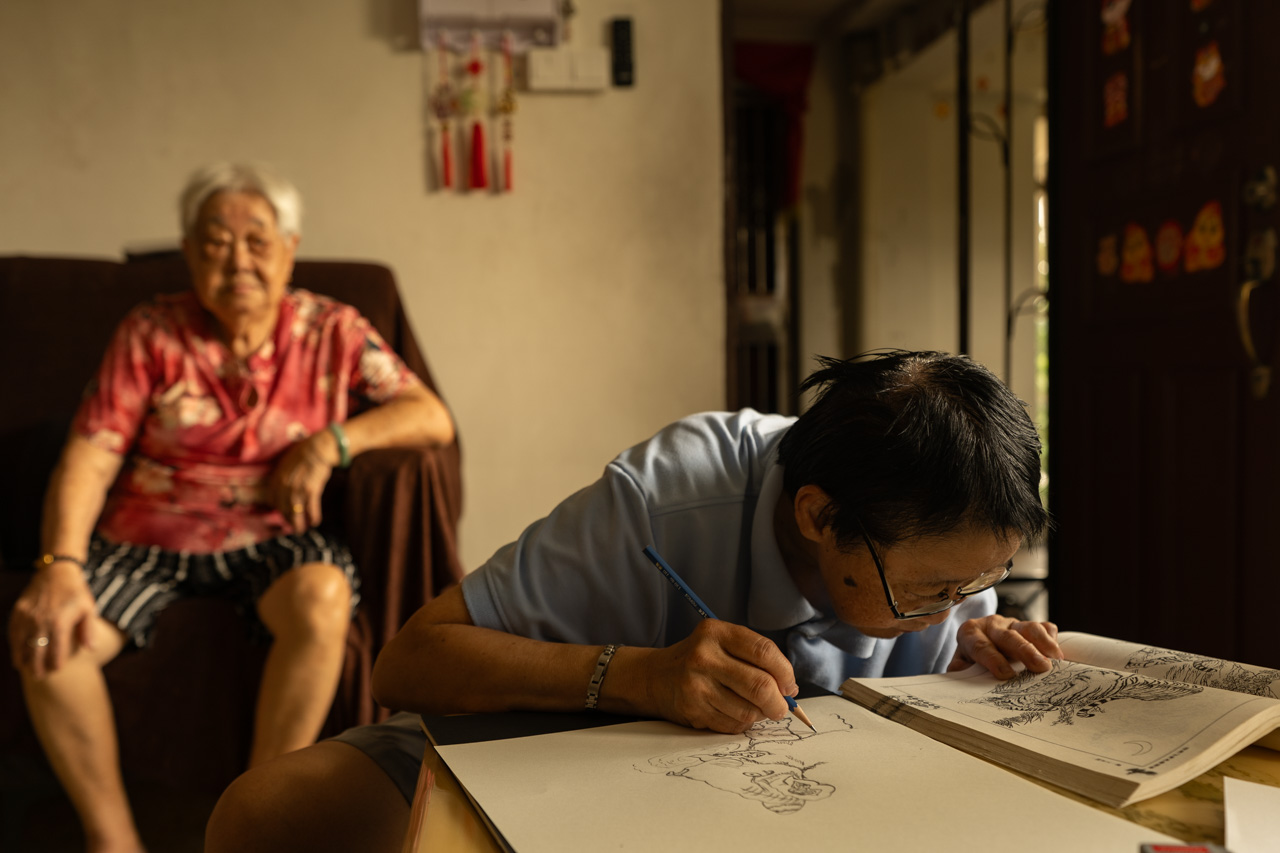
Dressed in a crisp pale blue polo shirt, Lim Meng Joke smiles at me and my photographer as we enter her Toa Payoh flat. But she reserves her brightest grin for Amy Toh, her art therapist from Dover Park Hospice (DPH), who tagged along with us.
Her good spirits, however, belie the fragility of her health.
Meng Joke, 68, is under home palliative care because of a congenital heart condition that has worsened in the last few years. Doctors told her mother, Madam Goh, that Meng Joke’s condition could deteriorate at any time.
Faced with such a bleak prognosis and an uncertain timeline, both mother and daughter are intent on living life as normally as possible for as long as they’ve got together.
“Have you been spending a lot more time together these days?” I ask.
“When she goes out, I don’t follow. When I go out, she doesn’t follow,” Madam Goh tells me bluntly.
The 85-year-old’s tone softens a little. “Our happiest moments together? Just watching her draw at home. That makes me happy.”
The only indication that Meng Joke is in palliative care is Amy’s monthly art therapy sessions.

Amy explains that art therapy looks different for each palliative patient. Essentially, what it provides is a supportive medium for self-expression. Grimly, it’s a way to process their thoughts on mortality.
For Meng Joke, who was born deaf and mute, it’s also a window into her inner thoughts when communication isn’t so straightforward.
Meng Joke makes eye contact with Amy, pointing at me and my photographer, Darren. She puts her fists together, thumbs almost meeting. She’s asking if we’re friends of Amy’s, I think.
Amy shakes her head. She points at me and mimes writing. She points at Darren and pretends to press a camera shutter. To that, Meng Joke nods enthusiastically before turning back to the tiger she’s currently sketching on her pad.
Amy tells me this is her forte—pencil drawings of Chinese imagery, dragons and phoenixes—some of which she can produce freehand, without any reference.
Since Meng Joke first started drawing at the age of 10, her work has been kept neatly in plastic folders. However, from November 8th to December 8th, Meng Joke’s art pieces will be exhibited to the public for the first time at Toa Payoh Public Library.
The idea, Amy tells me, isn’t just for Meng Joke’s sketches to be seen by others; it’s also an opportunity for the public to see her.
Communicating Without Words
So who is Lim Meng Joke? A picture of a bubbly, creative, resilient woman emerges during our visit.
Meng Joke never had any formal education, nor did she have any art lessons. She never learned conventional Singapore Sign Language (SSL) either. Back in the sixties, there was little awareness of special education, and children with disabilities sometimes slipped through the cracks.
Growing up, Meng Joke would dutifully assist Madam Goh at her chicken rice stall. Later, she followed in Madam Goh’s footsteps, picking up a job as a cleaner.
“When I first came to see her, I knew that she was not verbal. I was worried about how we would communicate,” says Amy, who has been working with Meng Joke for about a year.
“But when I first saw her in the first session, my worries faded away. She was very friendly, and she was actually very open for me to come in and look at her artwork, and make art together.”

Each client’s art therapy programme is tailored according to how interested they are in art and their preferred medium, Amy says.
She recalls one client who collected many old family photographs. During their art therapy sessions, they explored legacy work, which entails turning the essence of the client’s life into something tangible. Eventually, they decided to compile her photo collection into a video montage, which was screened at her funeral.
With Meng Joke, it quickly became clear that she loved drawing. Meng Joke would sketch animals like dragons deftly, and Amy would follow after her strokes.
“Sometimes my drawing looks out of proportion or awkward, and she’ll start laughing. I realised that she enjoyed the process of teaching someone else. It helps to build confidence as well.”
“And now when I draw something, she’ll just tease me,” Amy adds.
Almost right on cue, Meng Joke looks over at Amy’s tiger drawing, pointing out the way she’s feathering out its fur and cracking up.
Meng Joke’s art, Amy adds, feels like a window into an inner life that Meng Joke cannot easily express. And with her gentle ribbings, she’s expressing affection.
“Art sometimes reflects the person’s inner world. She has never shared with us, but if I were to hypothesise, it would be that being non-verbal can be quite challenging. I think art helps her, in a way, to regulate that.”

A Mother’s Love
At home, Meng Joke is cared for by her mother, Madam Goh, a cleaner who retired five years ago.
Their relationship, like their daily life, is straightforward. There are no sappy “I love yous”. Just silent companionship.
“I take care of her. I buy what she wants to eat and the helper cooks it for her,” Madam Goh says.
“She goes out without me all the time to exercise, buy things, and walk around. She knows how to do that herself. It’s not tiring to take care of her.”
She remembers how Meng Joke’s affinity for art started. While her two younger children went off to school, Meng Joke would tag along as she and her husband sold food to construction workers building HDB flats, says Madam Goh.
Meng Joke would occasionally wander off to a nearby bookstore. One day, she asked her father for a set of coloured pencils. Despite the family’s tight finances, he agreed.
“Before we knew it, she drew a dragon all by herself!” she says, pride in her voice.
“We didn’t have paper last time, so she drew on a door frame. She wasn’t even tall enough to reach the top, so I remember her standing on a chair to draw.”
Meng Joke soon expanded her repertoire to other animals; in her folder, I spot lively drawings of birds, insects, and even Sun Wu Kong.
“I don’t have a favourite,” Madam Goh tells me, waving her hand. “I like them all!”

Since her husband passed away 20 years ago, Madam Goh has been her daughter’s main caregiver. She can be rather taciturn when asked about their relationship, but her affection for Meng Joke is unmistakable.
Amy has seen it firsthand. “Sometimes I may be trying very hard to communicate something to Meng Joke,” she tells me. “Madam Goh just needs to do a sign, and Meng Joke gets it.”
In a rare moment of vulnerability (and maybe it’s something only mothers would say), Madam Goh admits she isn’t afraid of her own death. She’s afraid of losing her daughter.
“My only worry is her. I have no one else to worry about. I worry about her weak heart. If she leaves one day, I won’t have a companion. I won’t be able to see her.”
And so she treasures the ordinary moments, watching Meng Joke draw.
The Power of Art
These days, all Meng Joke has is art. Madam Goh tells me quietly that Meng Joke’s doctors have advised her to step away from her job as a cleaner and cut down on household chores.
People often think of hospice and palliative care in dreary terms. To many, it feels like giving up. Like you’re waiting for the end of life.
But in a way, Meng Joke’s art has done the opposite. It’s helped her connect with people like Amy, and added meaning to her life. It’s helped her actually live.
“What we were trying to do with her exhibition,” Amy explains, “is to pick artworks that represent her journey. The theme that really struck me is resilience.”
A lot of Meng Joke’s earlier work consists of ferocious tigers and dragons, sporting fierce gazes and bared claws, says Amy. Indeed, as Meng Joke flips through her portfolio, the vibrantly coloured-in creatures almost look like they’re ready to pounce off the page. Amy wonders if these drawings were born out of Meng Joke’s frustration and a desire to protect herself.
But now, as she’s gained confidence and grown happier, she’s been drawing docile kittens and birds.

“Even her eagles nowadays look less fierce, almost like parrots,” Amy notes.
There’s no denying that art has helped Meng Joke process her feelings. But now, Amy believes that it can do more for her.
Her hope with Meng Joke’s upcoming art exhibition is simple—to give Meng Joke a stage to shine.
“People with disabilities… they often live through life very quietly. They’re very unseen by other people. I hope that those who go down and see her artworks will be able to appreciate her strength.”
While I chat with Amy, Meng Joke catches Darren’s eye. She points at her drawing of the tiger, then at him, asking him to join in. From the corner of my eye, I see Madam Goh, smiling serenely.