Top image: Sammy Obeid / Facebook
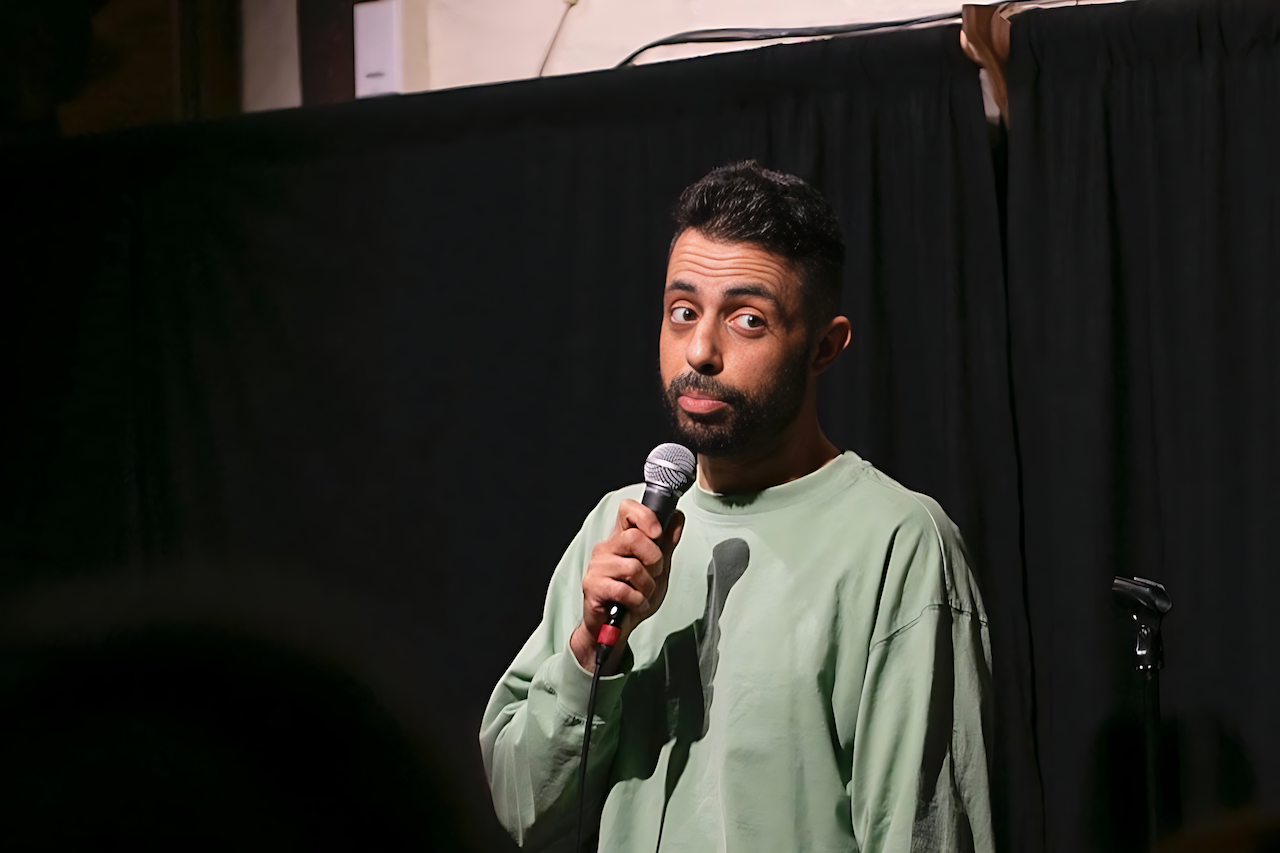
What do Bloomberg, Goh Meng Seng, and American comedian Sammy Obeid have in common? They’ve all had the dubious honour of getting POFMA-ed.
To properly explain how Sammy managed to earn himself a Protection from Online Falsehoods and Manipulation Act (POFMA) directive, we need to start from the sudden cancellation of the Singapore stop of his Domestic Terrorist tour.
Sammy was originally scheduled to perform at Victoria Theatre on August 31. But just days before that, he took to Instagram to claim that he’d been blocked from performing. According to him, his request for a permit to perform here was rejected despite acquiescing to the requests apparently made by Infocomm Media Development Authority (IMDA) to edit his script to remove references to Israel and Palestine.
This is the picture he painted: the outspoken comic versus the heavy-handed state. But things have gotten muddier since then.
The Ministry of Digital Development and Information (MDDI)—the ministry in charge of IMDA—has asserted that Sammy’s application was rejected solely because his local representative submitted it late. IMDA did not request any script edits, they said. It has since issued a POFMA directive compelling Meta and X to append their version of events to Sammy’s posts for all users in Singapore.
So we’ve got two contrasting versions of what apparently happened. At this point, things are deeply unsatisfying. We want receipts and hard proof. Sammy and MDDI are probably more interested in avoiding fanning the flames—and understandably so.
But it’s not just about getting a fuller picture to pick sides. It’s really about accountability. The public has been left hanging, and we’ve got questions. Sure, the drama is juicy—but this issue is bigger than one cancelled stand-up comedy show.
Who’s the Local Representative Involved?
Sammy mentioned in his Instagram post that he was working with “experienced people who knew how to do it correctly” to make his Singapore show happen. Meanwhile, MDDI says Sammy’s local representative applied for the permit on August 15th, just two weeks before the show.
Applications typically have to be sent in 40 working days before the show, which means that Sammy really should have submitted his application by July 7th. Apparently, this is the mystery local representative’s fourth late application since May 2024.
When RICE asked IMDA if they would disclose the identity of this local representative—after all, they already exposed this person for being chronically tardy—we were told they would not be commenting further on the issue.
The missing identity of the local representative leaves a major gap in the narrative. Without this link in the chain, the public is left with a muddled ‘he said, she said’. If there were indeed script submissions and edit requests, there would naturally be a paper trail.
This mystery local representative would have been the smoking gun that definitively determines which side is telling the truth. And yet, both sides have stayed silent on the individual’s identity.
Sammy and fellow comedian Steve Hofstetter claim they have receipts and emails to prove their side, but so far, we haven’t seen any clear evidence that IMDA asked Sammy to censor his script. What we do have are two undated video clips that Sammy posted on Instagram, showing him on a call with someone asking him to remove all references to Israel and Palestine from his set.
Was it really the authorities, like Sammy claimed? Or was his local representative acting out of an abundance of caution? Without any hard proof, the public claims of authoritarian censorship seem shaky.
Would IMDA Have Approved Sammy’s Application if It Had Been Submitted on Time?
Even if we accept the late application as the reason for the show’s cancellation, it’s hard not to wonder: Would the show have been approved if the application had been submitted on time?
It’s important to acknowledge that pro-Palestine voices have gotten into legal trouble for organising unsanctioned memorials and processions before. At the same time, the authorities have allowed pro-Palestine film festivals and dialogues talking about the crisis in Gaza to take place.
It is possible that Sammy’s show could have still been flagged for its content even if he had applied well in advance. But at this point, we can’t say for sure. And neither can he.
Who Loses Out in The End?
For Sammy, this entire episode is pretty much material for his next set. He can turn Singapore into a punchline, use the POFMA notice as ‘proof’ that he’s been censored, and keep performing internationally.
The local arts scene, however, doesn’t have that luxury.
Sammy said in an Instagram post that he’s spoken with artists and producers who have successfully made late submissions. Let’s consider for a moment whether IMDA is going to be as charitable towards late submissions in the future after this high-profile incident. Probably not.
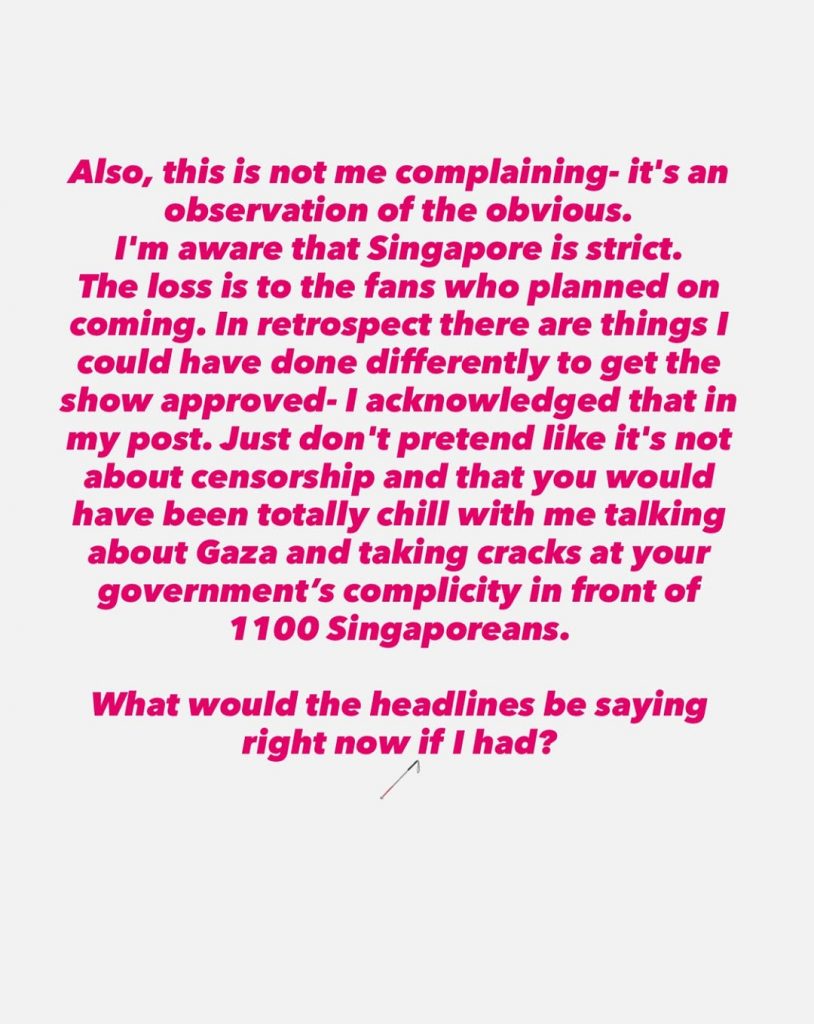
In the wake of the incident, Sammy has continued to claim that he’s a victim of censorship and that “Singapore is strict”. The picture painted of Singapore is an unflattering, stereotypical one: a small, oppressed nation that can’t take jokes.
Some local performers and promoters have since come forward to provide a more balanced picture of regulations impacting the local system and entertainment scene.
Veteran gig organisers Street Noise SG admitted the process is “not always smooth sailing” but added that turnaround times have improved drastically—from months to 40 days—and officials are usually responsive if event organisers play by the rules.
Comedians Rishi Budhrani and Sharul Channa echoed the point. Every country has its share of red tape; the challenge is learning to navigate it if your goal is to bring your work to a wider audience.
If this whole kerfuffle leads to tightened enforcement of the rules and puts other performers off coming to Singapore, it’s not Sammy that pays the bigger price. It’s the local arts and entertainment community that will still be wrangling with IMDA’s regulatory decisions.
A Matter of Accountability
As Singaporeans, we like things to be clear-cut. We crave order. When kerfuffles like this happen, we immediately demand the facts from everyone involved so we can sort this neatly into a box.
Beyond that, it’s more important for all the parties to be accountable to the people who missed out on Sammy’s show—and to the people who care about the state of the arts in Singapore.
At the end of the day, we’re missing out on what might have been a great show. And with the way the chips have fallen, it doesn’t seem likely that Sammy wants to return to Singapore anytime soon.
It’s frustrating because all the back-and-forth has completely overtaken any form of meaningful discourse over what happened, and, more importantly, where do we go from here.
How can we ensure that this doesn’t happen to another artist or comedian? We can’t say for sure without knowing whose version of events is undeniably accurate.
At the same time, we shouldn’t get so defensive about “our way of doing things” that we dismiss Sammy’s experience altogether. Even without all the facts of the matter, there’s definitely a bigger conversation to be had over censorship in Singapore.
Perhaps the local artists and promoters who’ve tangoed with IMDA before can speak on their own experiences to shed more light, because the rest of us just don’t know how it is behind the scenes. Perhaps they’ve done so plenty of times, but the masses just don’t care enough.
This is the system that we live within. And this is the system we’ve grown accustomed to. It’s easy to admonish Sammy for not following our standard operating procedure and to write off everything he has to say. After all, in Singapore, most of us are sticklers for the rules. Everything has to be by the book, or “law by law”, as we locals like to say.
But for anyone outside this system, the sheer weight of regulation can look absurd, even stifling. That discomfort shouldn’t just be brushed off; it should prompt us to reflect on what we’ve normalised.
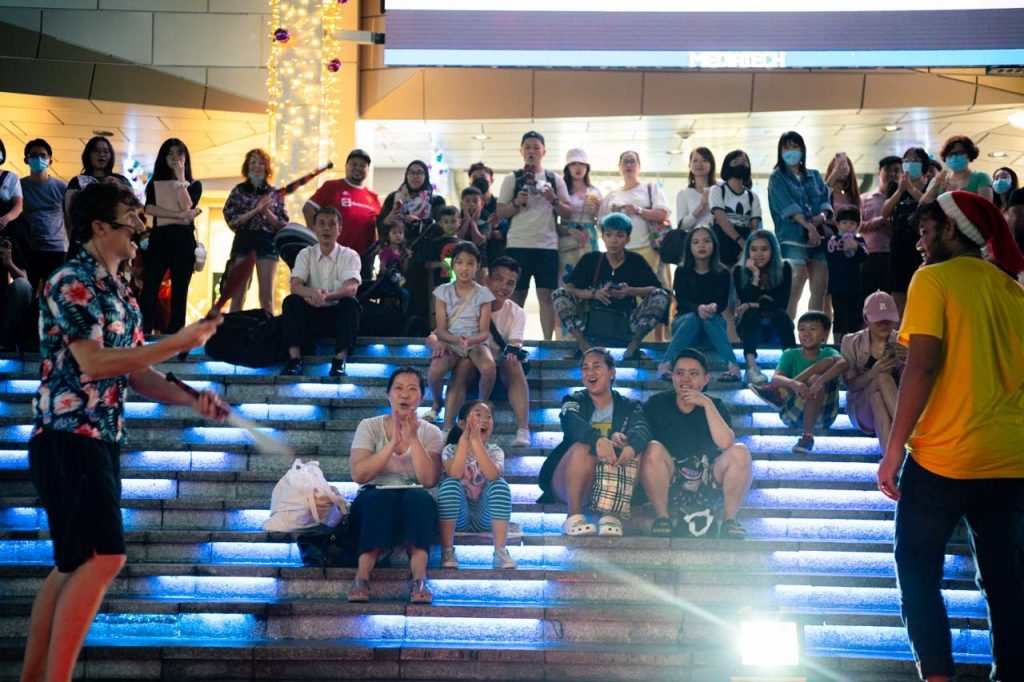
For example, consider the fact that most entertainment events, from comedy shows to busking, require permits and licenses in Singapore. Even if you’re simply playing music on the street, for example, you need a license. It’s something that the open-jamming collective, Ann Siang Sounds, has had to be concerned about lately.
And let’s not forget that any art that includes queer representation is deemed ‘mature content’ in our regulators’ eyes.
It’s easy to get caught up in pointing fingers and concluding who’s wrong or right. The bigger question, however, is whether we want to keep telling ourselves this is simply how things are, or whether it’s time to ask how much freer Singapore’s art scene could be if the rules were a little more lax.