
Top image: Shiva Bharathi Gupta / RICE File Photo
At first, I couldn’t understand why a profile story of coffee-themed “sober rave” founder Aden Low, published by Christian media platform Thirst last week, provoked such an outcry across Singapore’s electronic music community.
The issue, it turned out, wasn’t the music itself, but the motives. Suddenly, a crew once celebrated for championing alcohol-free daytime dance parties was accused of pushing a hidden religious agenda.
Beans&Beats was founded in 2024 by Aden, Ethan Lee, and Matteo Lie, all in their early 20s. Their pitch is simple: Enjoy good coffee and good vibes without liquor. Globally, it’s not a new concept—but the popularity of their coffee shop soirées carved the path for other sober parties in Singapore, including matcha raves.
They’ve hosted events in cafés, retail spaces, and even drew several hundred revellers to the inaugural For Real Fest at Funan Mall in August 2025. The backlash began when Aden’s remarks on faith in the Thirst piece struck a nerve. Aden, a devout Christian, was portrayed in the piece as someone who wants to evangelise through community-building.
And with him being a founder of Beans&Beats, it didn’t take long for people to connect the rhythm to religious agenda.
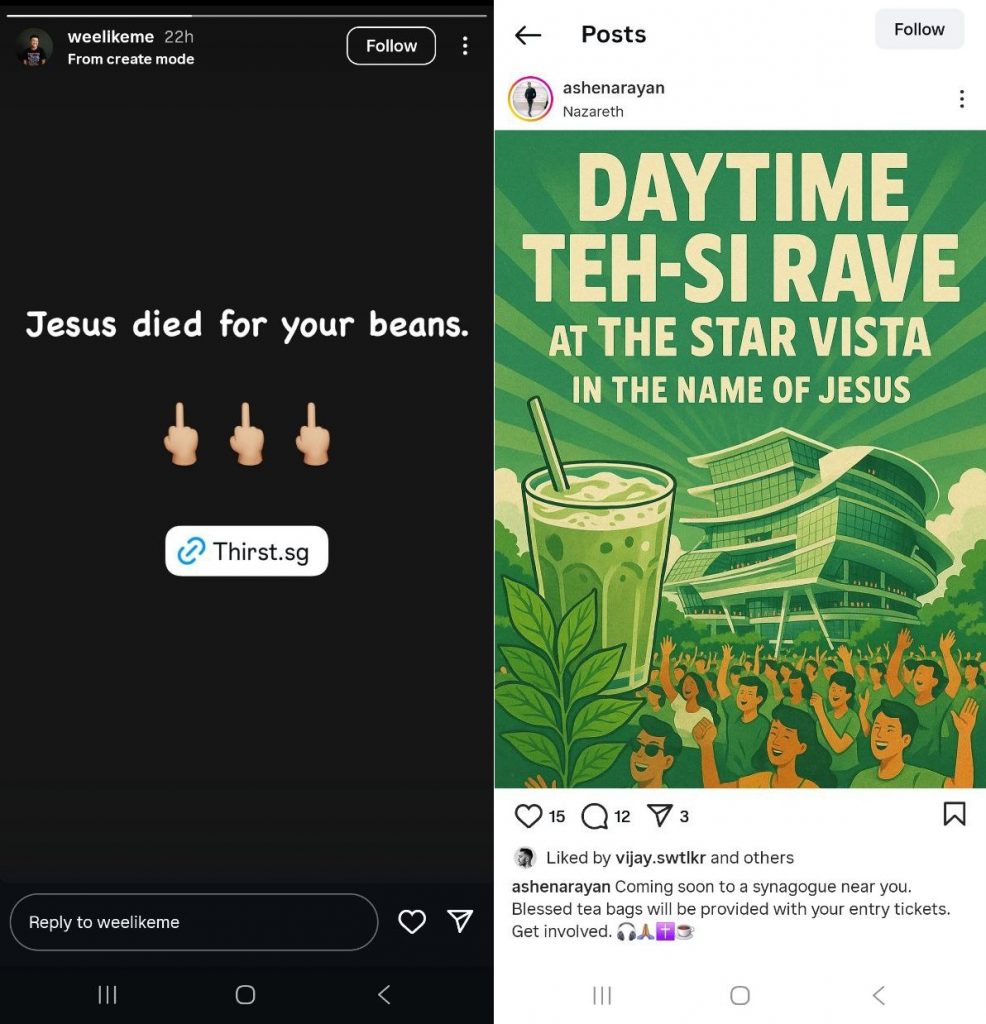
“Jesus died for your beans,” posted veteran DJ Adrian Wee on Instagram Stories, middle-finger emoji attached. DJ A:SHE created a parody poster advertising a “Daytime Teh-Si Rave at The Star Vista in the Name of Jesus”.
Were they gatekeeping, or safeguarding something vital in a community that prides itself on its counter-culturalism?
More than just a squabble on the dancefloor, Aden’s remarks called into question the sanctity of subcultures—and how years of trust and autonomy can unravel the moment an external agenda (real or perceived) disrupts the beat.
Last Night a DJ Saved My Life
Aden shared in the Thirst article that his discomfort with alcohol goes back to his teenage years, when he hosted a prom afterparty that ended with classmates blacking out and an ambulance being called.
“I felt convicted,” he told Thirst. “Do I really want to be promoting a culture of alcoholism?” That part seemed harmless enough. But a line that set the internet ablaze has since been scrubbed from the article (though the original still lives on the Wayback Machine):
“Evangelism is the main objective of why I do business… My main objective is to point to Jesus and to show Jesus through my business.”
On closer inspection, the Thirst piece itself was quietly edited after publication to soften some of its more overtly evangelical language. For instance, a quote about promoting “a culture of alcoholism” had originally read: “Do I really want to be the one who causes people to sin in this way?”
Also, what originally read:
That moment greatly shifted Aden’s perspective again, who became convicted again that if he wants to do business, he would view it as God’s business… ‘I’m not just having God as the CEO, but God as the main stakeholder of whatever I own – because stakeholders are higher than CEOs!’ he quips.
Was edited to:
That moment greatly shifted Aden’s perspective again, who became convicted again that if he wants to do business, he would be driven solely by God.
The uproar came quickly from veteran figures and pundits in the nightlife scene after the Thirst story went up. Instagram Stories lit up with passionate tirades about transparency, insidiousness, and the fragility of trust and resources that keep underground scenes alive.
The criticisms aren’t without merit. Nightlife has long been imagined as a secular space—one of the few zones free from moral policing in Singapore.
When an entity like Beans&Beats rises fast among young Singaporeans, even drawing government support, suspicion is inevitable. The emergence of evangelism raises the tension: it feels like a mainstream force is appropriating the subversive elements of underground raves, DIY parties, and niche electronic communities to push its own agenda.
Subcultures thrive on autonomy; the moment an external agenda tries to infiltrate—even with the best intentions—it tests the trust and social contract of the community.
Then, of course, there’s that quiet unease with the rise of ‘soft clubbing’—the notion that nightlife can be sanitised, curated, and packaged for mass appeal, all while presenting itself as rebellious.
The sense of underlying intent only makes it worse. Let’s be clear here that Aden’s Christian values were never the issue. The real issue was that after that Thirst article, Beans&Beats was inadvertently cast as something else entirely: an inauthentic space engineered by outsiders, where every gathering seemed secretly primed to turn partygoers into churchgoers.
“People at parties might express themselves by dancing and dressing ‘weird’, but that doesn’t mean they need saving,” offers Joshua C, 31, who is part of the DJ collective Revision Music.
“Evangelism crosses the line when people take a ‘sales funnel’ approach to gain your trust before springing religion on you when you are vulnerable. That makes religion less appealing, and more suspicious and derisive.”
Sacred Ground
In response to the uproar, Beans&Beats posted an Instagram Story on September 12th, insisting that its parties have always been secular spaces. The comments section on their Instagram account, however, remains limited.
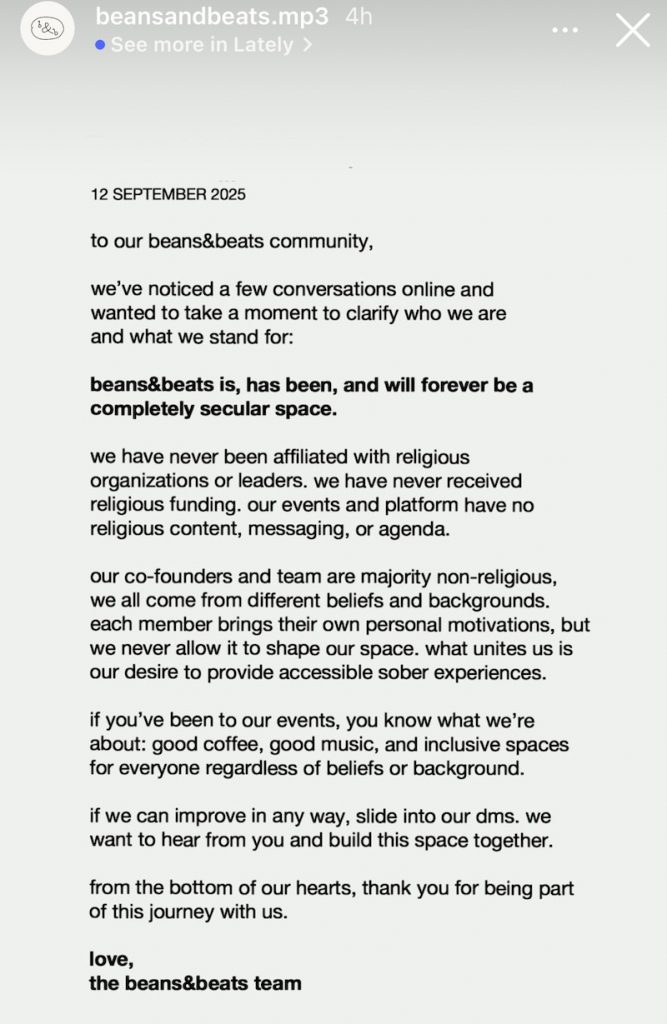
“First, Beans&Beats is, has been and will always be a secular space,” reiterates Ethan to RICE. He’s replying on behalf of Aden.
“Any implication otherwise is misleading and misrepresentative of the brand. The team is majority non-Christian, including the director of Beans&Beats.”
Ethan explained to RICE that the Thirst article was meant to be a personal profile of Aden, his faith and personal motivations.
“It was published without letting Aden vet, misrepresenting and misconstruing what he had shared.”
When approached for comment, Aden declined to respond directly, noting that his co-founder, Ethan, had already shared the team’s position. According to the Beans&Beats team, Aden had reached out to Thirst, which led to the article being edited to reflect his intentions more accurately.
RICE Media reached out to Thirst but did not receive a reply. At this point, we can’t say for sure how much of the original article was made up of Thirst’s spin, and how much was composed of Aden’s actual sentiments. The article now reflects a clarification at the bottom: “All views held in the article are solely of Aden’s and not representative of Beans&Beats.”
This quote, however, remains in the current version of the article, where Aden expresses his personal motivations for the secular collective:
“Whenever things go well, it’s only possible because God orchestrated it. In moments of success, I need to be down on my knees all the more, not just devoting my businesses, but devoting my entire life to Him.”
Old Man Yells at Cloud
Veteran DJ Sivanesh Pillai offers a reason why the old guard jumped at this opportunity to bash Beans&Beats.
“Beans&Beats has a successful product, but their model doesn’t support the majority of nightlife and F&B establishments that rely on alcohol—so it’s understandable that some in the industry feel challenged by it.”
Similarly, the Music and Entertainment Director of W Hotels notes that pioneers of Singapore’s nightlife naturally feel defensive when a hidden agenda is suspected.
“The nightlife and music community here values authenticity; it’s taken decades to build a fragile ecosystem against constant headwinds. When a platform presents itself as a wellness or cultural initiative but later appears tied to a religious agenda, that feels disingenuous and risks eroding trust.”
While Joshua commends Beans&Beats for starting a unique party that has garnered mass appeal, he still believes that communities and subcultures shouldn’t be treated as prospecting grounds.
“I completely understand why the people who built and live the rave subculture are up in arms about it. Subcultures provide reprieve for individuals suffocated by social norms, and the rave subculture here appears to be appropriated for religious agenda.”
It’s not all critical, however. Edward Cheang, who DJs under the moniker EKO, acknowledges how Beans&Beats managed to connect with an overlooked segment of Gen Z. In his eyes, the collective is emblematic of a generation “that is quick to pivot and find out-of-the-box solutions.”
“I love what Beans&Beats has done for music in Singapore—they’ve carved their own niche by making partying more accessible to the next generation,” Edward remarks.
“I saw veteran DJs bash Beans&Beats for using the words ‘rave’ and ‘underground’ too, but I think we older DJs might forget that words carry different meanings in different eras.”
What ‘rave’ meant in the 90s or 2000s is not the same as what it signifies to Gen Z. Conflict often arises when older gatekeepers impose old definitions on a new, youth-driven scene.
“The fact that Beans&Beats were able to sell out multiple shows and DJ at For Real Fest shows you how much more in touch they are with the youth than our so-called industry veterans,” Edward says.
It’s worth noting that Christianity doesn’t consider drinking alcohol itself a sin. What its scripture and theologians warn against is the excess: the damage to body, relationships, and judgment that comes with alcoholism. Seen in that light, Aden’s stance makes more sense—less about condemning the pint, more about resisting the spiral.
Still, Edward disagrees with the religious objectives that Aden voiced in the Thirst article, but acknowledges that they came from a good place.
“If they were going to push the sober agenda followed by a religious one, Beans&Beats would have been doing the opposite of what dance music is all about—inclusive fun, built by outcasts. Nonetheless, let’s remember that the article was written by a Christian outlet meant for their community.”
So was Aden quoted verbatim, or were his words shaped to fit a particular narrative? Either way, the fallout has been a painful crash course in public relations—for him, and for the Beans&Beats collective as a whole.

The Beat Goes On
Ultimately, it’s worth remembering that the trio behind Beans&Beats (all of whom only just turned 21) are still young. They’re grappling with a sudden rise to prominence while learning, in real time, what it means to operate under the scrutiny of a scene—and of veterans who’ve been DJing since before they were born. If anything, their inexperience shows how easily intent and perception can get tangled.
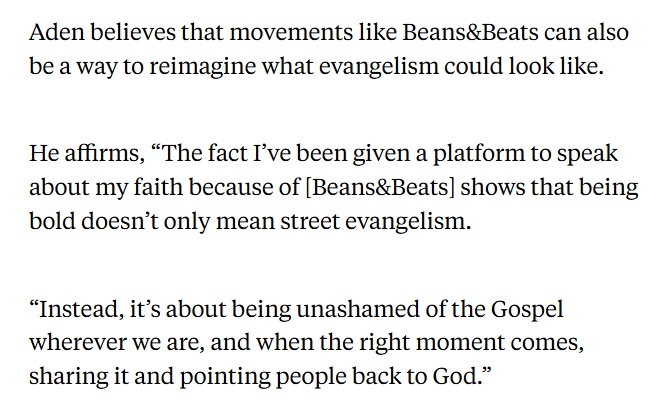
That said, accountability cuts both ways. No one forced Aden to front a Thirst feature. And as the group’s most visible spokesperson, it’s fair to expect more clarity from him—especially since the edited profile piece still reflects how much he wants to point “people back to God” when “the right moment comes”.
Beans&Beats have insisted they’re secular and will remain so, but the dent to their reputation lingers. Still, their contribution shouldn’t be dismissed. They’ve given Singaporean youth a safe, inclusive and alcohol-free alternative for people who don’t love drinking as much as I do.
By carving out space for sober celebration, they’ve broadened what “partying” can mean in this city—opening doors for younger crowds, non-drinkers, and those who’d rather party without the drama and danger that inebriation can bring.
This small scene drama reveals how delicate the balance is between personal conviction and communal culture. But perhaps that tension isn’t necessarily a flaw; it’s part of how subcultures evolve.
New ideas will always jostle with long-held traditions, and sometimes friction is the only way for a scene to interrogate itself. What do we want our dancefloors to stand for?
If Beans&Beats can listen as much as they lead, they might still find a place in shaping a rhythm that truly belongs to the entire scene—not just themselves.