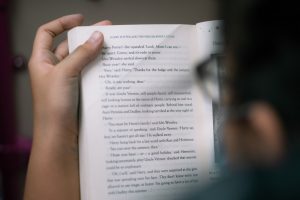
Top image: Muhammad bin Zailan
My more anti-AI friends in polytechnic will be disappointed to know that I use ChatGPT for some of my school assignments. Most recently, I had it help me brainstorm ideas for a marketing communications assignment. Yes, it’s an awkward admission for someone hoping to write for a living.
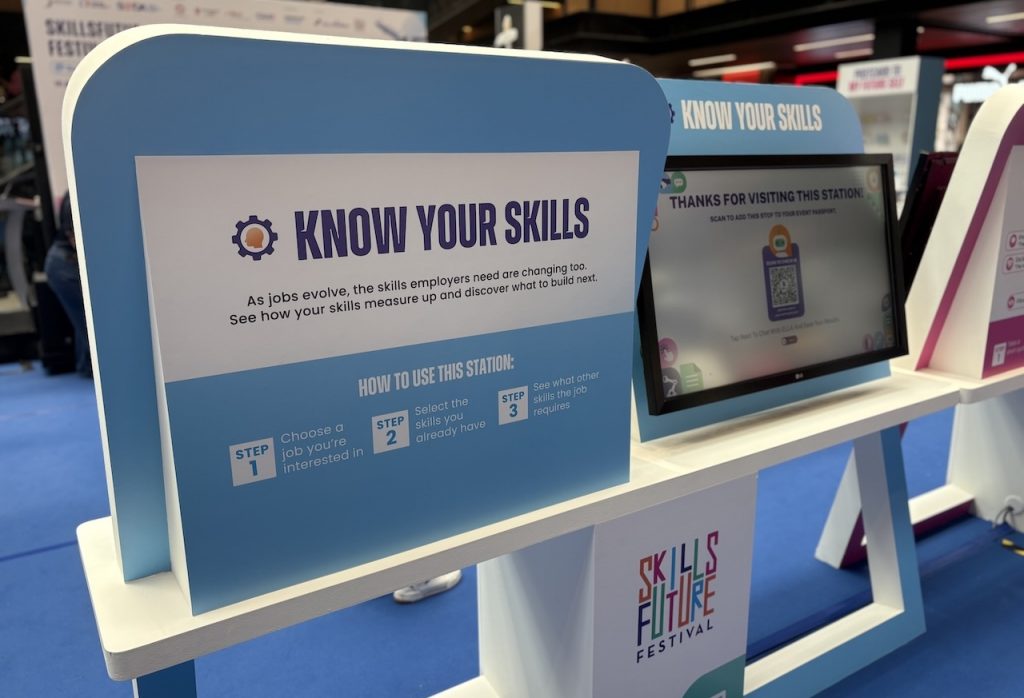
I’d never taken a course on AI, but I hadn’t thought I needed one either. It took a trip across Singapore to check out a few SkillsFuture Festival 2026 roadshows to make me wonder if using it sparingly counts as keeping up.
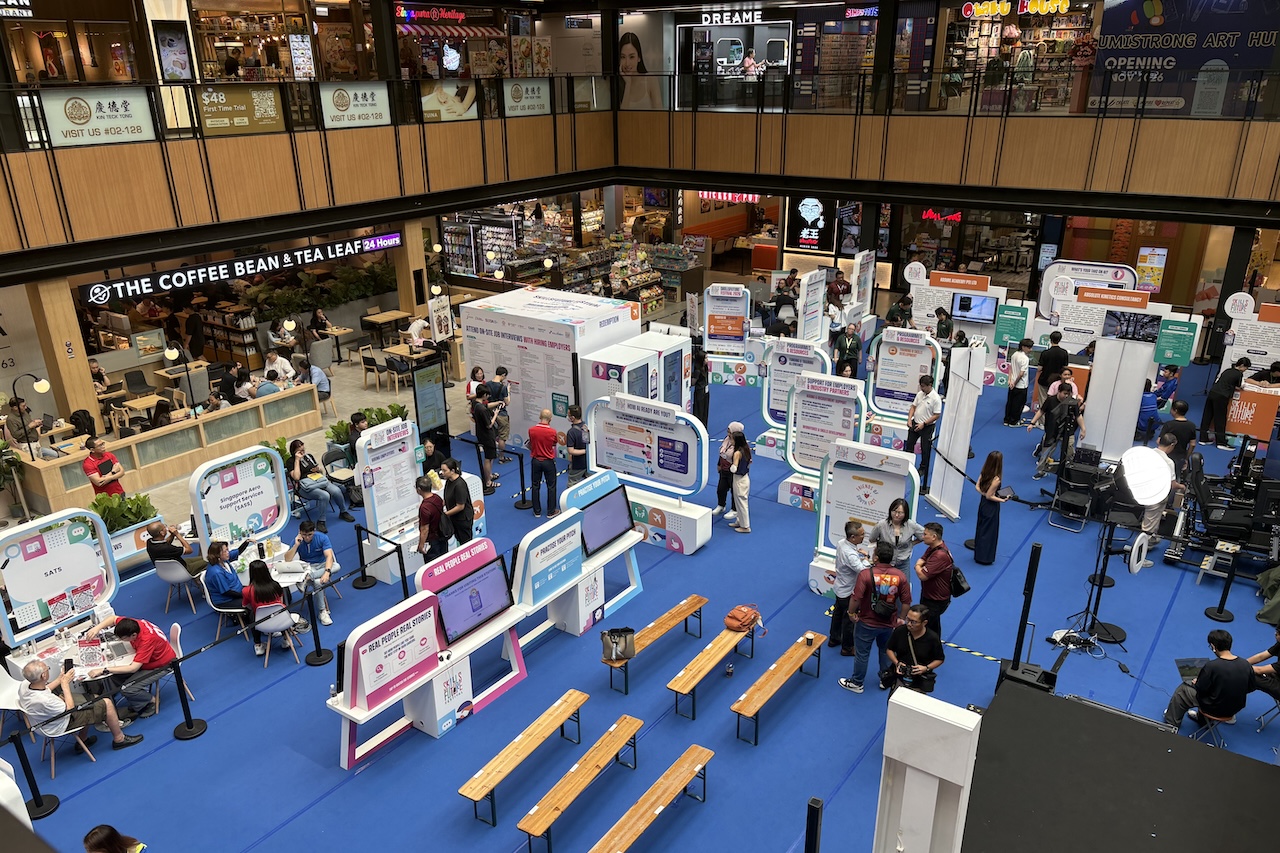
I spend some time circling the booths at a roadshow at SingPost Centre, passing office workers still wearing their lanyards and some senior folks—the usual suspects for the national upskilling push. A man sitting at a nearby Coffee Bean & Tea Leaf outlet on his laptop is prompting Claude to do something for him.
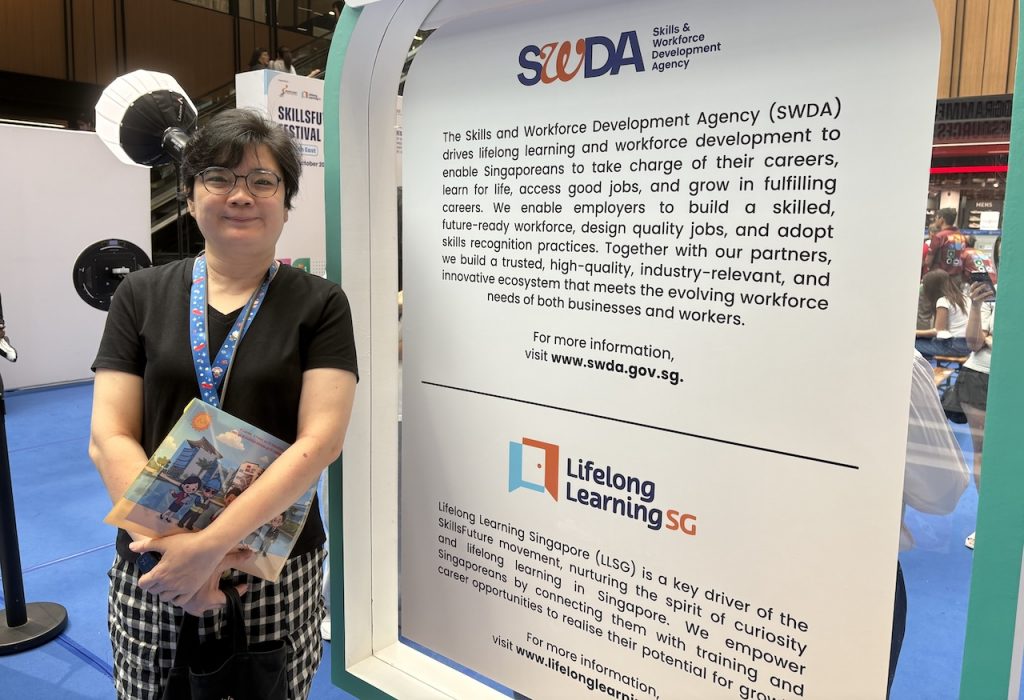
Ginger*, a 54-year-old operations executive, was open to sharing why she was looking to attend an AI course. She was already using AI at work for very specific tasks. Whether an item could be shipped in from the US, for instance, and which part of Singapore’s prohibited list it might fall under.
At home, the people Ginger sometimes turned to for help with AI were her children. They tended to discover new tools before she did.
“They will tell me to use this or use that,” she recalls, her eyes drooping slightly. She sounds a little resigned. “I still have to teach myself lah.”
Singaporeans like Ginger can’t help but feel left behind if they aren’t familiar with AI tools. And who can blame them? Demand for AI-related skills across Singapore more than doubled between 2022 and 2025, according to an analysis by SkillsFuture Singapore.
At the launch of this year’s SkillsFuture Festival, Prime Minister Lawrence Wong said AI would “reshape work across every part of our economy”, changing both jobs and skills. The task, he said, was to ensure Singaporeans were “equipped and ready” for those changes.
But what does readiness actually require? I had no idea. Like any other 17-year-old student, I already use AI for school assignments. Ginger is fluent enough to check prohibited shipping lists.
Neither of us seemed quite sure if we knew enough to stay useful in the decades to come.
Learning It Before You Need It
Harith, 18, a second-year student at Singapore Polytechnic, never went looking for an AI course. He didn’t even know they existed until his father told him about them.
When I ask why he agreed to spend part of his semester break taking one with his father, Harith simply said: “Because why not?”
His father, an electrical engineer, had a more practical answer—he thought AI could automate parts of his work and suggested they learn about it together. Harith, meanwhile, had little planned for his school break. He did, however, have plenty of questions.
Harith already used Claude and ChatGPT to clarify concepts from his course notes and get second opinions. He also had questions he could technically ask his lecturers, but he would rather not.
“I don’t usually consult my school lecturers for help because I will always have a lot of questions to ask regarding the topics covered, and I don’t want to bother them with stupid questions.”
Signing up for an AI course placed Harith somewhere nobody expects an 18-year-old to spend his semester break: sitting beside his father in a classroom full of working adults.
“We had nothing in common. Most of the adults took this course so that they could upskill themselves for work,” he mentions.

By the end of the semester break, he’d completed Effective Prompting Fundamentals, Advanced Prompting Strategies and AI Content Creation for Productivity. The courses took S$4,147.20 from his Post-Secondary Education Account (PSEA), while his father paid the remaining S$339.24 in cash.
Harith actually learnt new things. His prompts became more deliberate, and he got better at catching mistakes in AI’s answers and figuring out what different large language models could do.
But Harith tells me that, three courses in, he still didn’t have much use for the new skills he picked up. At least not yet.
“AI skills are useful, but currently as a student, I don’t feel the need to use them for school. I only use it to assist my learning. If it were for internships, it’d have a huge impact.”
But when I asked what he remembered most from the courses, his answer had little to do with AI.
“What really stayed with me the most is sitting in a classroom, learning about AI with my dad. It was as if my dad and I were students at the same school. It was like we were friends, going through the same struggles while learning about AI.”
No Escape from AI
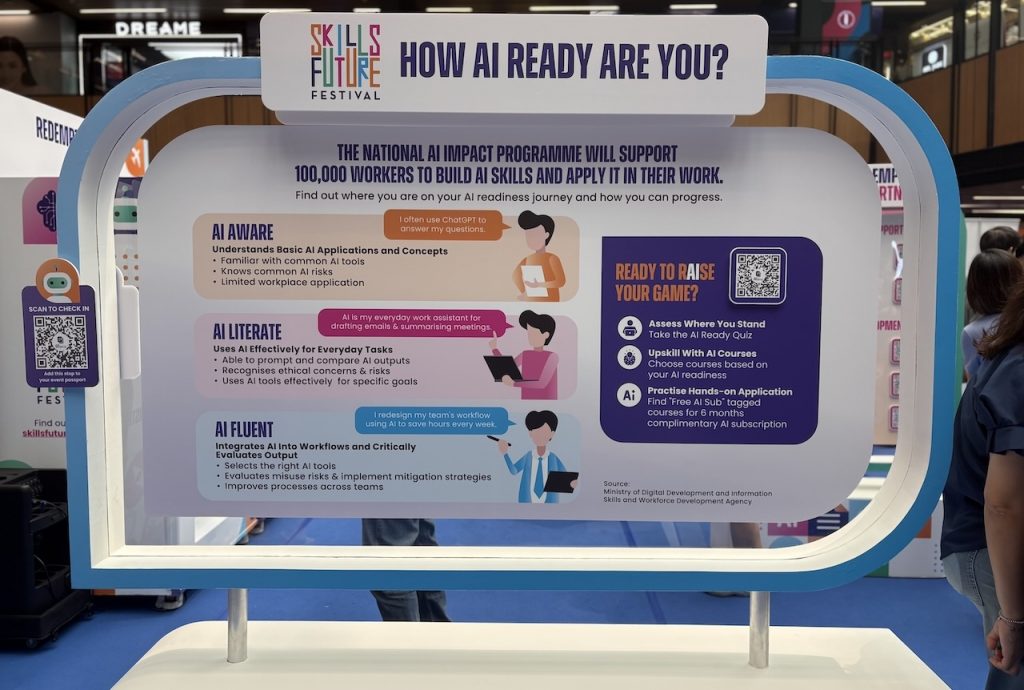
The next day, I’m at a SkillsFuture Festival roadshow at Westgate. One station asked visitors: How AI Ready Are You?
Wen Xuan* spent much of the previous year trying not to use it at all. The 20-year-old NUS law student knew AI could be useful, but had concerns about the environmental and social costs that came with it.
His classmates had fewer reservations. While Wen Xuan worked his way through the readings law school assigned him, he watched his friends feed the same material into AI and crunch it into something quicker to digest.
I can see the appeal. If I faced a reading that was long, technical and boring, I suspected it wouldn’t take much to convince me.
One judgment, Wen Xuan tells me, traces the history of a legal doctrine, how it developed and what it means today. It can practically bore you to death.
Still, he held out, even as he heard from industry professionals adopting it. His school had also started rolling out AI tools and talks, and reworking parts of the curriculum around it.

Then came the first moot he’d prepared for entirely without AI. With classes out of the way, he could throw himself into the problem: barely three pages long, on an unsettled area of law. It somehow consumed nearly every waking hour for two weeks.
“Because it was my first competition, I didn’t know what to expect. I had a routine where I would wake up, work on the problem until one to two hours before bed, and then rest. I repeated that kind of cycle every day for two weeks,” he recalls.
And after all that, Wen Xuan still walked into the competition and discovered issues in the problem he’d overlooked.
He doesn’t blame that on avoiding AI. It was his first moot, and he couldn’t know whether what he missed also came down to inexperience and carelessness. What he could account for was the time spent—a three-page problem swallowed almost two weeks of his summer break.
Once classes resumed, he knew he wouldn’t have two weeks to spend the same way.
“I just thought to myself: ‘Wow, if I do a mooting competition in the school term, there’s no way I can do it without AI.’”

His next moot inevitably landed during the school term. This time, the hours he’d spent so freely over the summer had to compete with lectures and assignments. He tried juggling both. He couldn’t.
“If I don’t use AI here, I will be handicapping myself in many more ways than what I normally think I would be.”
Wen Xuan gave in, eventually. He turned to ChatGPT and Harvey to surface potentially relevant cases and laws and explain the frameworks courts might apply, then went back to the cases themselves and other legal commentary to check its work. Once he had one or two arguments of his own, he turned it against himself.
He had AI chatbots play opposing counsel, throwing arguments back at him so he could work out his rebuttals before someone was actually standing across from him.
One or two of those arguments did come up during the moot, and Wen Xuan was ready for them. Still, he was careful not to give AI too much credit.
“Because I could save that amount of time by crunching that amount of research down, it allowed me to focus on how I wanted to deliver my argument, and what points I really wanted to emphasise,” he tells me.
“I know I personally don’t really like using AI, but if it means that I do need it to remain employable or something like that, then I may as well get good at it.”
New Errors
By the time I reached my third SkillsFuture Festival roadshow at Northpoint City, hardly anyone was there to talk to.
Ahmad*, meanwhile, had mostly learnt to use AI on the job before eventually taking a course on it.
“I confess I use AI. I am complicit,” the 25-year-old quips.
A few months into his job in a communications team, he was tasked to explore building an AI agent for speeches—the same speeches Ahmad had been hired to help write.
It wasn’t always this casual. When generative AI first arrived, Ahmad says some of his colleagues used it “on the down low”—a chatbot open while they worked, then another tab whenever a boss walked past. For writers, being caught with a ChatGPT window on their screen could still look a little too much like being caught cheating.
“I felt like I was digging my own grave. I was like, ‘Is that not my job? Is that not what you hired me for?’” he remarks.
These days, nobody on his team thinks twice about AI tools open across their screens, even for writing. Speeches, media releases and other communications materials all go through it at some point.

Things don’t always go smoothly. When I spoke to Ahmad, he was mulling over a mistake he’d made at work.
He’d used Microsoft Copilot to put together an internal newsletter, feeding it the previous month’s events instead of combing through company folders himself for attendance figures, award recipients and other details. The newsletter went out with duplicate paragraphs he hadn’t caught.
The incident bothered him because it wasn’t an isolated lapse. He’d started catching more mistakes in his own work—errors that he couldn’t simply pin on AI hallucinations.
“I feel like I am becoming less present and less sharp in my work because of all that dependence,” he ponders.
“I feel like with AI, you don’t really use your brain at full capacity. You can afford to shut down half of your brain.”
Ahmad still uses Copilot. But he now writes every email himself—if only to capture his personality and convey some emotional nuance. “Perhaps me being thankful, or wanting to convey a sense of urgency or disappointment.”

Outside of work, Ahmad writes poetry, prose and plays. In the creative writing classes he attends, he says there is no opening of chatbots for research, no asking it to dream up a character, and no feeding it an idea to see what comes back.
At work, the line around AI usage has shifted considerably. Ahmad has crossed it, redrawn it, and occasionally found himself on the wrong side of it. The hard line sits with his plays and skits, where AI doesn’t come into it at all.
What Are We Really Catching Up To?
At the SkillsFuture Festival roadshow at Westgate, I watch older visitors stop at multiple booths to talk to professionals about their careers. At neighbouring booths, some of the professionals were busy networking with one another.
Two volunteers eventually came over to ask what I was doing there. I’m 17, a good decade younger than the roadshow’s intended audience, with a notebook and far too many questions for attendees. Fair enough.
Before I left, I scanned a QR code that took me to a form asking me to pick my first reaction to hearing the words ‘Artificial Intelligence’.
There were four choices: Excited, because AI could make work and life easier; Curious, because I wanted to make better use of it; Unsure, because I was still figuring out what AI meant for me; or Cautious, because I wasn’t sure how it would affect my job.
I picked Cautious. I write for a living, or at least I’m beginning to. I’d like to know what an AI-driven future in Singapore holds for me. Harith, Wen Xuan and Ahmad had all learnt more about AI than I had, and it hadn’t settled much for them.
I’d come to the festival to find out how far behind I was on AI, and what I’d actually need once I started working. Nobody knew, because nobody could say what the future would look like. The advice, more or less, was to learn more about AI just in case. That’s where the money is going, anyway.
For a few years now, the official line is that AI will reshape the economy, so we’d better be ready. AI or die, it feels like. But before I sign up for anything, I’d like to know: ready for what, exactly? And once we are, who really stands to benefit?