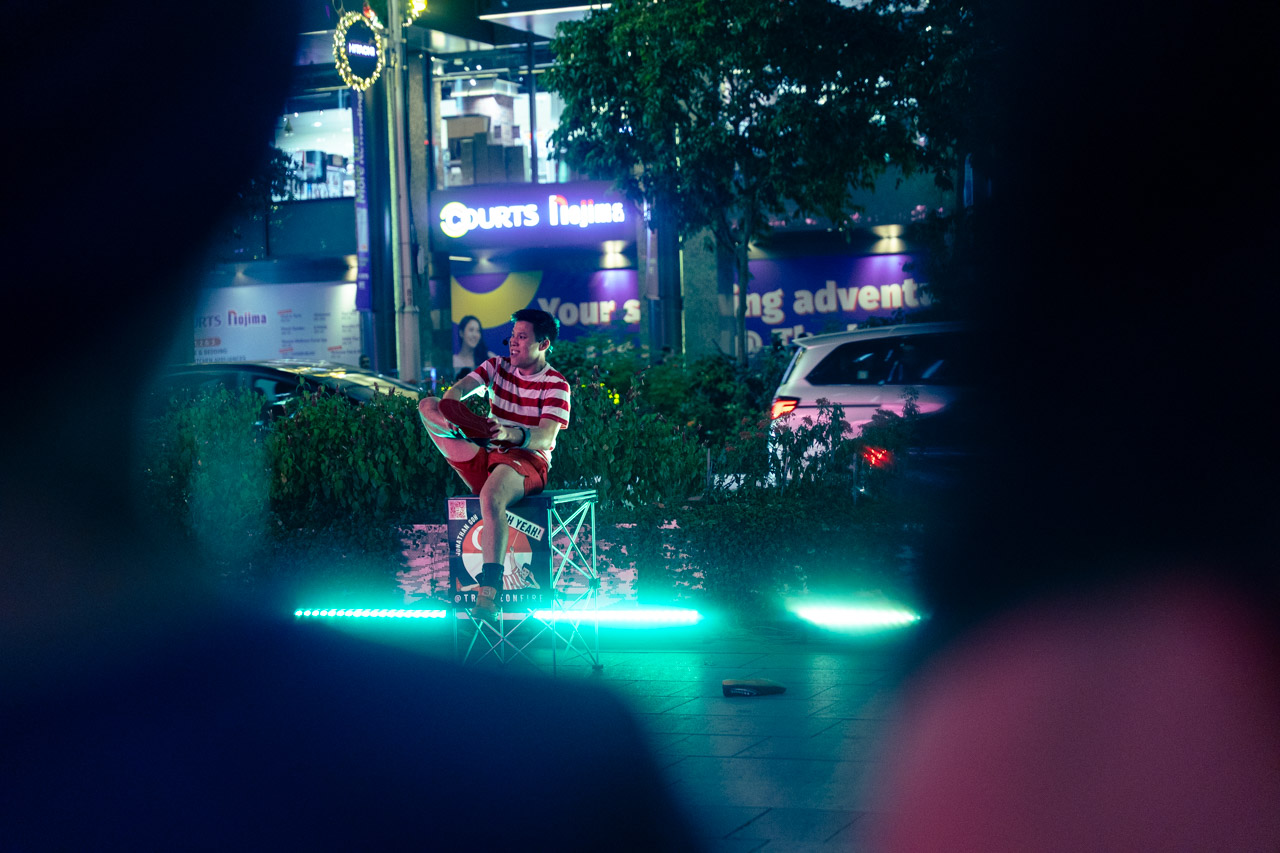
All images by Darren Satria for RICE Media.
The first time Jonathan Goh saw someone playing with fire, he was killing time at Tanjong Beach while waiting for his older sister to finish her shift at a bar.
As night fell, a troupe of fire performers had taken over a corner of the beach, spinning flaming torches in perfect arcs. The rebellious 11-year-old was mesmerised.
Back then, he was attracted to trouble like a magnet. In the wake of his parents’ separation, he fell into some “bad company”, as he describes it. Left to his own devices, he’d hang out with his friends, get into fights, and shoplift. He didn’t know any other way to while the time away. But for the first time, he’d found something else that piqued his interest.
Week after week, Jonathan would go back just to see the fire performers. Eventually, they heard his story from his sister. Finally, they approached him with an offer: “We’ll teach you on one condition. Stop hanging out with bad company.”
Two decades later, the multi-disciplinary circus artist—he’s adept in juggling, diabolo, firespinning, and ladder stunts—has made good on his promise, and then some. He’s made it to Singapore Night Festival, and the Chingay Parade, and was even the first Singaporean act to perform in the Edinburgh Fringe Festival’s street events.
And if you’ve passed by London’s Covent Garden in the last three years, you might have seen the 29-year-old dressed patriotically in red and white stripes, working the crowd with his unapologetic Singaporean accent.
“I can’t fake my accent. It’s who I am,” He laughs.
Jonathan has spent the last few years Bachelor’s Degree in Circus Arts at the National Centre for Circus Arts (National Circus) in London. For now, armed with his degree and a thicker skin thanks to his stints on London’s streets, he’s back in Singapore to keep a promise to the local arts community that turned his life around.
Cirque Du Singapore
Jonathan sheepishly tells me that firespinning wasn’t his first exposure to the performing arts. As a child, he was so hyperactive that his mother had tried to put him in a wushu class. Unfortunately, that did not work out.
“I was a very difficult child. The instructors said I was unteachable,” he says, shaking his head.
When he first accepted the fire dancers’ offer of mentorship, he thought it would be a distraction from trouble. But slowly, it began to give him a sense of purpose. Not only was he finding joy in performing, he also felt an urge to prove the naysayers wrong.
At school, the other kids call him gay simply because he was interested in the performing arts, he recalls. Some of his family members also doubted that he would actually find success in street performances.
“There was a lot of pain going through this journey. The support [from people around me] only came in when I started appearing on the news.”
He describes his gradual realisation that this was his calling: “Performing became an escape, and then a passion of mine. I started to feel like I’m performing. I’m chasing this dream. I’m advocating for this art form.”
The boy who once couldn’t sit still in wushu class slowly began to realise that passion wasn’t enough for him to perfect his art form. It was this desire to improve that eventually led him to pursue a formal education in circus arts.
“What’s a circus arts degree all about?” I ask.
Jonathan smiles patiently, even though I imagine he gets this question all too often from the people he meets. He launches into a well-practised explanation: “It’s 80 percent technical skills, 20 percent academic. We learn the history of performing arts—dance, theatre, movement.”
There’s a difference between traditional circus acts, which are more focused on tricks, and contemporary circus shows, like Cirque du Soleil.
“For contemporary circus, there’s a lot of storytelling, concept, and research. You can’t just juggle five balls and say that’s a story.”

He started out literally playing with fire, learning from the fire dancers at Tanjong Beach. But Jonathan tells me that he’s passionate about furthering both street performances and stage performances in Singapore.
Both hold a special place in his heart for different reasons.
The main reason why he can’t give up street performances is accessibility, he tells me. When he first started getting curious about the performing arts, he didn’t have any money to pay for shows. It was also back in the days when YouTube videos were “like three pixels”.
“All I had were free events that I could find online, but there were quality issues. It made me feel a certain way,” he reflects. “Why is it always people like me who cannot watch quality arts?”

Busking, to him, is the most democratic art form, both for the audience and the performer. “Even if you’re in a wheelchair, even if you’re blind, even if you can’t speak—you still can do busking.”
Even though he’s made a name for himself, he’s never too good for the street, he tells me. In fact, he’s committed to making sure that people who can’t afford tickets can still enjoy a quality act.
Beyond the streets, Jonathan’s also got big dreams of putting Singapore’s circus scene on the map.
“I don’t want it to just be my name in lights. I want more people to flourish. I want our works to be recognised at festivals worldwide,” he tells me, full of determination.
The idea of a “Singaporean circus” still sounds fuzzy at this point in time. In fact, Jonathan tells me that many of the locals he encounters still think only of clowns when they hear the word ‘circus’. Eventually, Jonathan says the goal is to have a solid Singapore circus identity—something people around the world could recognise instantly.
“You know how some shows sound Japanese or Indonesian, just from their music? I want people to see a show and go, ‘Oh, that’s a Singaporean show.’”
“People say our only defining trait is expensive housing,” he chuckles. “But there is so much more. Singaporean childhood games. Cultural quirks. Our accents. All these cultural codes that make us Singaporean… I want to draw from them to tell our stories.”
Can Street Performers Survive in Singapore?
Over the years, Jonathan has become one of busking’s biggest advocates here in Singapore.
When the Covid pandemic halted street performances, Jonathan found himself turning to food delivery work to survive.
“Covid was a time where I reflected. I asked myself, what can I do?” He channelled that urgency into co-founding the Buskers Association of Singapore, a bridge between buskers and the National Arts Council (NAC). “We started it for the buskers, by the buskers, to make busking better.”
Ask Jonathan whether busking has a future in Singapore, and he doesn’t hesitate. Performing overseas—especially in London’s legendary Covent Garden—only affirmed his confidence in his career path.
“Covent Garden is the Mecca for street performing… you really need to be at the top of your game to build a big crowd.” Out there, he discovered that leaning into his unapologetically Singaporean identity made him stand out.
“My accent, the red and white costume, the jokes. I lean into it. You would think it’s Singaporeans who come up to me, but it’s also Malaysians, Indonesian, Thai. Even Chinese, Korean. They’re very happy to see an Asian person and are so proud of me.”
Some Singaporean tourists even showed their support by slipping him S$50 notes; in about two months, he collected more than S$700 on top of his earnings in pounds.
This, to Jonathan, dismantles the stereotype that Singaporeans don’t support the arts. He also points to the money he makes from busking and the regulars who show up whenever he performs back home.

“I always feel that we shoot down Singaporeans for not supporting the arts, but I feel that it’s because of this shooting down that even more people don’t support the arts. Singaporeans do support,” he says passionately. “We’re complaining too much. The message should be more positive. Like, ‘Come and watch this. Come and watch that.’”
While he acknowledges that busking is a livelihood with ups and downs, it’s all a matter of planning ahead, he says. After all, a corporate job isn’t always an iron rice bowl either.
“Maybe in December I can make, like, $20,000 over the holiday period. But in the next few months, I might make close to $900, $500. It’s just about making sure you spread your $20,000 over the months.” He’s wary when we talk about money, and is careful to offer the caveat that every street performer has different circumstances.
Despite the persistent public perception that street performing is an unstable field, however, Jonathan still sees the local scene expanding.
Last December, NAC added 17 new busking spots to support street performers. The statutory board has also introduced a pilot programme to allow buskers to collaborate with each other.
“The busking scene used to be mainly retirees. But these days, I see so many people of different ages. And there are lawyers, bankers, teachers—all kinds of people.”
Planting The Forest
Jonathan tells me that he finds inspiration in stories like that of Megan Lau, a National University of Singapore graduate who’s now an aerial performer in Macau. But he also wants to create an environment where intrepid performers can flourish in Singapore, too.

He now mentors about 15 young performers through circus labs, where he runs workshops on storytelling, feedback, and presence.
A defining moment for him was back in 2014, when he formed a duo act with Edwin Ong, The Annoying Brothers. They had planned out their first 30-minute show and lugged their props all the way to Takashimaya for their first busking session.
“Five minutes into the show, people started walking away,” Jonathan remembers. Then it started to drizzle. “We were so broken.”
But instead of giving up, they regrouped. They weren’t ready for a 30-minute set, Jonathan quickly realised. They returned the next week, and the next, slowly improving on their act. Crowds started forming. Festivals began to invite them. Eventually, they even made it to Asia’s Got Talent in 2017.
Jonathan had to learn everything the hard way—through failing. But he says he’s now trying to impart all of his hard-won lessons to Singapore’s young budding performers.
His biggest hope is simple: that what he builds today will outgrow him.
“You just keep planting the seed,” he says. “Hopefully, something will grow. And one day, there’ll be a forest.”