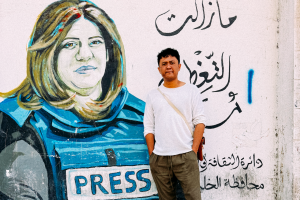
Noor Huda Ismail is a Visiting Fellow at NTU’s S. Rajaratnam School of International Studies (RSIS) and a strategic communication consultant for Southeast Asia with the United Nations Office on Drugs and Crime (UNODC). He also runs the award-winning interactive community website, ruangobrol.id.
In this op-ed, published in RSIS Commentary and republished on RICE, he argues that policymakers, educators, and communities need to start reckoning with a modern radicalisation process now scattered across social media, gaming chats, encrypted messaging apps, and algorithm-fed feeds.
Top image: Stephanie Lee / RICE file photo
The case of 19-year-old Cyrus Dzulqarnain Al-Shahriar, who was issued a Restriction Order under Singapore’s Internal Security Act (ISA), illustrates how radicalisation is evolving in the digital age.
According to Singapore’s Internal Security Department (ISD), Cyrus was influenced by a mix of pro-Hamas narratives, anti-Western views, anti-LGBTQ sentiments, violent incel ideas, and Islamist accelerationist content. Rather than adhering to a single ideology, he constructed a personalised worldview from multiple, sometimes contradictory, sources.
This phenomenon is known as Composite Violent Extremism (CoVE). Unlike traditional extremism, which is typically associated with a single ideology or organisation, CoVE combines different extremist narratives into a worldview that ultimately justifies violence.
While Cyrus represents Singapore’s second known CoVE case, the broader significance lies not in whether CoVE is entirely new, but in what it reveals about the increasing online radicalisation of young people.
For many years, counter-terrorism efforts viewed radicalisation through the lens of clear ideological categories. Individuals were often linked to organisations such as Al-Qaeda, ISIS, or far-right groups. Radicalisation was understood as a relatively linear process: exposure to an ideology, commitment to it, connection with a network, and, eventually, movement towards violence.
Today, this model is becoming less relevant. Young people are immersed in digital environments where social media, online forums, gaming communities, encrypted messaging platforms, and recommendation algorithms simultaneously expose them to countless narratives.

Instead of adopting a single ideology, they often select ideas from different sources and combine them into worldviews shaped by their personal experiences, frustrations, and grievances. As a result, individuals may consume extremist religious content, conspiracy theories, misogynistic narratives, and anti-establishment messages without perceiving any contradiction.
Although CoVE has gained attention as a new concept, scholars caution against treating it as an entirely new phenomenon. Terrorism researchers John Horgan and Kurt Shayler argue that extremists have long borrowed ideas, symbols, and grievances from different ideological traditions. The crucial difference today is the digital environment, which makes ideological mixing easier, faster, and more accessible.
The internet has weakened the barriers that once separated ideological communities. Individuals can move rapidly between online spaces, consuming content from multiple extremist ecosystems without joining any formal organisation. This has led to a more fluid and personalised process of radicalisation.
The Cyrus case also highlights that radicalisation is often driven less by ideology than by identity. Many young people are not actively searching for extremist beliefs; instead, they seek meaning, belonging, recognition, and purpose.
My documentary film, Jihad Selfie, which explored the journeys of Indonesian foreign fighters and their families, found that many were initially motivated by a desire for significance, adventure, identity, and community rather than by sophisticated ideological arguments. Ideology often served as a framework through which these emotional needs were expressed rather than their original source.
This pattern remains highly relevant today. Young people experiencing loneliness, uncertainty, frustration, or a lack of belonging may be vulnerable to online narratives that offer simple explanations for complex problems. These narratives identify enemies, provide certainty, and create a sense of purpose.
In this sense, CoVE reflects identity formation in a fragmented digital environment as much as ideological commitment.
Another emerging trend, as terrorism scholars Thomas Renard and Colin Clarke describe it, is ‘fast-food terrorism‘. Contemporary radicalisation is becoming faster, more accessible, and increasingly driven by emotion rather than prolonged ideological indoctrination. Whereas extremist organisations once required lengthy recruitment and socialisation, individuals can now independently access vast amounts of extremist content through digital platforms.
Many contemporary extremists are attracted less by coherent doctrines than by the emotional appeal of extremist narratives. Feelings of anger, resentment, victimhood, humiliation, status, or belonging often outweigh a detailed understanding of ideology. This helps explain why contradictory beliefs can coexist within the same individual.
Different narratives identify different enemies, but they often appeal to similar emotions of grievance and alienation. Violence, then, becomes attractive because it promises empowerment, recognition, or meaning.

Young people are particularly vulnerable to these dynamics because adolescence and early adulthood are periods of identity formation.
During this stage, individuals naturally seek belonging, recognition, and purpose, much of which now happens online. Algorithms designed to maximise user engagement often recommend increasingly niche and emotionally charged content. At the same time, private online communities and encrypted messaging platforms provide social validation and reinforce increasingly extreme views away from public scrutiny.
Importantly, radicalisation often begins with ordinary personal vulnerabilities rather than extremist beliefs. Loneliness, identity confusion, social isolation, disappointment, or outrage at global events can create opportunities for extremist narratives to resonate. The issue, therefore, is not simply what young people believe but how those beliefs interact with their vulnerabilities and digital environments.
Although the Internet has become the primary arena for radicalisation, families remain one of the strongest protective factors. Parents cannot and should not monitor every online interaction, but they are often the first to notice behavioural changes, such as secrecy, social withdrawal, emotional distress, or unhealthy online obsessions. Many successful interventions begin when a parent, sibling, teacher, or friend recognises these warning signs and seeks help early.

Open communication within families is therefore essential. Discussions about identity, religion, politics, global conflicts, and online experiences should take place without fear or stigma. Early reporting should not be seen as punishment but as an act of care that enables timely support before vulnerable individuals move closer to violence.
Looking ahead, radicalisation is unlikely to be defined by loyalty to a single ideology. Instead, it will increasingly involve personalised combinations of narratives assembled within digital ecosystems. CoVE offers a valuable framework for understanding this evolution, and its broader lesson is that radicalisation is becoming more personalised, more emotionally driven, and more deeply embedded in online life.
My work on Jihad Selfie and Ruangobrol.id suggests that although technologies and ideologies evolve, the underlying motivations remain remarkably consistent. People continue to seek identity, belonging, recognition, and purpose.
For policymakers, educators, and communities, the challenge is not merely identifying extremist ideologies. It involves understanding how digital environments shape identity, grievance, and vulnerability among young people.
In the age of CoVE and fast-food terrorism, the most important question may no longer be what young people believe, but why violence has become meaningful to them.