Imran Johri is a marketing strategist, an editorial veteran, and a father of three. He also grew up under the stereotypical expectation that he’d be good at football because of his ethnicity—a promise the universe never delivered on.
In this op-ed for RICE, he reflects on going through another World Cup, performing the part of a seasoned Malay football unc.
Top image: Arun Sharma / Unsplash
“France looks strong. It’s their year.”
This was my best, uneducated guess when I was asked about the World Cup a month ago by the number-one football fan at the office. On any other given day, if anyone asks me about football, my unadulterated answer would be, “Meh, not a fan”.
But every four years, I adopt a more performative reaction.
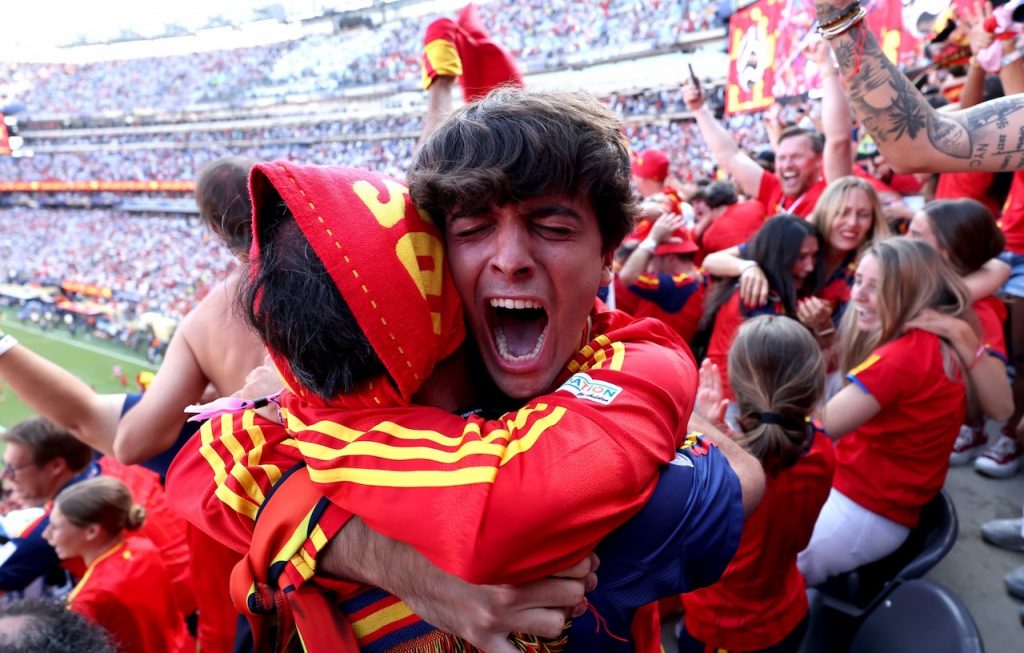
Why? Because everyone is excited. It is, literally, the world’s game. A planet-wide ritual where men lose sleep and scream at screens. Suddenly, everyone’s an expert in pressing formations, national character, and hamstring recovery timelines. It’s a game that has spawned a fandom that rivals even the most fervent patriotism.
Plus, I don’t want to be that unenthused, downer Malay Uncle whose apathetic response sucks the life out of that one fun office activity.
So yes, with a big, confident smirk, I give my thoroughly unqualified two cents: France will win (spoiler: they don’t). I even partake in the Google Sheet polls, complete with emoji reactions on the official Slack channel when the points are tallied after every match.
The best thing about my prediction was that when France got knocked out, all I had to do was release a vaguely Parisian “pfft” of disappointment. It is then automatically assumed I understand both football and the French.
Look, I’m not proud of this ok? But these theatrics were honed from years of pent-up expectations.
Just because I’m the only Malay guy in a room full of football fans doesn’t mean I should automatically be the authority and the guy to Maradona all the way past the goalie.
Not pointing any fingers here. But, THANKS, Fandi.
The World’s Greatest Game
I keep up this mildly excited football face for about a month. I display mellow hurt when France plays underwhelmingly and feign moderate joy when Mbappé displays brilliance.
It took a while to perfect this. Major tweaks were made in my early 20s, when I first started work. Back then, naive me thought I could simply dismiss office football chatter with indifference—only to be accused of being “lame” or “unsporting”. Most ironically, “action bedek”, as if I were secretly pretending to have football knowledge and withholding it from the people.
It was baffling.
This is where social media has been tremendously helpful in keeping me updated, even though I’ve never bothered to sacrifice sleep for the matches. This year, in particular, the constant, aggressive feeds of Haaland memes and GOAT-comparison tributes between Ronaldo and Messi have been on full blast.
This keeps me caught up with the highlights, the goals—all the best plays. In all my years of faking it till you make it, it’s easier than ever to be a World Cup fraud.
I must admit, this theatre of enthusiasm that I display is not entirely fake. The ancillary political shenanigans emerging from this year’s World Cup are truly a joy to observe. From the revelation of which national fans are the most racist, to the mostly baffled, uninitiated hosts discovering that football is a bigger sport than they thought it was. I especially love the football-in-mouth opinions of purported experts who end up drowning in their own sea of bad predictions.
The absolute circus surrounding the World Cup genuinely makes me smile. None of that changes the fact that come kickoff, everyone gets pulled in anyway.
The few times I’ve had the chance to watch a live televised match, especially with close friends, have been truly emotional. I couldn’t have cared less if one country had beaten the other; I was simply happy and in awe of the sheer spectrum of emotions on display. I could not help but be vicariously emoted.
Beyond the World Cup, though, I mostly get away with my indifference to this almost-religious sporting activity, especially at my age. Let’s be honest, no one is going to question a 52-year-old Malay uncle on his sports-viewing habits—and this Unc is clearly past his football prime.
But growing up, this was a real pain in the pelvis.
Confessions of a Kaki Bangku
Lineage-wise, my dad (if the accounts of his youth are not entirely embellished) played football during national service, making him a former Singapore Armed Forces player. There is some photographic evidence of him on a field in what looks like a green jersey, and the fact that he casually drops “I wasn’t in any unit” comments, making his claims reasonably legit. So yes, my dad can play.
It was my elder brother who inherited The Touch from my dad. For as long as I can remember, he has played and obsessed over the beautiful game. He’s a lifelong Liverpool fan, whose club shrine is, to me, the most jarring element in his home. The man has even passed (or force-fed, I’m not sure) this cultish devotion to his eldest son.
I, however, was labelled ‘kaki bangku’ as soon as I could walk.
This was not some casual, throwaway childhood insult. To call a Malay boy ‘kaki bangku’ (literally, ‘stool legs’) is to suggest a near-mythological failure of ethnic promise. Without leaning too hard into other cultural stereotypes, it’s like calling a cheetah slow or an elephant forgetful.
Right off the bat, my father’s expert gaze ascertained that my gait was off and was not built for any manner of footballing. My feet pointed outwards too much, making my early steps a waddle, hence the moniker. Horrifically, the Malay kids in school also picked up on this. And I honestly believe that a kaki-bangku-radar is an actual thing.
It also didn’t help that I was built rather… unathletically. I was a pale, waif-like child, with oversized Steve Urkel-era glasses who was always seen reading Dark Forces books. Which immediately made me the butt of jokes and snide remarks from my brother’s circle of football fanboys.
Even geography was against me. Growing up in Jurong West, among a larger community of Malay Singaporeans, made certain that there was a substantial footballing fraternity in my neighbourhood. Now I’m not saying the CMIO levelling out of races in HDB estates didn’t work, but I was surrounded by a legion of brown bola fans.
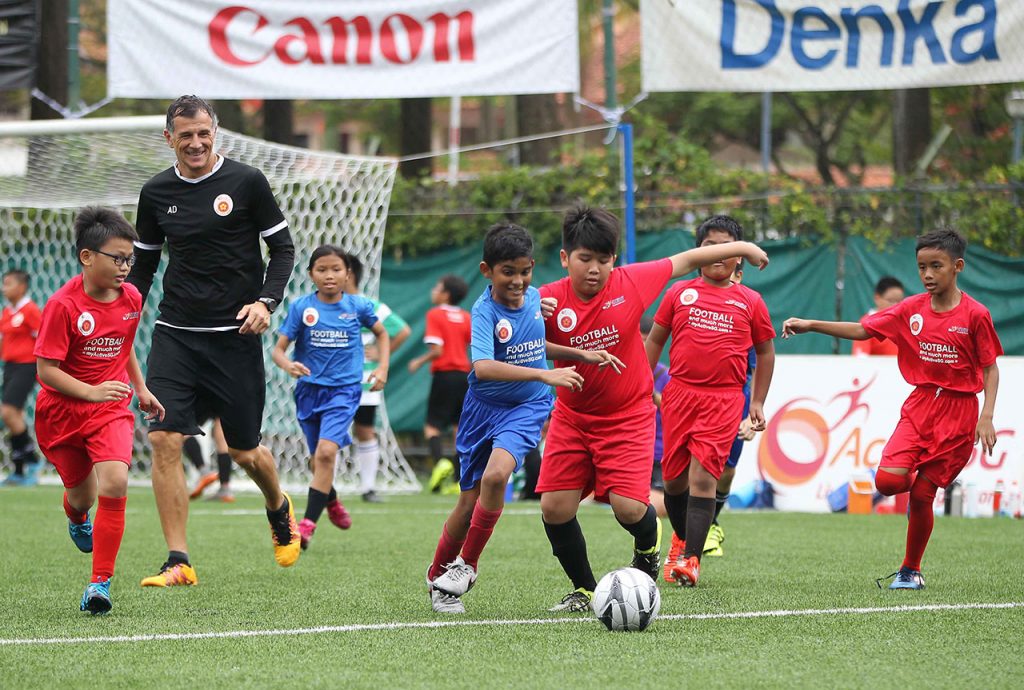
Maybe it was just the overwhelming peer pressure of it all. I mean, my bookish self had few friends compared to my brother’s full-on football ‘hood club. And by a few friends, I mean having none in my immediate neighbourhood.
So not only did I not play with these guys on evenings after school in the open field outside our flat (nor did I partake in the void deck games when it rained)—and this is most damning—I didn’t even watch the EPL matches with them.
He Who Watches the Watchers
For context, our humble HDB flat was the screening hub for football matches. My father, who believed that a man’s worth is tied to the size of his television, was an early adopter of the projection TV. This behemoth in our living room served as a rallying beacon to the horde that was my brother’s friends.
EPL seasons were especially trying for me back then. Swarms of older teens would descend upon our home, ready for rambunctious late-night jeers, cheers and adrenaline.

I mostly steered clear of this spectacle, conscious of my incongruity with this cohort of hyped-up men-boys. And when I did have to pass by them to make a toilet run, or to find nourishment from our fridge, I could almost always hear the judgement.
“Adik kau tak tengok bola eh?” (“Your brother doesn’t watch football?”)
“Dia tak main bola lah!” (“Oh, he doesn’t play football lah!”)
“Dia bapuk eh?” (“Is he a fairy?”)
By the time I got to secondary school, the football expectations ramped up exponentially. Landing in a school that only had a handful of Malay kids, the pressure (and typecast) was on.
The worst part was not being bad at football—lots of children are bad at it. The worst part was being selected as if I came with some ancestral warranty.
When teams were picked from a mostly Chinese line-up, my Malayness often did the trial for me. I would be chosen early, with the undisputed confidence of boys who believed they had just secured a midfield asset.
When the ball would arrive at my feet, the myth would collapse. “What the fuck was that?” they’d exclaim in disbelief.
It did hurt initially to be deemed an ethnic washout—it was the quiet disappointment, the look in their eyes, that got to me.

But by then, with puberty, I had started to develop my own nuanced interests. I was still locked onto horror literature, and very much into horror films, alongside an unhealthy obsession with lycanthropy, mysticism and of course, professional wrestling.
The football picks began to lay off as soon as I started doing my Macho Man Randy Savage monologues unrequested and dropped flying elbows from the top of a two-stacked table.
Also, I made the next-best school-sport move: I joined another team of mostly brown kids and became the goalkeeper for the school hockey team. As it turned out, I had a penchant for stopping fast-moving projectiles (and slightly more dangerous hard leather balls) that flew my way.
In a way, I had to work hard to carve this weird identity mash-up, born from misexpectations. But despite this, when anyone, at any time, picked me for a game, I still stepped up.
Yes, I’d be terrible at it, but no one can say I didn’t try my darndest when I was tasked with taking on a football position. And damn it—it seems this extends to every World Cup fake-out as well.
Same-same but Different
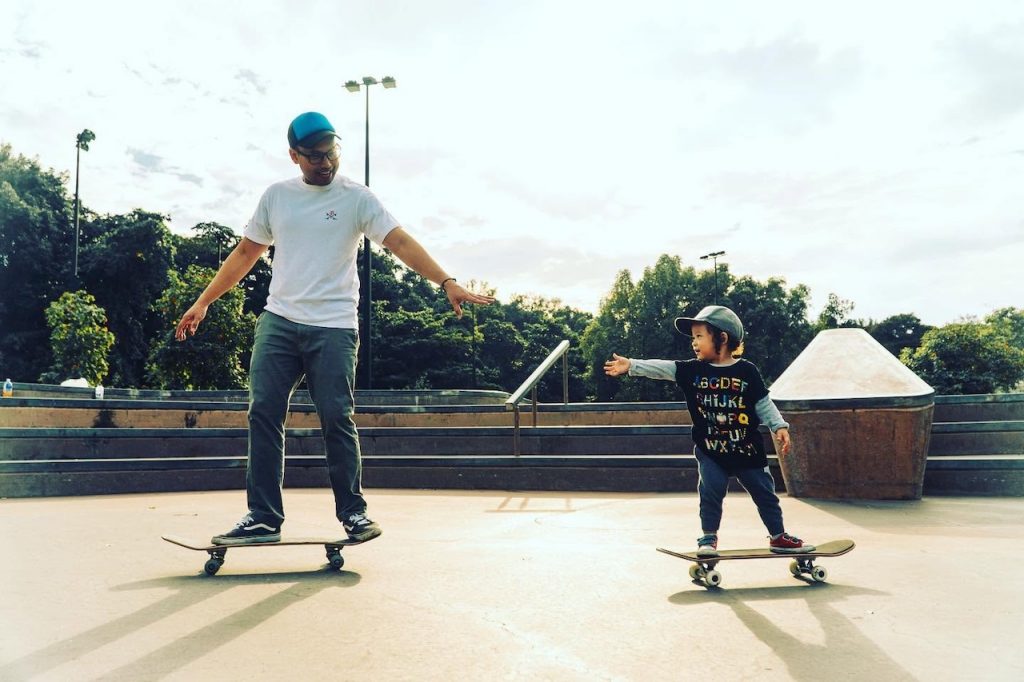
It has come full circle. My son, who’s now 11, has inherited my disinterest in football.
He, however, gets away with it. Being half-Chinese, he gets a racial discount: the Malay kids almost expect him to be only half as good at football.
So it appears the lineage has stayed its course, perhaps diluted by diversity, but not derailed altogether.
Still, I catch myself watching him in the same unfair way I was once watched. Not for football, thankfully. But for signs of whether the world will misread him before he gets a chance to properly introduce himself.
To be clear, I am neither pleased nor disappointed by this outcome. Although if it were my brother’s son who missed the football gene, I’m sure an urgent family tribunal would have been convened.
In actuality, I am infinitely grateful. What my son did inherit was my love for skateboarding and martial arts. We both skate, we both practice kicking moving objects, and we both already have scars associated with both practices. From broken bones to teeth that have been kicked out, we’re both about taking hits and stopping them when we can.
So when the next World Cup season comes around, and the office Slack channel starts combusting again, I will probably still feign just enough enthusiasm to remain socially functional.
But I won’t mistake the performance for belonging.
Football is a beautiful game. It just isn’t my inherited faith. And if my son grows up never knowing the difference between a false nine and a parking fine, I will consider that not a failure of culture, but a small family liberation.
Also, for the record, I’m technically Javanese.