This story was brought to you by the Land Transport Authority.
All images by Zachary Tang and Jack Soh for RICE Media.
Boy, was it rough living in Woodlands in the pre-Thomson-East Coast Line era. If you were, like me, a car-less, motorbike-less teenager working in the CBD in those distant years, you just had to accept that two hours of your day would be buggered on a dreary train commute.
When trips to and fro the city felt like ten-year odysseys (three of them stuck on the stretch between Khatib and Yio Chu Kang), you tend to pick up some things to make the daily expeditions bearable. You learn to maximise your voyage.
You learn to make space in your Crumpler sling bag for a rotating roster of books borrowed from the library—one of the first ones I finished while commuting was, funnily enough, Trainspotting. You learn to install emulators and Game Boy ROMs on your phone and beat Dracula in Castlevania on the way to work. You learn to really listen to music and appreciate albums in their totality on your dinky 1GB Creative MP3 player.
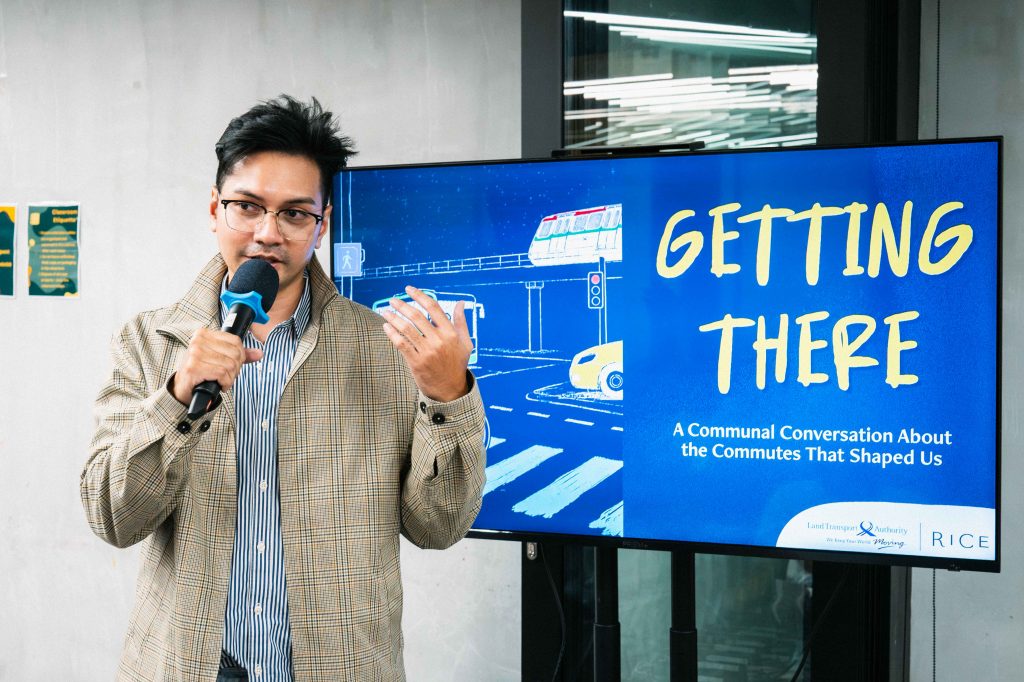
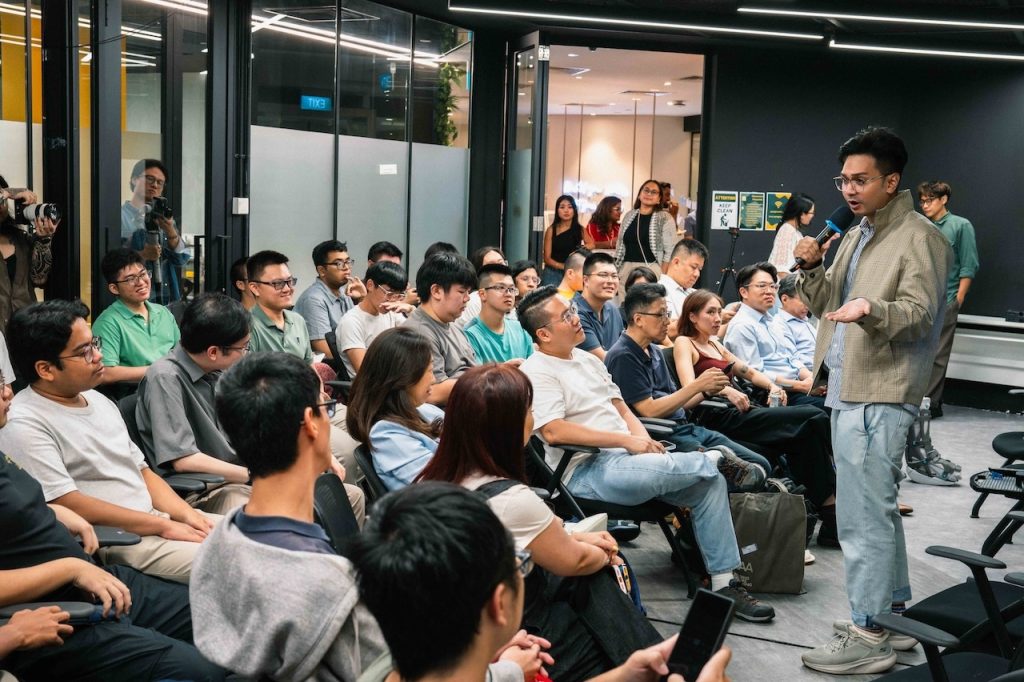
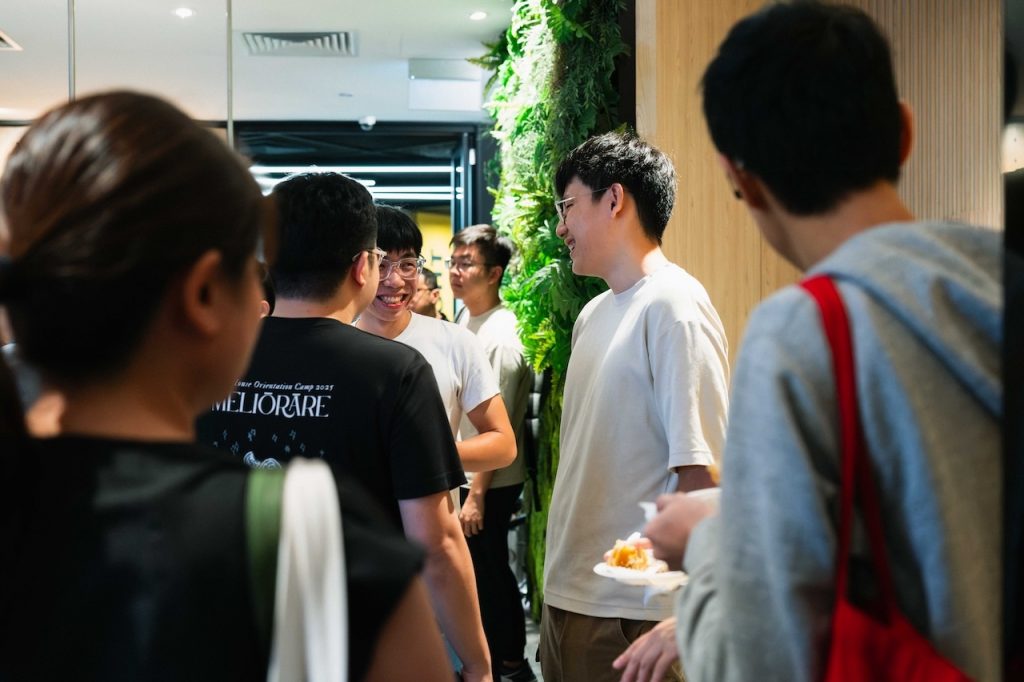
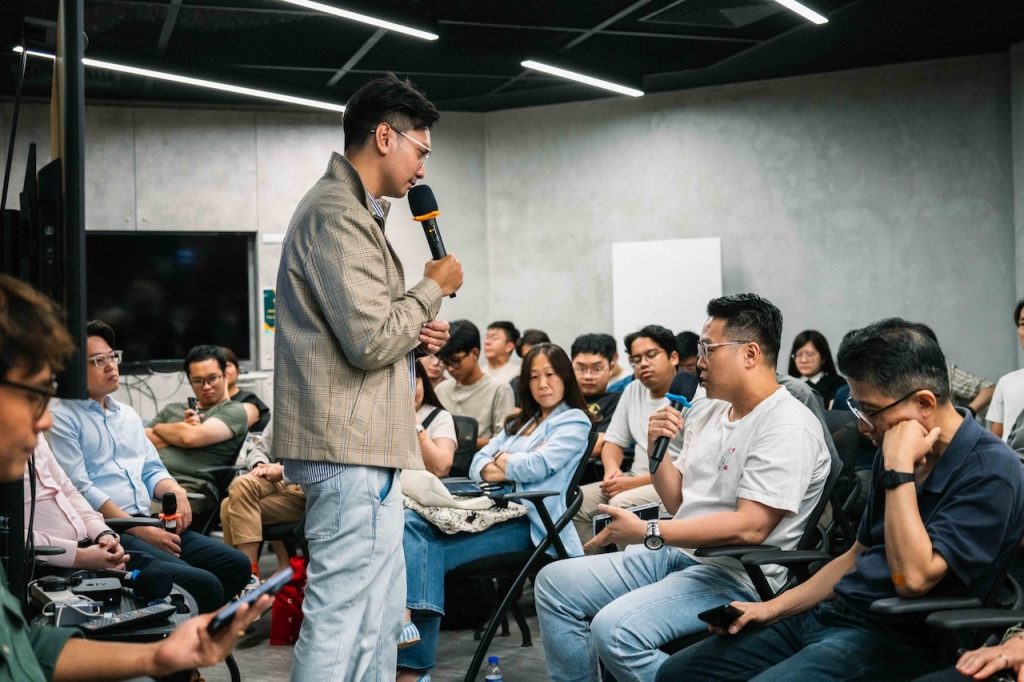
Those memories came to mind at ‘Getting There’—a RICE community event held in conjunction with the Land Transport Authority (LTA) on July 31—when a young attendee posed a question about commuting durations.
The attendee, a university student, picked up on a statement I made earlier that night: how we Singaporeans virtually spend half our lives on public transport. He was genuinely curious about what it would take for him to not feel so exhausted getting to school—the distant, remote province that is Pulau NTU.
It was a measured query. Underneath it, though, was a question that’s been sitting under every quibble about commuting: when do we actually get to shorten the distance between where we are and where we need to be?
Redefining the Way We Move
There are no easy answers, and no overnight solutions, but there will always be (master) plans for improvement. Such is the Singapore way.
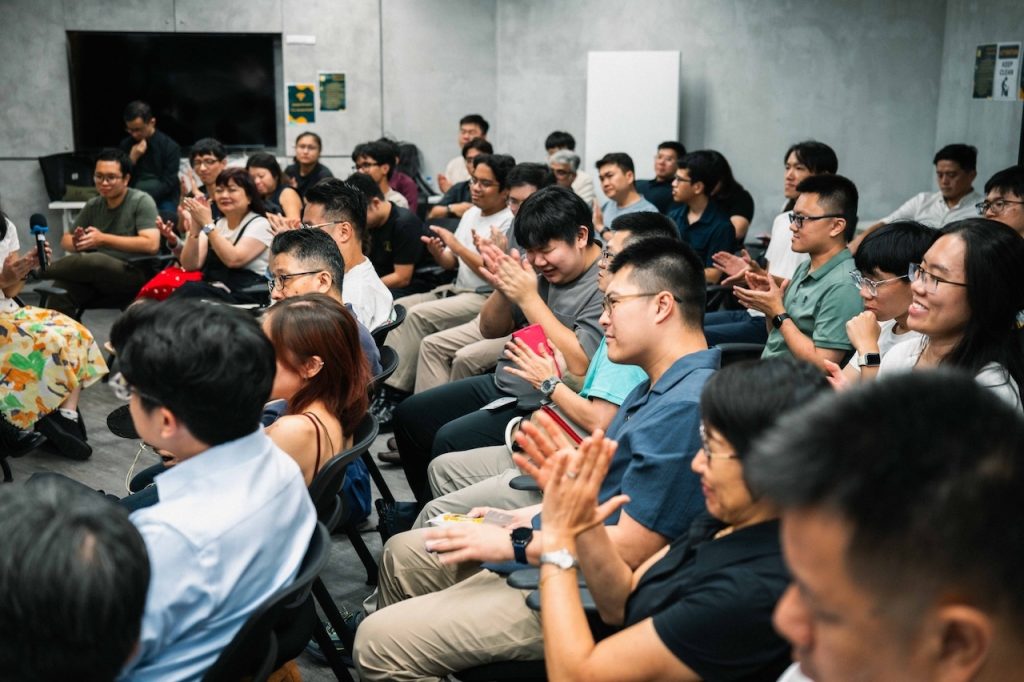
The Land Transport Master Plan 2040—and LTA’s endeavour to refresh it alongside everyday Singaporeans—was the impetus for the community gathering, a sold-out affair filled with curious members of the public and public transport enthusiasts alike. All had vociferous questions about what it would take to make our commuting experiences more comfortable.

LTA has designs to address that: the 45-Minute City with 20-Minute Towns. It means nine in ten of us should reach anywhere on the island within 45 minutes during peak hour, and the nearest neighbourhood centre within 20.
The unglamorous mechanics involve expanding the rail network and speeding up buses. Then there’s the garnish: more cycling paths and wider footpaths. And of course, more sheltered walkways.
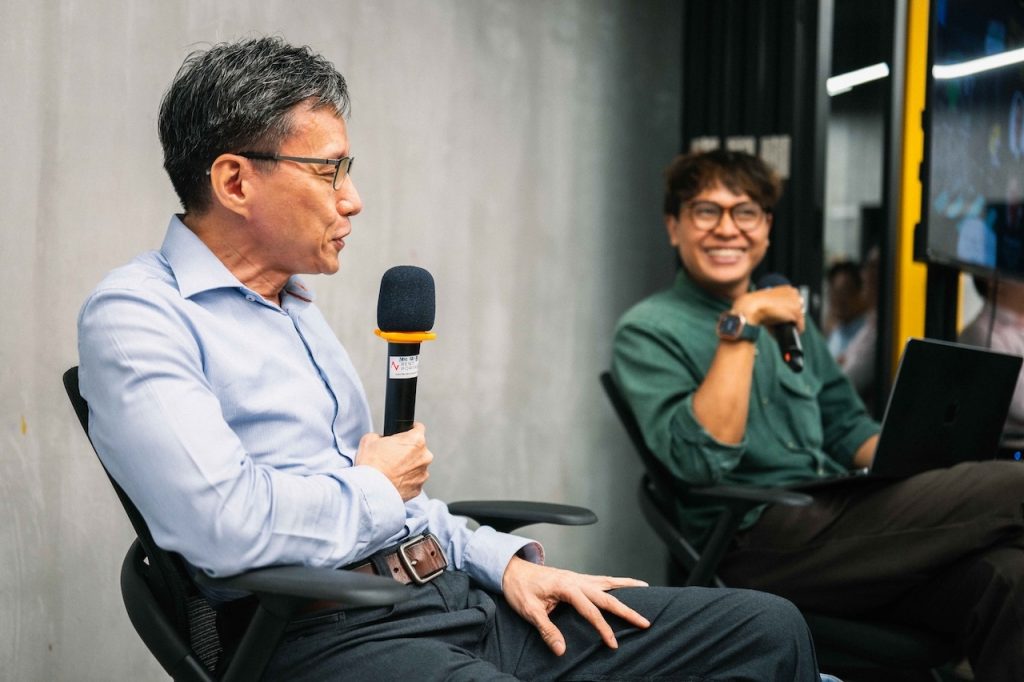
Jobs, too, are meant to move closer to where people actually live, negating the need for long daily commutes. Dr Yap Fook Fah, Associate Professor at NTU’s School of Mechanical and Aerospace Engineering, points out that the very landscape of where we work is changing. Offices are no longer constrained to the city centre, and Singapore’s version of that idea has three decades of precedent behind it.
It was the 1991 Concept Plan that first floated decentralisation: spreading jobs and amenities out to regional centres instead of stacking everything downtown. What’s different now is the scale of what’s actually in those centres.
Jurong Lake District, slated for roughly 100,000 new jobs and 20,000 new homes by 2040 to 2050, is pitched as a second CBD. Punggol Digital District, already branded as Singapore’s Silicon Valley, is expected to bring 28,000 jobs to a part of the island previously known mostly for BTO flats and newly married couples. Woodlands Regional Centre (my own former commuting haunt) is getting about 100 hectares of new developable land, timed to open alongside the RTS Link to Johor Bahru.
“But then the question is: Why refresh the plan if there’s still so much to be done?” Lim Zhi Jian, LTA’s Chief Operating Officer and Deputy CEO (Public Transport, Policy, and Planning), put forth.
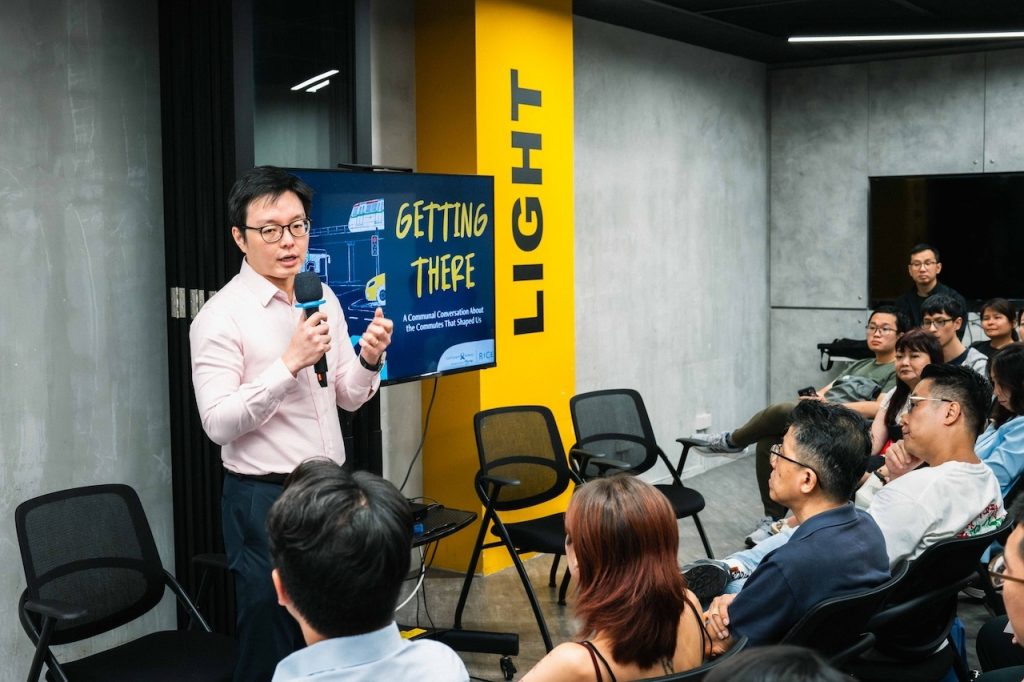
He walked through three shifts LTA has been watching closely. Climate change is the most familiar and the least new; Singapore’s been talking about rising sea levels for years. The second, an ageing population, isn’t new either, but it’s pushing LTA to build an inclusive, accessible network around the users who need it most.
The third is technology: “We’re in the midst of what I’d call a century event—the arrival of autonomous vehicles. The last transformation on this scale was the shift from horse carriages to automobiles.”
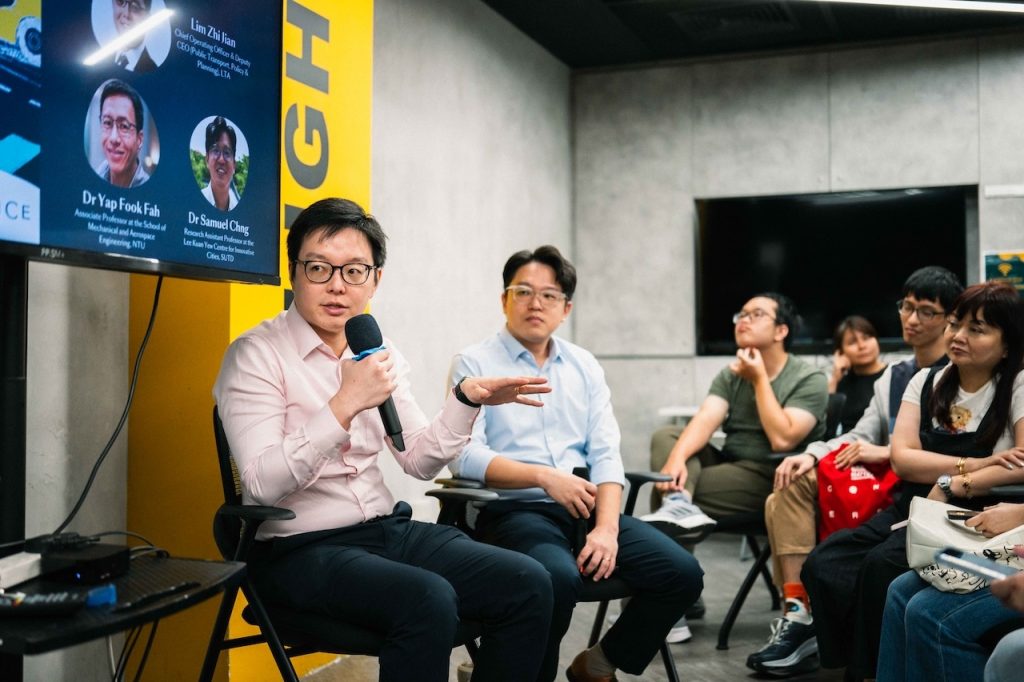
It’ll be years before we all have driverless cars. Improving infrastructure similarly takes time—and the student worrying about commute times will likely only start seeing them in action after he graduates.
Change arrives eventually, but almost never on the immediate timeline we want. The TEL wasn’t around when I needed it most, but I’m glad it exists now, if only because whoever’s doing the same commute today doesn’t have to endure the same dreariness I did all those years ago.
Lim’s answer to that gap between now and its imminent arrival was a reframe. A smaller, more immediate shift in perspective. Catch up on reading if that’s your thing, or clear actual work off your plate, now that 5G hotspots are a thing. Or take in the little touches of culture and community that over 120 local artists have worked into your commute as part of the Art In Transit initiative.
Failing either, let the commute be that one stretch of the day nobody expects anything of you: a decompression chamber on rails.
Pivoting Perspectives
That change in perspective is a familiar notion—one that’s especially growing in the age of mindfulness and rebelling against digital dopamine hits. I remember thinking how radical it was when a former colleague, Julian, mentioned how he started appreciating being present during commutes without a phone in hand or music/podcast in his ears. He was rawdogging before it was cool.
I’ll admit that the premise of this event itself was influenced by a RICE Community Voices piece. It was an op-ed by Danial Sim—founder of public transport miniatures and memorabilia brand Tap Space—about why he feels strongly about appreciating the commuting experiences that take up half our lives. In it, he espouses the mantra of paying attention to the little things lest we forget them when it’s gone.
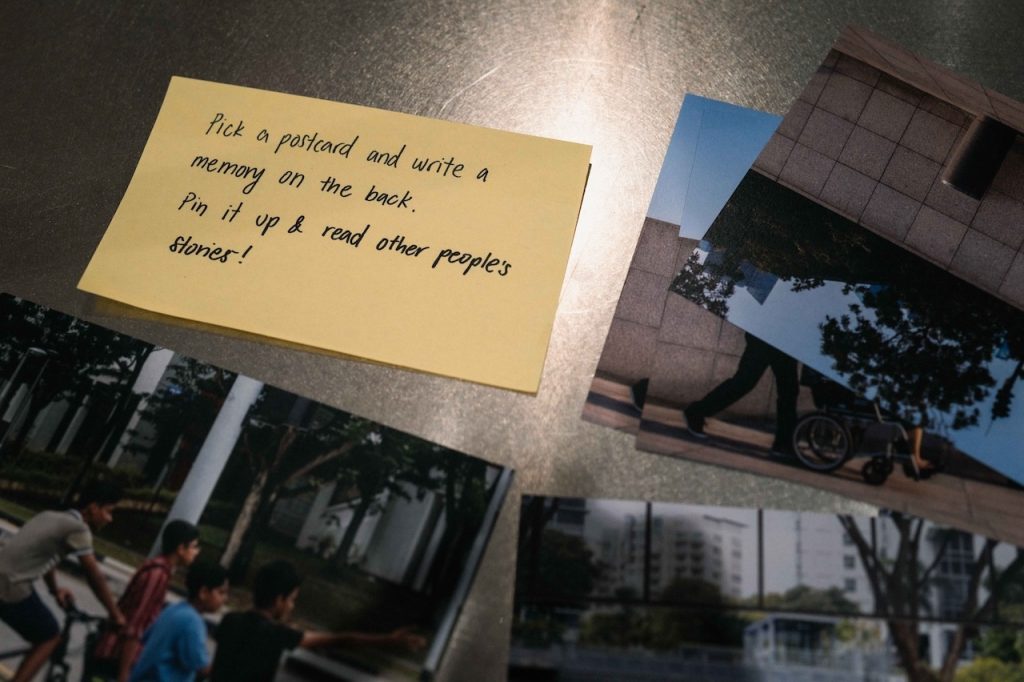
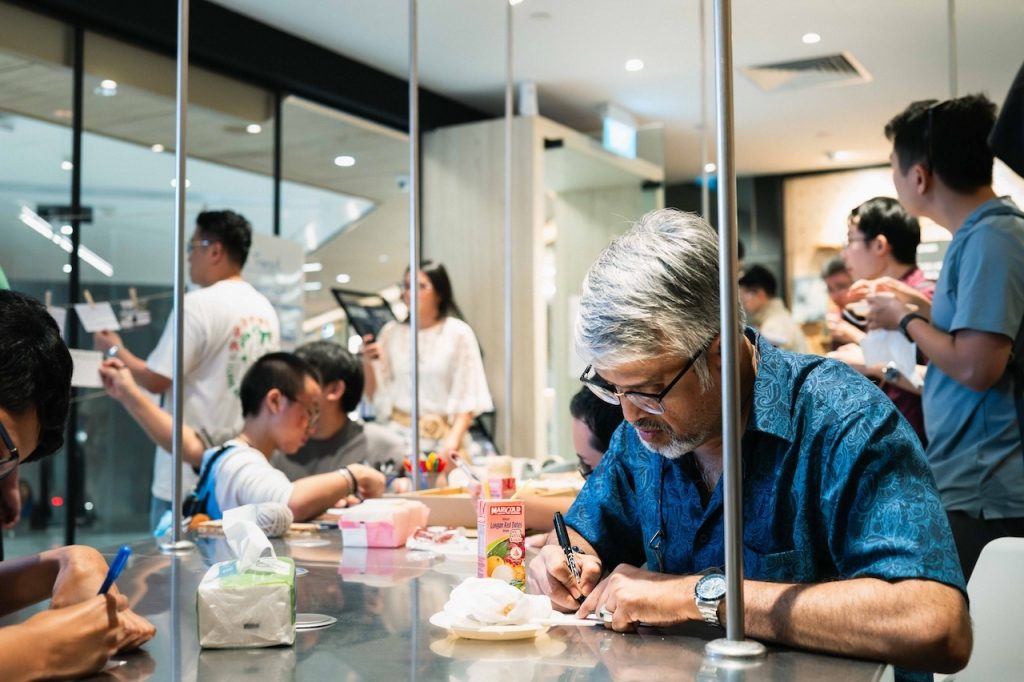
He’s right. It’s only when we pause that we remember: oh yeah, most of our core memories in Singapore have been shaped by transport infrastructure. The distance between where (and who) we were back then can be traced to the varied stops we make in the commute of our lives.
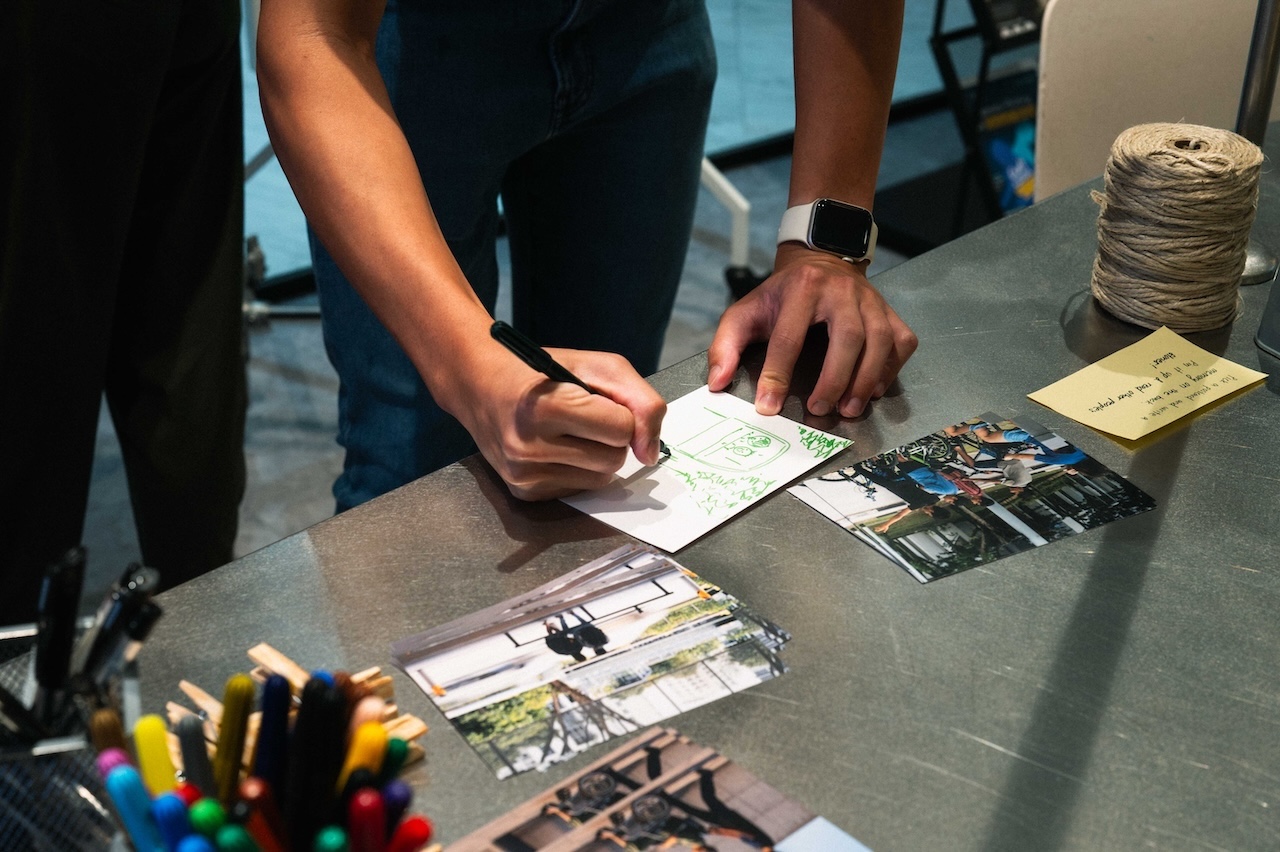
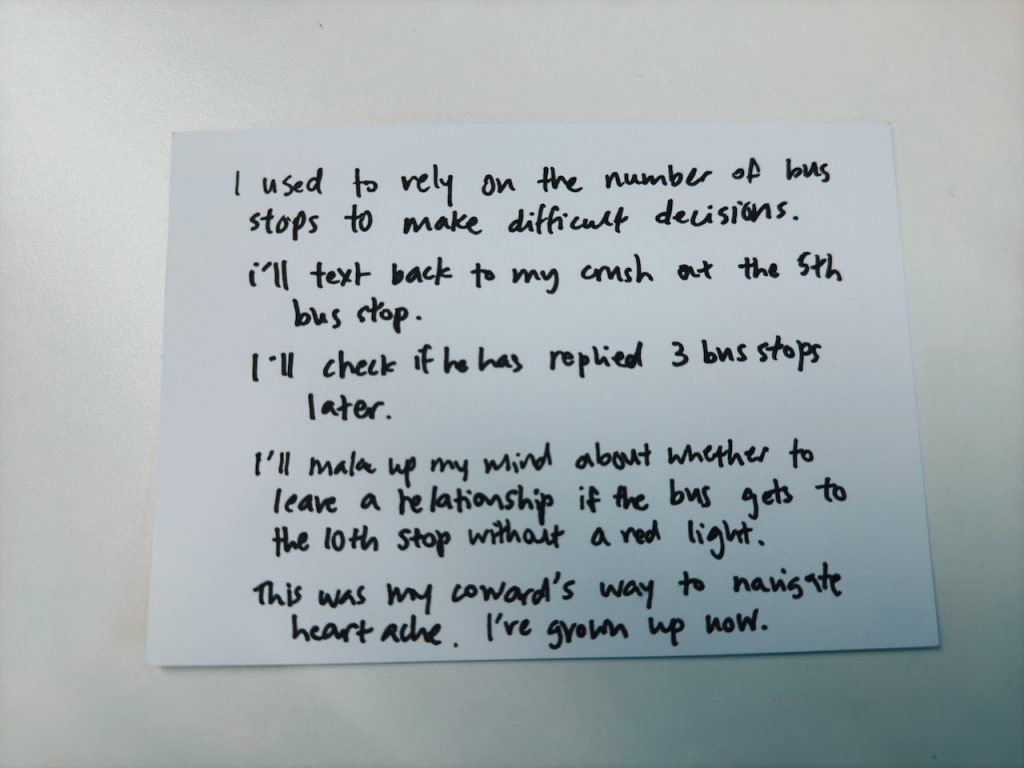
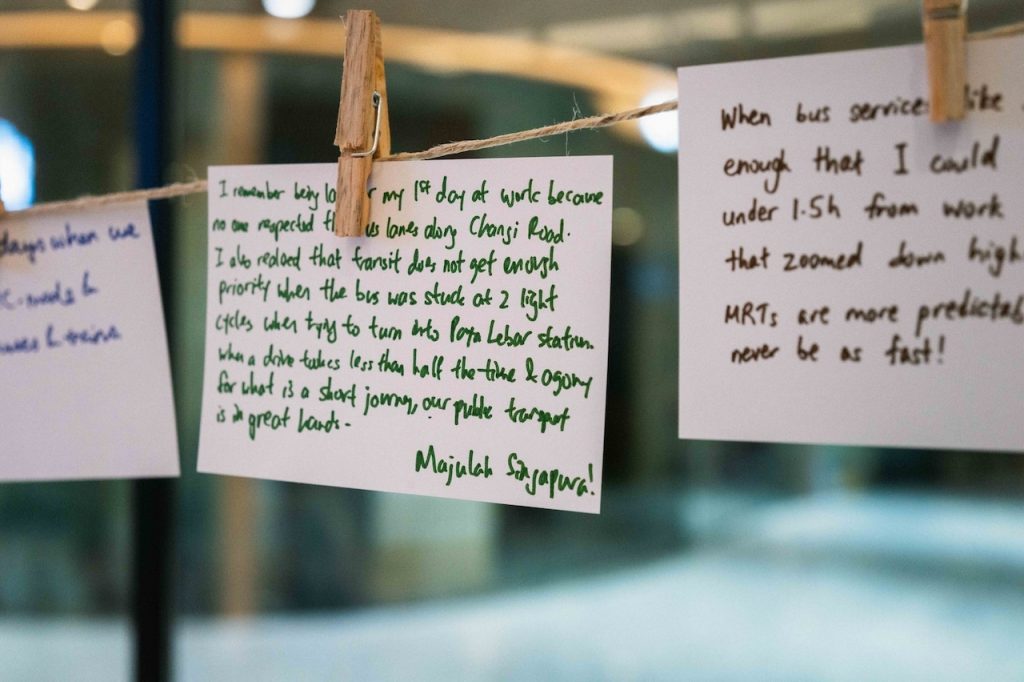
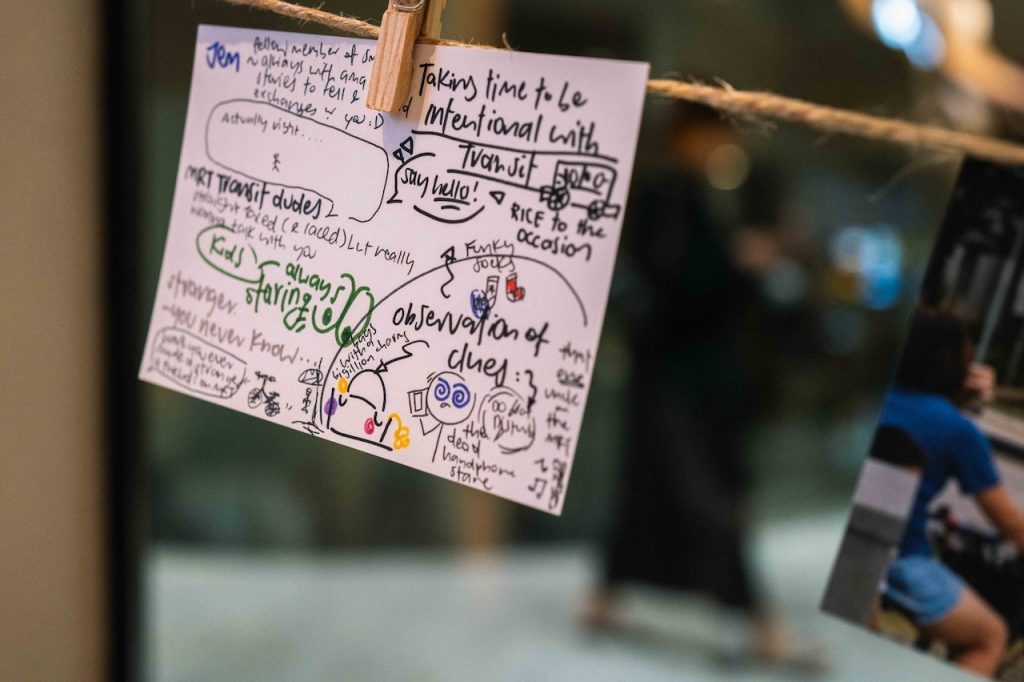
Attendees had plenty to write about the rides that shaped their Singaporean coming-of-age story:
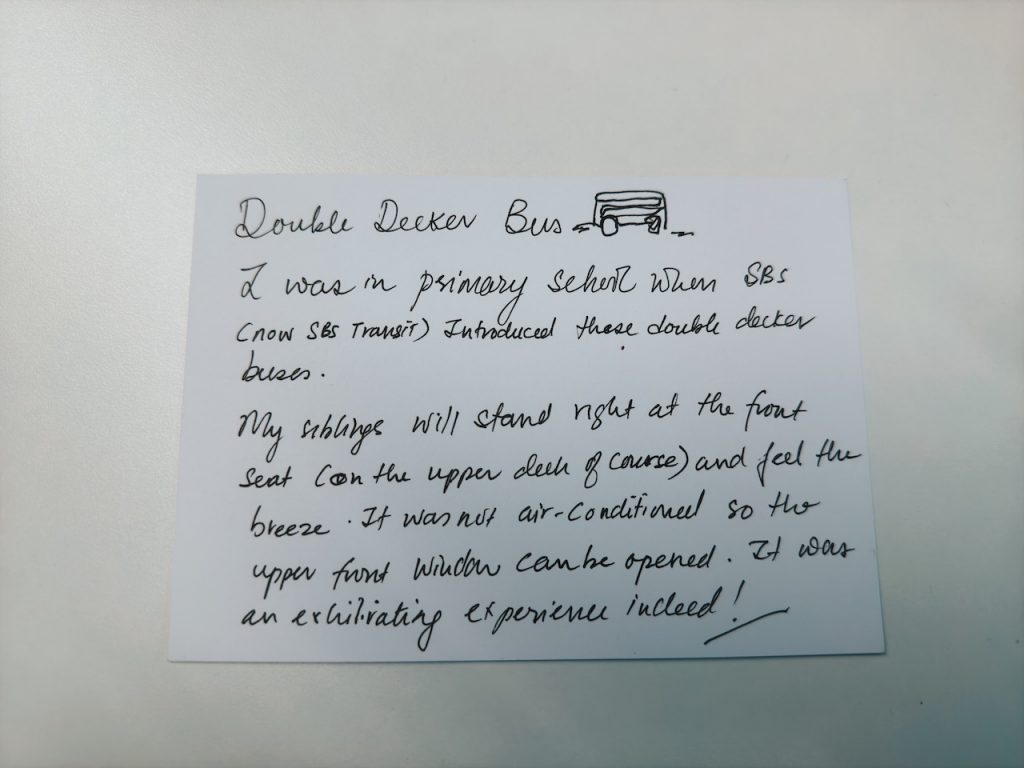
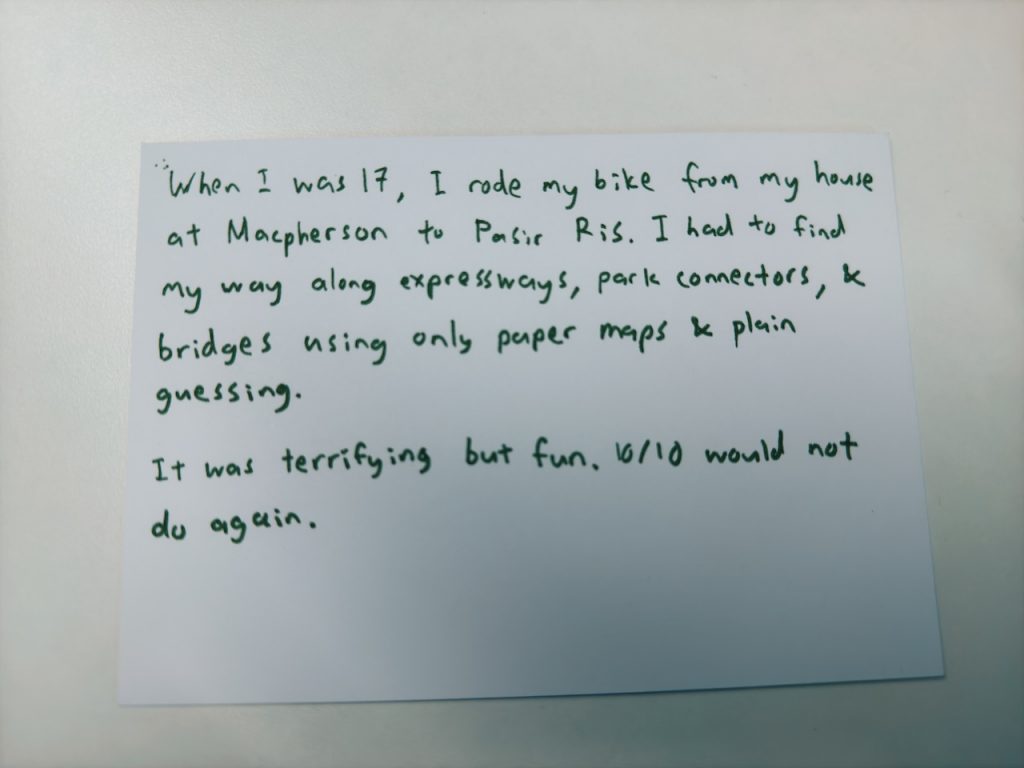
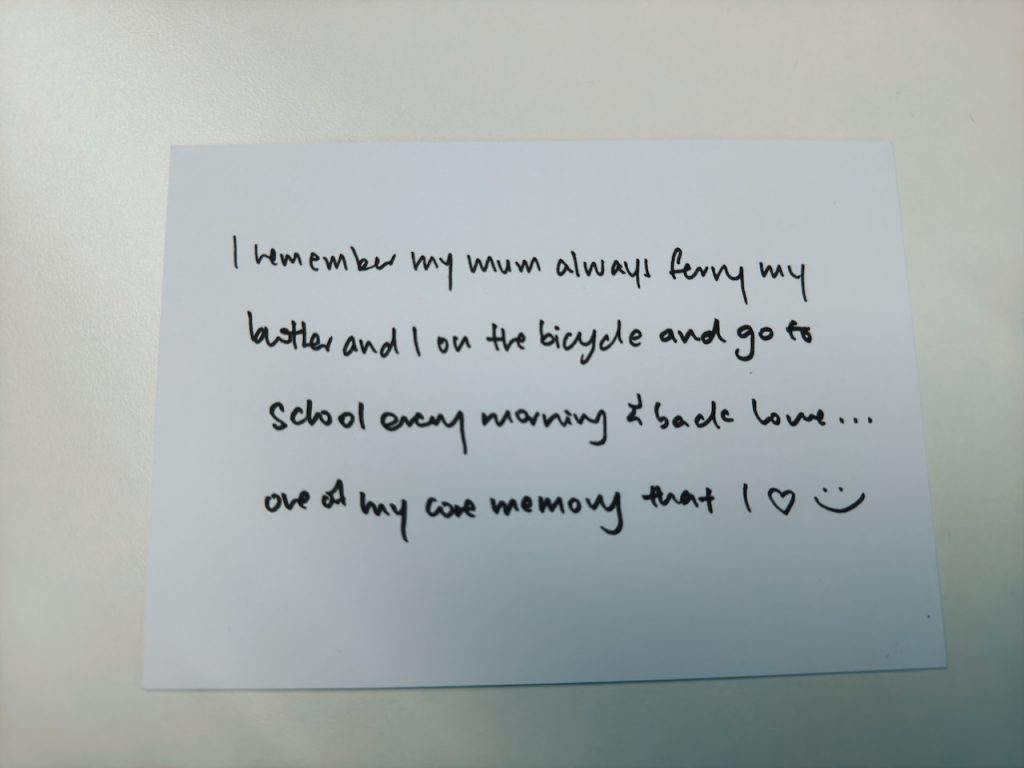
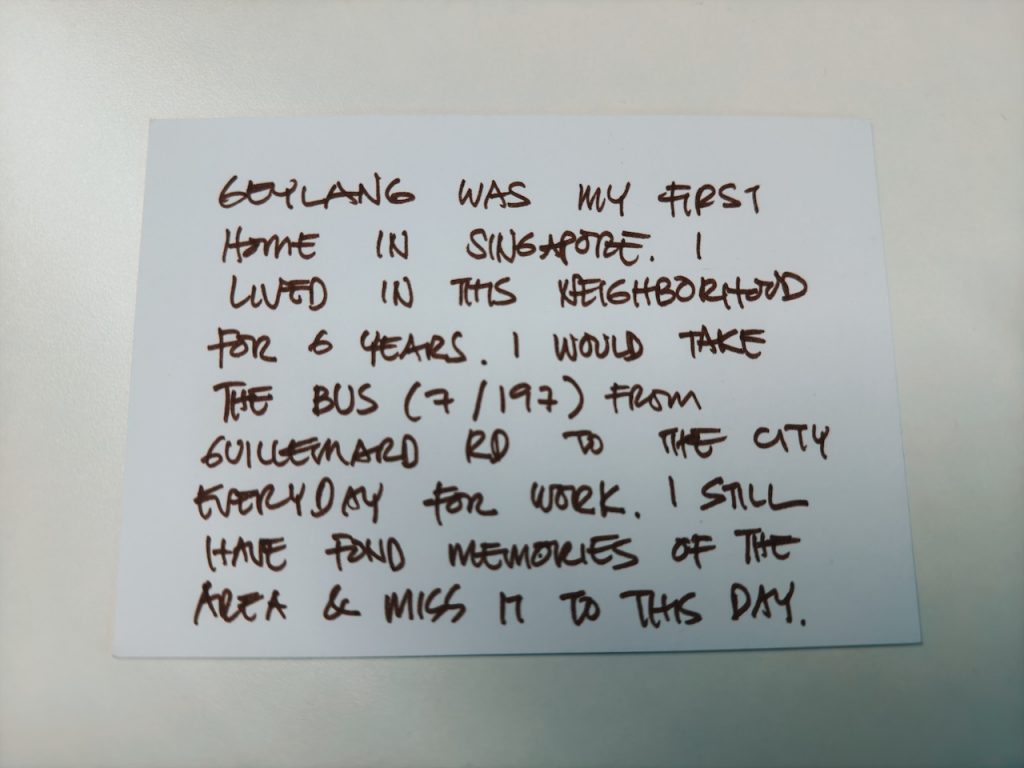
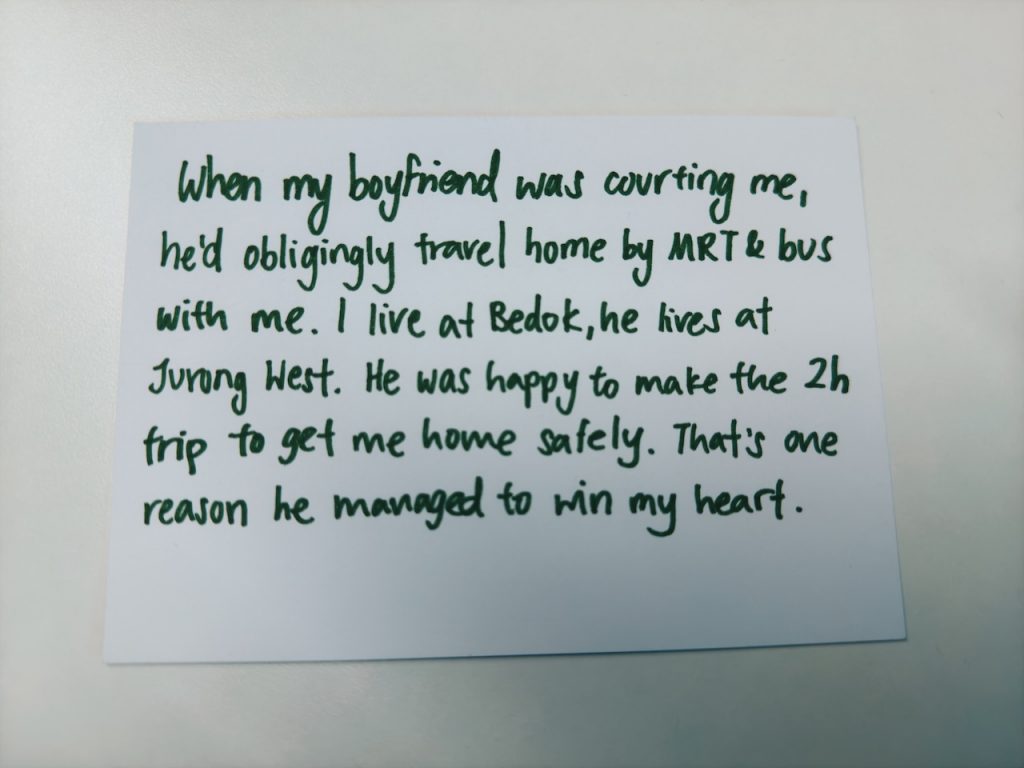
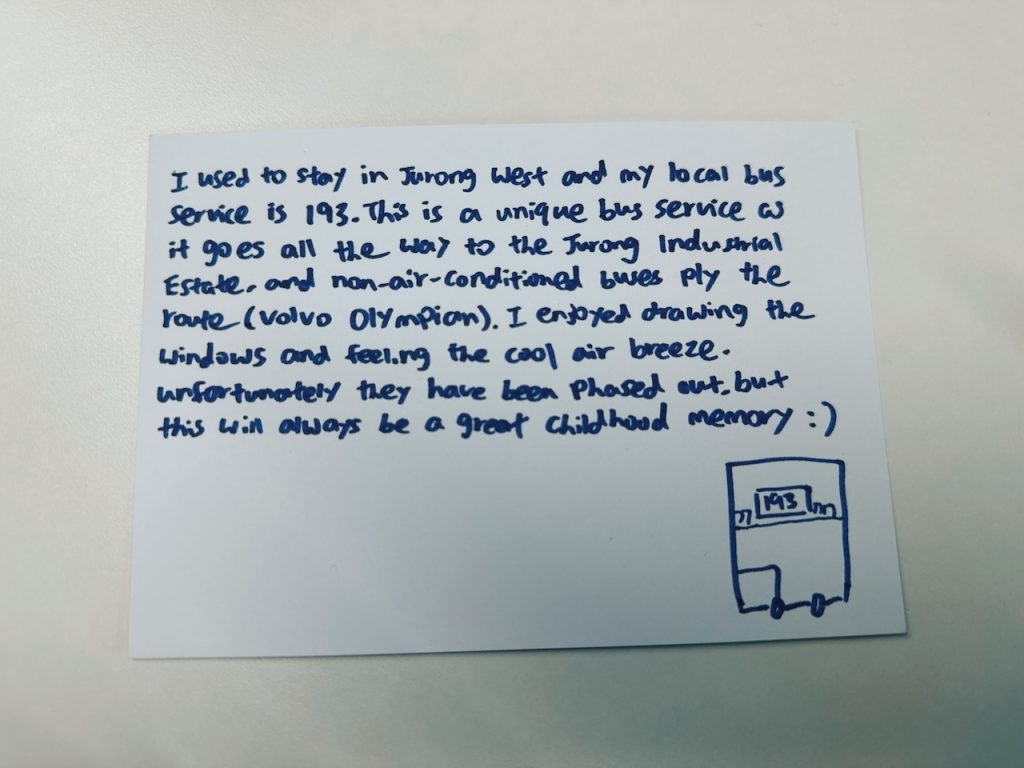
Dr Samuel Chng, Research Assistant Professor at the Lee Kuan Yew Centre for Innovative Cities at SUTD, noted how his kids are appreciating the rides they take on public transport.
As a social psychologist with expertise in human behaviour in urban environments, he’s cognisant that these rides will become the raw material of how they’ll remember growing up here.
Ask any Singaporean for their coming-of-age memory, and there’s a fair chance it happens in transit: half-asleep on a parent’s shoulder on a car ride home, or the nerve-wracking text exchanges with crushes on the bus. The heartfelt anecdotes written by the attendees proved just as much.
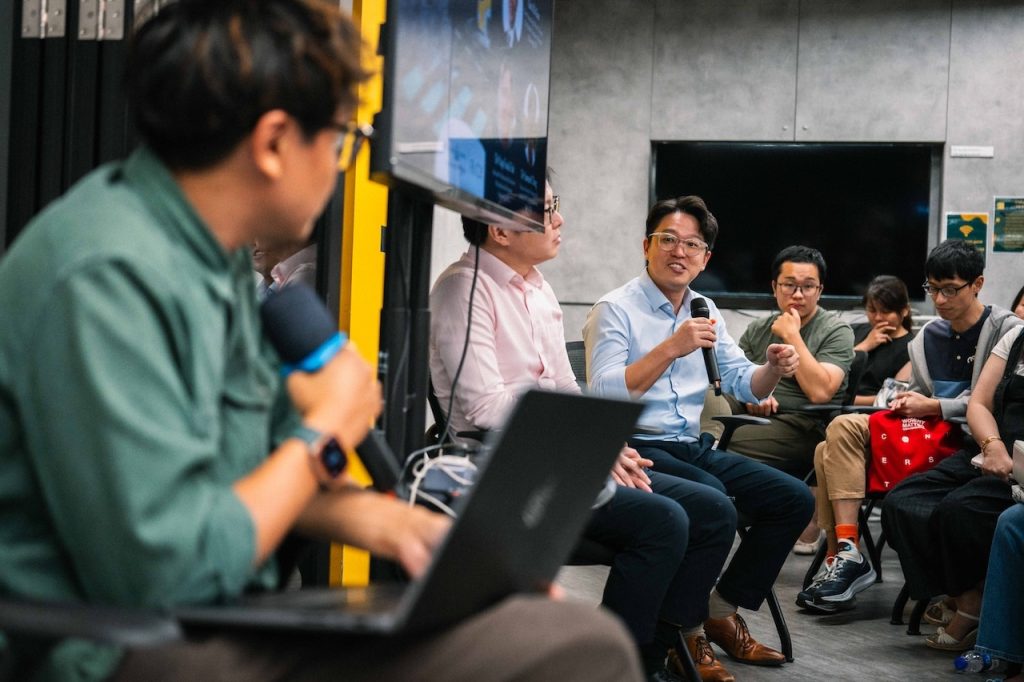
That extends Lim’s point past pure logistics. Dr Chng’s angle adds a different use for that same block of time, like paying attention to the experience.
Some of it can just be looking out the window, appreciating how the light hits the water as the train crosses the Kallang River at golden hour. Or noticing how that secondary school kid sitting across you is doing exactly what you used to do 20 years ago: vibing hard to a good tune on their wired earbuds.
‘It would simply be the default’
There’s a ceiling to what any master plan can promise. Hit the 45-minute City goal on schedule, and the next question is already queued: “25-minute city, when?”
What we actually want, I suspect, isn’t a number at all. It’s better texture during our commutes. Colder air in the cabin; a smoother ride on a bike path that makes you appreciate the last-mile journey. Or perhaps a station exit that drops you close enough to your actual front door.
Fair asks, all of them. But how much of the commute do you actually remember afterwards?
Comfort is backdrop. It disappears the moment things are fine, and it only announces itself when things break. Like the directional signs in an MRT station, systems are invisible when things work; people only start grumbling when things don’t.
Ryan, one of the attendees that night, had a different frame altogether.
“For those of us who take public transport, we spend enough time on our journeys that they end up feeling like a big part of who we are. Shared experiences, shared memories that a lot of our generation is going to have, as the generation that’s likely not going to be able to afford a COE,” he says.
“If public transport is really good enough for our daily commutes, it wouldn’t even be thought of as a viable alternative. It would simply be the default.”