This story is part of RICE Media’s Storytellers initiative, a mentorship programme for budding content creators to learn about the art of creative non-fiction. This piece is a product of a partnership between RICE Media and Singapore Management University (SMU) for its Professional Writing module.
Top image: Darren Satria / RICE file photo
Layla* received her citizenship only recently, in late 2024. She’s only been able to call herself Singaporean for about a year, but as I chatted with her over prawn-paste fried chicken and iced lemon tea (her guilty pleasures) at a kopitiam in Novena, it struck me how Singaporean someone born outside of our country can be.
She was just eight when she first visited Singapore, and she fell in love. Compared to Hanoi’s busy streets, Singapore’s roads were cleaner, quieter and more organised. She tried Indian curry for the first time at a mamak stall, and she just could not get enough of it.
Par for the course for anyone’s initial experiences of Singapore as an outsider.
As a young tourist, with no attachments and minimal interactions with the locals, she genuinely believed that Singapore was a utopia. It’s a belief common enough to compel tens of thousands of people from across Southeast Asia to try their hand at Permanent Residency or citizenship here.
But the sweetness of the picture Layla had mentally painted of Singapore as a tourist only made the reality of what she observed as an immigrant even more bitter.
The Implications
Layla recounts to me the discrimination she faced in primary school.
“[My nationality] was an issue to the teacher, even if I matched the marks of the [locally born] top scorers in class. I had to do better than the rest, or else I was worth nothing,” she recalls.
Layla says the same teacher once caught her reading a book in class and told her to go back to Vietnam if she thought she could get away with it. She didn’t know how to make sense of something like that then—she just cried.
“I guess, in a twisted way, I do have to be grateful to her for that; she opened my eyes to the inequality. I didn’t know the term for it at the time, but she prepared me the most by treating me so strongly like that.”
But it didn’t end in school. Years later, she recalls another encounter—this time at the Woodlands Checkpoint, with an overzealous officer.
“He really asked me in my face: ‘Do you have a husband? No? How did you get your PR?’”
Layla understood exactly what the officer was implying.
“Maybe he was just doing his job, I don’t know. But why is it okay for him to say these things? It’s not even just about me; it’s about how the authority at Singapore’s borders views Vietnamese women!”
It is widely stereotyped in Singapore that women of other Southeast Asian nationalities here fall into certain roles within society. Just as most Filipina and Indonesian women are stereotyped to be domestic helpers, Vietnamese women are stereotyped to be sex workers who entice Singaporean men into marriage as a path to Singapore PR status.
This was obviously not true for Layla. It was a remark that she found highly degrading.
“I worked hard to get here. My achievements are my own; my hand in marriage will be for someone I actually love. He had this narrow idea of the person I was just by looking at my passport. It felt so, so dirty.”
Performative Harmony
Let’s not mince words. Our harmony exists but can be performative at times.
We are all too familiar with how Singapore institutionalises racial and religious harmony: we put on ethnic costumes once a year in primary school, HDB estates have ethnic quotas, and people are jailed for deliberately intending to wound racial feelings.
Layla knows she can pass as Singaporean Chinese, yet her nerves still spike whenever she starts revealing more about her background, bracing herself for judgment. Her feelings touch on the idea that belonging in Singapore depends on how much a person fits the ‘default’ in Singapore.
The reality is that institutionalising harmony can breed complacency. We take for granted that harmony will remain an unshakeable part of Singapore, no matter how we act.
No matter if a student from what is ostensibly Singapore’s most elite school dresses as a dark-skinned delivery rider for Racial Harmony Day. No matter if racist online echo chambers like r/SGRabak freely proliferate before their eventual ban.
It should not be a comfort to us to hear of punishments meted out for racial misconduct; it should be an ugly reflection of the mere existence of acts that deserve these corrections in the first place.
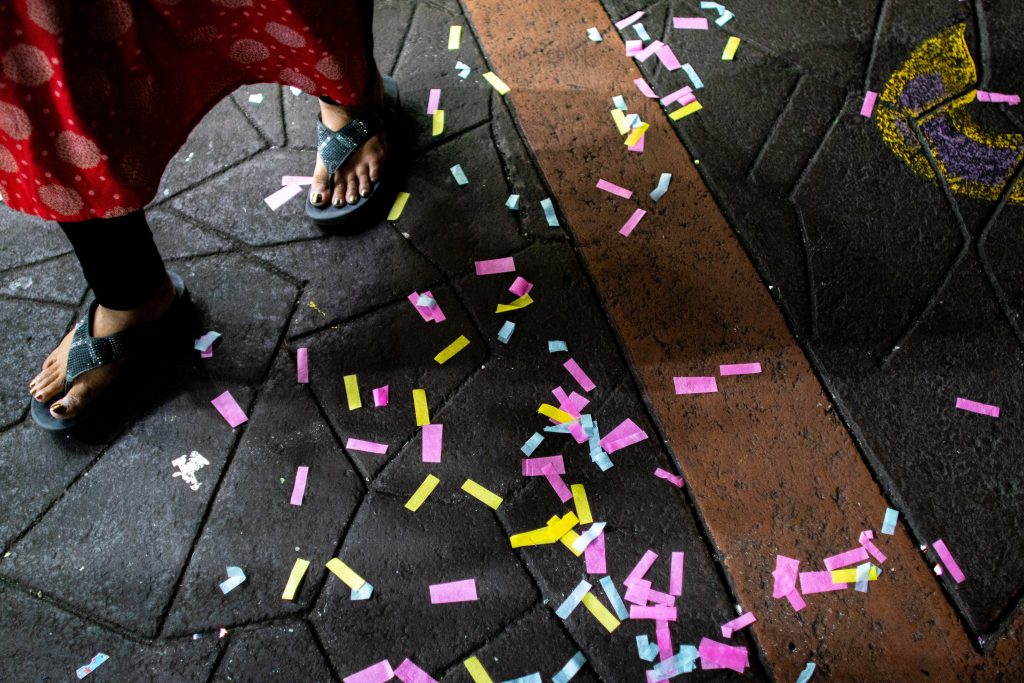
Layla points to the online discourse on the state of mess some venues were left in after last year’s Deepavali celebrations.
“Inclusivity and tolerance only happen when it benefits [people], right? When they are pushed outside of that threshold of tolerance, that’s when their bias really starts to show.”
The online thread didn’t exactly inspire confidence in Singapore’s idea of ‘harmony’. The outrage was loud and, arguably, disproportionate. After all, other cultural practices have sparked complaints when they inconvenience others. During the Hungry Ghost Festival, for instance, complaints abound about smoke and ash in the air. In another case, a resident took issue with the adhan being broadcast from a nearby mosque.
These examples are not comparable in scale or severity, nor was any backlash justified. But these practices, for the fact of having been disruptive to members of other races (in some cases, even members of the same race), demonstrate that if we are unable to empathise with and tolerate others, then racial harmony will continue as an uphill struggle.
When Harmony is Mandatory
Our model of harmony relies on laws and punishment rather than open communication and a genuine willingness to understand one another.
We enforce harmony, but often miss the slower work of cultivating it. Pair that with groupthink and the comfort of online anonymity, and it’s no surprise that the moment something unsettles the surface, the masks slip—and people show how little harmony they actually believe in.
If genuine harmony struggles even among citizens, where does that leave immigrants?
If racist sentiments can surface against those who share our citizenship and lived experiences, immigrants will always be easy targets for resentment and suspicion. And we all know how this discontent can boil over, triggering multiple responses from the government.
Despite all this, it would be disingenuous to reduce all Singaporeans to an unmovable, intolerant bunch and to say that we are hateful for the sake of it. However negative the responses are to members of other races or immigrants, they are a result of a defence mechanism against threats seen to be posed by others—outward manifestations of inward fears and frustrations.
This does not justify hateful actions, but it means that we are not irredeemable. The issue is not unsolvable.
The million-dollar question now is: How do we go about replacing both xenophobia and intra-Singapore racism with genuine harmony?
The Optics of Social Stability
Singapore’s current system relies heavily on optics. We have equal representation at large celebrations such as National Day. We have speeches from politicians that, without fail, reference and reinforce the importance of racial and religious harmony.
The issue with relying on optics is that social stability is not synonymous with empathy and understanding. It just means nothing big has happened yet to crack the surface.
If we want real foundations, we can’t keep defaulting to punishment after the fact. Instead of shutting people down the moment they say something uncomfortable, we need genuine conversations—ones where everyone is heard, and where the goal isn’t to win, but to repair. Our implementation of harmony must be rebuilt from the ground up, not on the simple absence of conflict, but on the presence of understanding.
To be fair, some Singaporeans are already doing the work of active citizenry. hash.peace pushes for sustainable social harmony through responsible advocacy and discourse. Meanwhile, Migrant & Me is building a more inclusive community for migrant workers through workshops and student-led initiatives.
Mainstream sentiments, however, are still dominated by fear and cross-group isolation. As an immigrant, Layla knows she can’t fight these sentiments head-on.
She had never experienced physical violence as an immigrant, nor was she denied opportunities for being one. But the slower stuff—the microaggressions, and the little reminders that you’re still ‘not really Singaporean’—chips away at you over time.
These actions tell her, plainly: You’re a foreigner, you don’t belong here. But Singapore is built on migration; only a minority of people here are indigenous to this land. At some point in our ancestry, we were all foreigners.
So does belonging come down to who arrived first and got citizenship first? It has to be more nuanced than that.
“I don’t want to take other people’s places in schools, or other people’s jobs, or anything. I’m here for the same reason as any Singaporean; I face the same challenges in life as any Singaporean,” Layla sighs.
“They can’t say anything anymore now that I’m a citizen. But I also can’t just forget the times they said something when I wasn’t in a position to tell them they were wrong.”
The Struggle Within
Layla rants as the ice melts in her lemon tea. If only the feeling that she belongs could dissolve into place just as easily.
She will continue to live and work as a citizen in Singapore—whether she can feel that she truly belongs one day is up to the rest of us and our capacities for change.
Just as Layla has had to accept what it means to be an immigrant here, Singaporeans also need to have clarity about what exactly we’ve been feeling. Some of it is valid: the pace of immigration, the sense of overcrowding, or the unease that Singapore doesn’t feel as much like home anymore. So how do we talk about that honestly—and how do we make sure we’re directing them at the right places, instead of the most visible people?
Valid anxieties don’t excuse ugly behaviour. And if we keep relying on simply policing harmony instead of treating it as something to build together, resentment will find a way to spill over—usually onto immigrants like Layla, who want to belong but have the least power to push back.